
The amount on the order
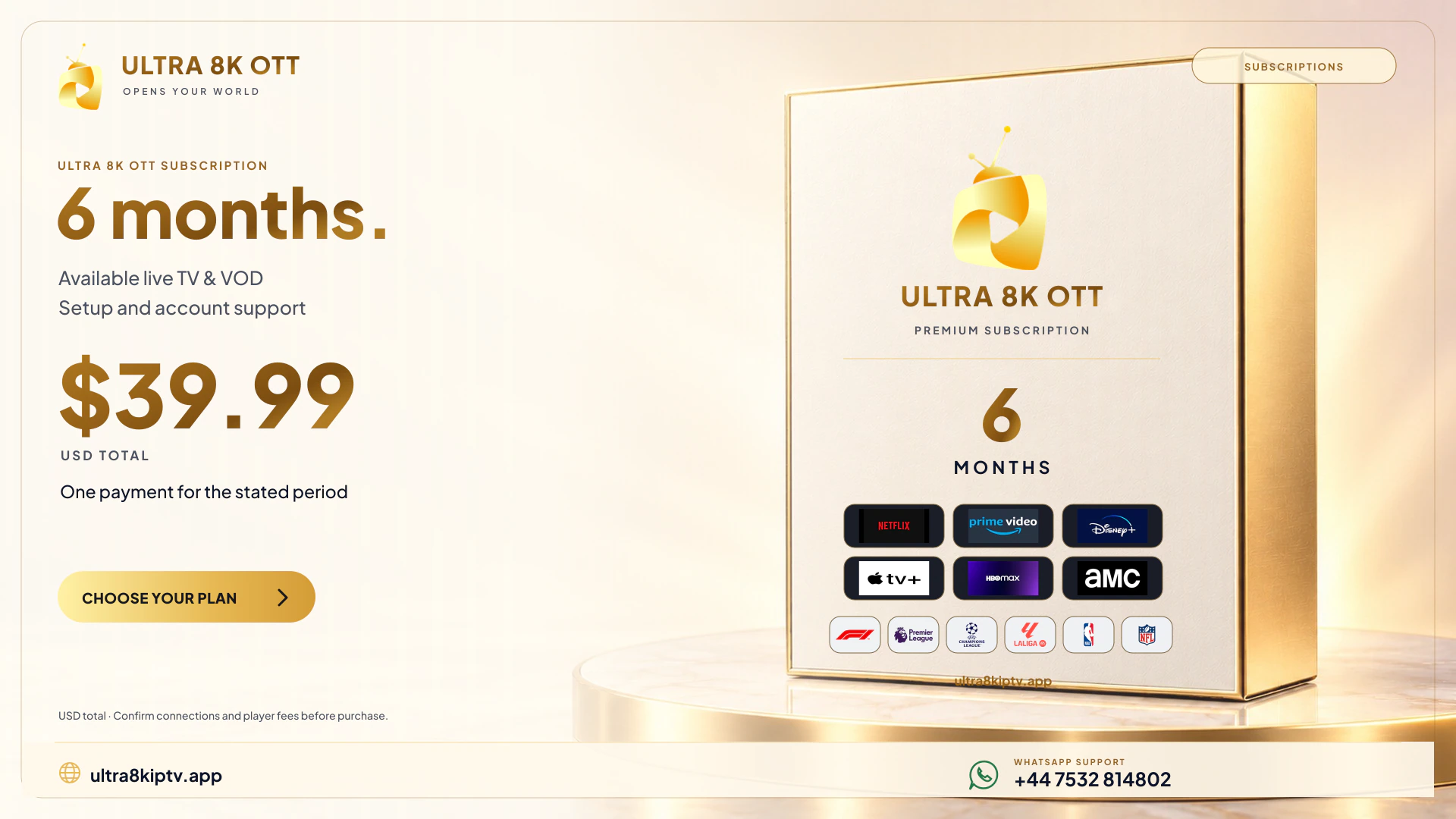
Ultra 8K IPTV lists USD 54.99 for 12 month(s). Dividing that bill by 12 gives USD 4.58 per month. The full bill is the amount to compare with your budget for the order.
| Alternative at the listed rate | Combined total | Difference from this term |
|---|---|---|
| 12 × 1-month order | USD 115.08 | USD 60.09 |
| 4 × 3-month order | USD 95.96 | USD 40.97 |
| 2 × 6-month order | USD 79.98 | USD 24.99 |
Repeat-order examples use the same listed rate each time. They do not assume a renewal price, uninterrupted eligibility or a future discount.
What changes the value of this term?
Ask for the exact allowance on the consumer order.
Which controls belong to the viewer's account, which ones are granted to a reseller, and what does the quote cover?
Ultra 8K IPTV has three different places to make a change
A household wanting a shorter channel list, a viewer buying another six months and a shop opening a new account all have a reason to visit ultra8kiptv.app. They need different screens. Following those differences reveals what the published prices buy, what the panel pictures can establish and which payment the refund policy actually covers.
Count the months the television will be used
Ultra's retail page shows USD 9.59 for one month, USD 23.99 for three, USD 39.99 for six and USD 54.99 for twelve. Each is a term price. Consider someone staying in a rented flat for four months. At the prices reviewed, three months and one more month total $33.58. The six-month option is $6.41 dearer up front. If the person moves out on schedule and has no further use for the subscription, that extra money buys time they may never use.
Change the stay to seven months and the comparison looks different. Six months plus one month total $49.58 at the same figures. A full year costs another $5.41. Someone with an uncertain moving date can now decide what five extra months of potential access are worth. These calculations assume the same retail prices are available when renewing and the account can be extended as expected. Ask how an early payment affects remaining days before treating two consecutive periods as a continuous booking.
A player purchase can change both examples. Ultra names an Android and Fire TV player and a separate smart-TV player. A store listing may have its own activation or fee. Check the specific application for your television model, software version and region, then read the price and billing description on the actual device. Keep a note of which amount goes to the player and which goes to Ultra. A lower advertised monthly equivalent leaves both the up-front service charge and any separate app payment to be found today.
Use a trial to settle one difficult question
Ultra describes a route to request a one-day trial after a compatible player has been installed. Its refund page also cautions that availability can change. Have the device ready, then ask for the current offer, when its clock starts and which configuration it covers. A day spent waiting for somebody to return with the television remote produces little evidence. Someone who needs to watch at a particular hour should choose a trial window that includes that hour.
A useful question might be whether the evening news is legible from the kitchen table. Open the actual regional edition where it is available, read the guide text and look for the captions you need. Return to another programme and see how many remote presses it takes to find the news again. A sample promo in a higher resolution answers a different question. Resolution also depends on the particular stream, screen and player. Ultra's brand name by itself cannot tell a buyer how that regional bulletin will arrive.
Work through one failure before trying a new app, another device and a different network all at once. Note which programme opened, which failed, whether sound continued and whether the guide itself was reachable. Then make the one change support suggests and record what happened. It is fair to report a fault during that trial on the named device. One working evening cannot establish a season's availability, and a failed guide entry on one set leaves a number of possible causes for the provider to investigate.
Translate an order book into connection-months
Ultra describes one reseller credit as one month for one connection. The published options include 60 credits at USD 107.40, 120 at USD 202.80, 300 at USD 477.00 and 600 at USD 894.00. Two orders for one year and twelve orders for three months would consume exactly 60 credits, assuming single connections and the quoted conversion. Someone could equally serve five annual customers with the same balance. The number of people a pack supports depends on the terms those people order.
The 300-credit option can cover twenty-five complete single-connection years. At the reviewed pack total, each annual allocation works out to $19.08. A 600-credit purchase can cover fifty such years at $17.88 each. Buying two 300-credit batches at the published prices would cost $60 more than buying 600 once. For a business expecting twenty-five annual orders now and another twenty-five only possibly later, that difference is the price comparison. The larger up-front balance still relies on those later orders actually arriving and on the seller's balance rules.
Keep a little of the order book in its original units. An invoice might say six months for one subscriber. Your internal record can give the agreed connection count, credit deduction, paid expiry and customer reference as well. If a customer asks to add another television halfway through a term, that history makes it possible to request a price for the remaining period. The one-connection conversion is useful arithmetic. A mid-term change or an additional connection deserves a specific quote before you promise an amount.
Put the refund request against the right receipt
Ultra's policy gives eligible initial subscriptions purchased directly through its own payment routes a thirty-calendar-day window to submit a request for review. The count starts from the original purchase. The policy covers verification and exceptions, and treats renewals and reseller transactions separately. Save the transaction reference, seller, purchase date and agreed term when buying. A viewer who later discovers two charges needs to identify the two transactions individually, particularly if one went to an app store and the other to the subscription provider.
If something fails on the eighteenth day, describe what you want support to do. A request to diagnose playback, a request to stop a future payment and a request to review the original payment have different outcomes. Give the private support channel the device, player and brief failure history where this is pertinent. If seeking review of a purchase, identify that purchase explicitly and retain a copy of the dated request. Ultra says an approved refund normally follows the original payment route where possible and settlement timing depends on that route.
A shop with a partially used wholesale pack faces different economics from a viewer with a newly activated plan. Credits may already have been allocated to customers. Ask the supplier what happens to unused balances, active customer terms and access to support if the shop closes. Do that with the proposed wholesale terms in hand. Promising every customer an unconditional thirty-day refund on the strength of a retail badge would leave the shop responsible for a commitment the published supplier policy does not make.
A television shop preparing a demonstration branch
Consider a shop that wants one set on its counter for demonstrations and one private viewing account for the staff room. It also plans to sell six-month customer subscriptions. These uses appear in one business proposal, yet Ultra's standard retail and credit descriptions settle different parts of it. The wholesale rule prices a standard month for one customer connection. It does not establish what display use is allowed in a shop or whether visitors can try the account on their own devices. Put the intended demonstration arrangement to the seller before funding it.
Now model the orders that do fit the published arithmetic. Eighteen six-month customer subscriptions need 108 single-connection months. A 120-credit pack leaves twelve for one annual account, two further half-year accounts or a combination of shorter terms. If four of the eighteen have asked for two concurrent streams, remove those four from the standard calculation until a corresponding quote arrives. The fourteen single-connection cases use 84 credits. The exact debit for the four more complex cases is the unknown that determines whether one pack will suffice.
Ask what staff will see when they create each kind of account. A picture of a Smart TV form and another of a MAG form can guide a question about required fields. It cannot tell a shop whether the employee assigned to the counter can open both forms, whether it can change a device identifier or who authorises a credit adjustment. Request the procedure on a demonstration record that belongs to the supplier or your authorised test account. A genuine customer's account does not need to be displayed to establish that workflow.
There are two useful outputs from that conversation. For the buyer, a quote sets out what the home account will do, for how long and at what price. For the shop, a written response sets out the supported customer role, standard debits, treatment of extra connections and responsibility for support or correction. Keep the answer about using a counter demonstration separate. It concerns how the account may be used in a particular setting, a question a credit quantity was never designed to answer.
Begin with the change you want to make
Picture a television in a kitchen. Its owner watches a small handful of stations and would happily do without the rest of the menu. A well-meaning relative buys another subscription to start over. That is an expensive way to answer a question about categories. Ultra has a dedicated help page about customer control panel access. It says an active customer can manage supported category preferences through the access route supplied for that account. First find out whether the existing account can present a more useful list.
Three things might have a password or activation step here. The player on the television receives the service. The customer's panel controls the settings Ultra makes available to that account. A reseller's panel handles business tasks such as provisioning a customer's term. Buying a longer subscription does not establish that any of the reseller tools are included. Likewise a picture of a reseller creating a line says little about the menu a family will see when it turns on the television.
Before moving anything, write down the problem in the terms the viewer would use. Perhaps the guide opens at the wrong regional category, or a favourite is buried twenty presses down the list. Find out whether the change needs to follow the account to another television or only apply in the kitchen. A local favourite may solve the latter immediately. For the former, ask which preference lives in the account and how each installed player picks it up. That distinction can save the trouble of setting up two devices twice.
See whether the change survives normal use
If support confirms category editing on your account, start with a category you can readily identify. Record its original setting, make a single change and follow the provider's instructions for refreshing the player. Check the guide again after closing and reopening the app. This is a reversible test with a clear result. Hiding a dozen categories at once makes it harder to work out which change removed a programme somebody else watches. Agree on the categories worth keeping with everyone who shares that television.
A programme can have an entry in the guide yet appear under an unexpected category. To report that well, give support the name shown in the guide, the local time, the category you expected and what a search in the player returned. If the programme opens directly from search, say so. If you restored the original category and it reappeared, say that too. Both observations narrow the job. A public screenshot can show a cropped menu while the account address, activation code and private link stay out of view.
Households with more than one set have a second question. If the bedroom uses a different player, a preference saved on one screen might be displayed differently there. Test one set, close its stream and then check the other. That lets a household with one approved active connection compare the menus without inadvertently making simultaneous playback part of the experiment. Where two streams at once are essential, get the allowed count and any additional cost with the actual subscription quote.
Provider material for this report
- Retail term prices and order information
- Access to the customer panel and supported preferences
- Credit packs and captioned partner panel views
- Provider guidance on preparing a customer subscription
- Questions about branding and wholesale access
- Full refund policy, exceptions and request route
- Distinct XOTT and XC 8K OTT routes and descriptions of supplied installers
- XOTT television store checks and illustrative navigation
- Ultra account access, wholesale enquiries and payment guidance
Planning a viewing window with Ultra 8K IPTV
A season rarely lasts exactly one, three, six or twelve months. The table finds the least expensive combination of the available terms that covers each viewing window. It allows unused months when a longer order costs less. Equal totals favour fewer purchases, then less unused time. Some combinations require a second purchase. Every example assumes today’s published amounts still apply to that later purchase.
| Viewing window | Months wanted | Orders at the listed rates | Combined bill | Unused months |
|---|---|---|---|---|
| Two months between moves | 2 | 2 × 1-month | USD 19.18 | 0 |
| A four-month season | 4 | 3-month + 1-month | USD 33.58 | 0 |
| Five months in a second home | 5 | 6-month | USD 39.99 | 1 |
| Seven months away at work | 7 | 6-month + 1-month | USD 49.58 | 0 |
| An academic year | 9 | 12-month | USD 54.99 | 3 |
| Twelve continuous months | 12 | 12-month | USD 54.99 | 0 |
| A year and a three-month extension | 15 | 12-month + 3-month | USD 78.98 | 0 |
| An eighteen-month stay | 18 | 12-month + 6-month | USD 94.98 | 0 |
4 months of viewing. On these figures, 3-month + 1-month comes to USD 33.58. The purchased periods end at the planned finish. Buying separately at the listed one-month amount would total USD 38.36, a difference of USD 4.78.
7 months of viewing. On these figures, 6-month + 1-month comes to USD 49.58. The purchased periods end at the planned finish. Buying separately at the listed one-month amount would total USD 67.13, a difference of USD 17.55.
15 months of viewing. On these figures, 12-month + 3-month comes to USD 78.98. The purchased periods end at the planned finish. Buying separately at the listed one-month amount would total USD 143.85, a difference of USD 64.87.
How the 12-month order compares
Read each row as an alternative for this exact duration. Currency and market are shown because they affect eligibility and the amount that reaches your statement. A missing figure means the provider still needs to identify a current offer for that period.
| Alternative provider | Listed market | 12-month total | Relative to this offer |
|---|---|---|---|
| 4K OTT Pro Max | USD listing | USD 54.99 | Same listed total |
| 8K IPTV | USD listing | USD 54.99 | Same listed total |
| 8K PRO IPTV | USD listing | USD 54.99 | Same listed total |
| Pro Max 4K OTT | USD listing | USD 54.99 | Same listed total |
| Strong 8K IPTV | USD listing | USD 54.99 | Same listed total |
| Team 8K | USD listing | USD 54.99 | Same listed total |
| Trex IPTV | USD listing | USD 54.99 | Same listed total |
| XOTT | USD listing | USD 54.99 | Same listed total |
| Hot IPTV | USD listing | USD 50.99 | USD 4.00 less |
| Smarter 8K IPTV | USD listing | USD 50.99 | USD 4.00 less |
| Dino IPTV | USD listing | USD 49.99 | USD 5.00 less |
| Dream 4K IPTV | USD listing | USD 49.99 | USD 5.00 less |
| Golden OTT | USD listing | USD 49.99 | USD 5.00 less |
| Hello Sky IPTV | USD listing | USD 49.99 | USD 5.00 less |
| B1G IPTV | USD listing | USD 44.99 | USD 10.00 less |
| Lion OTT | USD listing | USD 44.99 | USD 10.00 less |
| MegaOTT.app | USD listing | USD 44.99 | USD 10.00 less |
| MegaOTT.io | USD listing | USD 44.99 | USD 10.00 less |
| IPTV USA | United States | Current bill unconfirmed | Compare eligibility and currency on the order |
| 4K IPTV | EUR listing | EUR 44.99 | Compare eligibility and currency on the order |
| 5G Live | Ask the seller | Current bill unconfirmed | Compare eligibility and currency on the order |
| Crystal IPTV | EUR listing | EUR 50.99 | Compare eligibility and currency on the order |
| IPTV Australia | Australia | AUD 71.99 | Compare eligibility and currency on the order |
| IPTV Canada | Canada | CAD 76.99 | Compare eligibility and currency on the order |
| IPTV Europe | Europe | EUR 49.99 | Compare eligibility and currency on the order |
| Rynex Play | Ask the seller | Current bill unconfirmed | Compare eligibility and currency on the order |
| Sky Glass IPTV | UK | GBP 40.00 | Compare eligibility and currency on the order |
| StarShare | Ask the seller | Current bill unconfirmed | Compare eligibility and currency on the order |
| UKIPTV | UK | GBP 40.99 | Compare eligibility and currency on the order |
Three alternatives worth reading in detail
4K OTT Pro Max compared with Ultra 8K IPTV
The seller publishes an Android player file, a four-term subscription menu and a separate reseller credit table. A TV owner needs only one compatible route to playback. An operator needs a confirmed unit cost for the service being sold. The same logo appears on both journeys.
A second look before paying for another year
Return to the purchase when the current term is close enough to expiry that the memory of setup has faded. Open the actual service record before the app store. Compare the end date the seller confirmed with what the customer sees now. Find out whether renewing early adds the next term after that end date or starts a new calculation from the payment day. If the buyer replaced the box in the meantime, identify the player that is in everyday use. It may differ from the Android edition originally explored.
A useful renewal decision starts with what changed over the year. Did the family add a second television? Did one person lose access to the subtitle control after an app update? Is the local programme that justified the first order still available in the right edition? A year renewing at a similar price can still represent a materially different purchase if the household now needs two simultaneous connections or an additional player licence. Ask for one current quote covering all the changed requirements.
A forum update after renewal can be especially valuable. Readers can compare the original trial, the first customer order and the later support experience without assuming those events happened on the same day. Give each observation its own date. If support confirmed a transfer, say whether that confirmation was for this account and device. If the provider’s software page now describes a different file size or date, link the current record and keep the previous detail attached to the previous build. That small discipline makes a heavily branded product much easier to recognise over time.
The price to keep watching after a trial
The household term table is straightforward. One month is USD 9.99, a quarter USD 24.99, half a year USD 39.99 and a full year USD 54.99. The FAQ invites readers to request a 24-hour trial. Use the period to settle the questions that could make a paid term unusable. Can the intended app open the supplied account? Does the remote reach the guide and audio options? Is the household’s essential programme available on the relevant regional edition? If two sets need to play together, get the simultaneous connection count confirmed for the paid quote.
There is a $15 difference between the displayed half-year and annual totals. Four successive quarters at the current price would cost $99.96 compared with $54.99 for a year purchased in one go. A person who wants access for a known three-month season has an obvious reason to spend only the quarter amount. Someone buying all four quarters solely because they have overlooked the annual total may appreciate knowing what the extra flexibility will cost. A short commitment has a price and a purpose. Set those beside one another.
The seller says activation follows payment and order checks, with timing confirmed separately. For a buyer whose intended programme is tomorrow, the start time is material. Ask when credentials will be ready, what time zone applies, and whether any player activation is still outstanding. A message accepting an enquiry, a payment receipt and a working service account are three different milestones. Keep the confirmation that establishes the paid term. It will matter more at renewal than the picture of the plan card.
Ask the panel to account for one customer
A reseller can make a quotation easier to assess by sending one concrete example. Take an existing customer with an expiry at the end of next month. The customer wants another year at the same connection count. Ask 4kott.app how many credits the action takes, where the operator sees that amount, which date the extension starts from, and what record proves that the original line received it. Add a question about correcting a wrong duration. None of this requires a supplier to expose private data from a real person.
The seller’s reseller pricing guide explicitly describes one of its purple control-panel images as fictional. That is a useful caption to keep with the image. Treat the art as an illustration of the product category. To judge how an issued login works, ask the seller to describe or demonstrate the actual actions available at the quoted role level. Trial creation, access for a second staff member, allocating stock to another operator and reversing a customer change are different permissions. The reseller page itself asks buyers to confirm several of them.
There is a good reason to ask about roles before the first customer pays. A business planning to handle evening renewals while its manager is away needs either a supported staff arrangement or a clearly agreed way to escalate. If only the manager can apply credits, describe that service window honestly to the customer. A pack of 600 prepaid units can fund a large quantity of panel activity, yet it does nothing by itself to ensure that an authorised staff member is around on a Sunday evening.
Read the address before reading the offer
“Pro Max” and “4K” are easy words to remember after an evening spent looking at televisions. They are poor details to rely on when finding a subscription seller again. This review covers the offers on 4kott.app, which calls its service 4K OTT Pro Max and names a player Promax Android IBO Player Edition. If a payment enquiry or renewal leads to a different domain, return to the confirmation from the original order. Ask which seller supplied the account and which service the new payment will extend.
The distinction is especially important on this forum because a separate listing uses the similar name Promax 4K. Similar term lengths or dollar totals give a reader no reliable way to decide which contract an existing login belongs to. Keep the original service URL with the private purchase reference. Retain the chosen player name separately. When asking for help in public, identify the domain and service title. That is usually sufficient for another reader to find the right product without needing access to the payment record.
A single household might therefore have three useful identifiers. One belongs to the service seller, another to the player software and another to the television or box doing the playing. “4K Pro stopped working” gives support few clues. “The Android player from the 4kott.app downloads page opens on my box, but the subscription end date did not change after renewal” points to a concrete account question. It also avoids a needless detour through similarly named applications.
8K IPTV compared with Ultra 8K IPTV
The gold subscription cards on 8kiptv.app settle the price and the number of simultaneous streams. A household still has to choose a player, fit a trial around its viewing and decide who gets the television when two programmes overlap.
Start in the room where someone actually watches
Think of the television that everybody knows how to use. Its remote has a worn button, the inputs have accumulated names over the years, and somebody has favourites arranged in a sensible order. This is the screen on which an 8K IPTV subscription has to earn its place. An impressive demonstration on a recent phone answers very little about opening a programme guide from the sofa with that remote. The seller offers a one-day trial by request. It makes sense to spend that day on the screen you care about.
The site describes a particular sequence. Pick the player for your device, install it, then ask for the trial through the provider's WhatsApp contact. Get the model and operating system from the television settings first. Two televisions sold by the same manufacturer can have different software and different stores. If the suggested app is absent, send the model, software version and store country privately and ask for the exact store listing or another supported choice. An app icon with similar colours is a poor basis for handing over an account.
It helps to choose a small job for the evening. For one family it might be finding tomorrow's local news, turning on captions during the bulletin, switching to a second channel and returning. Someone who watches a series after work may care much more about finding the right episode and resuming it the following night. Tell the seller what you want to check when requesting the trial. Ask when the day starts and ends in your time zone. A trial issued shortly before you leave for work is an awkward way to evaluate evening viewing.
The app, the player licence and the account
On its homepage, 8K IPTV distinguishes the service subscription from any licence required by the developer of the player. That can mean two amounts paid to different recipients, with different renewal dates. If the player wants a fee before you can enter account details, check the publisher, the device it covers and whether a trial mode is available. Get the service total separately. The published one-month service price is USD 9.99. Any player fee belongs in a different line of the household budget.
A family replacing an older television also needs to know where the licence lives. Does the player developer recognise a store account, a device registration or a particular installation? Can the same purchaser move it to a replacement set? Those are questions for the app publisher. Whether the viewing account may be moved, and how an old session is released, are questions for the service seller. Save both answers and both receipts if there are two purchases. The next person to change the television should be able to find them without guessing.
The difference shows up in ordinary support conversations. An app that asks to be bought again after a television reset points first to the paid player receipt and its publisher. A player that opens normally but shows an expired viewing account points first to the service activation record. A player that opens with an empty list could involve either side. Read the precise message on the screen and note what you were able to do immediately before it appeared. A description of the stage where it stopped usually gets a more relevant reply than a photograph of the whole room.
Buy the months you can put on a calendar
8K IPTV publishes full-term bills of USD 9.99, USD 24.99, USD 39.99 and USD 54.99 for one, three, six and twelve months respectively. The monthly average on a longer plan can be useful for comparison, but the amount charged up front is the figure that belongs on this month's statement. A household that uses the service only through a particular series or season has a better question than which card has the smallest monthly average. What is the smallest sensible payment for the dates we actually need?
At the November prices, a three-month term plus two individual months came to $44.97. The six-month card cost $39.99. Someone confident of using five consecutive months could therefore spend $4.98 less and have a sixth month available on those published figures. Someone unsure they will get past the first fortnight might still reasonably start with a month. The lower total depends on keeping the service for the period in the example. It says nothing about the value of a future month you may never want.
A seven-month period tells a different story. Six months plus one was $49.98, or $5.01 less than the annual card. Add a second individual month and that combination rose to $59.97, or $4.98 more than the listed year. Anyone weighing these combinations should ask what happens to the original account when another term is bought. The fit is good only if consecutive orders can be applied as intended, the rates still stand and the new purchase covers the calendar dates required. A separate player renewal during that period also belongs in the comparison.
Work out what a reseller pack could issue
The same homepage also publishes a wholesale unit that has an intelligible meaning. Its standard model uses one credit per customer-month. A three-month activation consumes three credits and an annual activation consumes twelve. The listed packs contain 120, 240 or 1,200 credits. Their published up-front totals are USD 222.00, USD 429.60 and USD 2,028.00. The household one-connection subscription and the wholesale balance answer different questions. A reseller still needs the account scope, permissions and any additional charges in the written offer for their account.
Consider eight households ready for a year and eight more ready for a quarter. The first group requires 96 credits and the second group requires 24. All sixteen activations together would consume the smallest pack exactly under the stated standard rules. Only six months of the year have passed when the eight quarterly households have already had two opportunities to renew. A reseller who promises those renewals will need another available balance. The original 120 credits cover the initial orders. Money expected from an extension is a separate entry in the business's accounts.
Someone expecting 180 customer-months has a different choice. One 120-credit purchase covers the earliest commitments while leaving sixty credits to find later. The 240 pack could fund all 180 at once and leave sixty unassigned. At November's prices, buying two small packs would cost $444 against $429.60 for the 240 pack. The $14.40 difference has to be weighed against the extra $207.60 needed to buy the larger pack on day one. Ask when unused credits expire, who can add funds and whether a receipt identifies the panel account credited. These answers determine whether the timing is workable.
8K PRO IPTV compared with Ultra 8K IPTV
An earlier order page names 8K PRO and prices a month at $9.59. The newer site calls its plans 8K IPTV and charges $9.99. The difference is small enough to miss, particularly if you are trying to renew an account bought last year.
The panel owner and the customer each need an answer
Suppose a small reseller has five annual households to look after and twelve credits visible on the original panel. Under the old standard mapping that balance would cover one more year for one standard household. Before promising the next renewal, identify which operator issued the panel, whether the login still works and whether a preview for that kind of renewal shows the same debit. A screen showing twelve in the balance box says nothing by itself about a present ability to add funds or renew lines.
Ask for a sample using a demonstration account. Which role may create a line, which may renew it, and which can correct an accidental activation or recover access to the panel? If the five households have different expiry dates, ask what renewal does to an active line and what it does to an expired one. A dealer who used to have all these controls may receive a new account with different permissions. No public dashboard image establishes the permissions or support terms for either account today.
Customers need a simpler answer. Who holds their service record, whom should they contact for a renewal, and what will happen to prepaid time if the reseller moves its business? The dealer should answer using the obligations it has actually agreed. If the underlying supplier has yet to confirm a transfer, say the request is pending and record a realistic next update. A premature instruction to delete a working app can create a second problem for a household that came to the dealer only to ask when it should renew.
If the old account still opens
The best place to begin a renewal enquiry is the original order confirmation. Identify the exact plan name, payment date, seller or merchant, service period and any private reference from that transaction. If the old account still opens, check its displayed expiry date and the player in use. There is no need to paste the login into a public thread. A buyer asking the correct seller can usually start with the old reference through its known private support route.
Give the seller a precise operation to confirm. Do you want to add twelve months to an existing account before its term finishes, change its number of connections, or obtain fresh access after the original account expires? A generic reply saying a year is available does not settle any of those requests. For an early extension, ask what end date will appear and whether the current credentials remain valid. For a replacement, find out what happens to any unused time and how to move the player's settings.
Consider an account with six weeks left. A new one-year account starting immediately could overlap those six weeks, while an extension beginning at the old end date could preserve them. The two offers could have exactly the same annual sticker price. An extra six weeks is a meaningful difference when a household has already paid for that time. There is no evidence here that either outcome is the rule. This is the question the returning customer should settle before committing the annual amount.
Untangle a picture fault before deciding the account has changed
A returning viewer who notices a softer picture might reasonably wonder whether the service itself has changed. The current 8kpro.tv site includes guidance on picture behaviour when playback begins. A first observation should identify the programme, device, player, time and what happened after the opening seconds. Test the relevant feed more than once. A television still reporting the same display resolution does not establish that the incoming programme source, app settings and account are unchanged.
If another supported programme plays well under the same conditions, report that difference. If the problem affects everything in the player, describe which other functions are still accessible. Is the account opening normally? Can you see programme descriptions? Does audio continue while the picture stalls? Each answer directs the seller towards something it may be able to examine. The problem becomes a claim about account continuity only when there is separate evidence about which account was issued or renewed.
A household that wants to compare the old and new services needs permission, separate test records and a clearly matched comparison. A redacted note of the device, programme, approximate time and player can show what somebody tried. Labelling a natural change of picture or a single unavailable programme as proof of common or different ownership goes well beyond the observation. The useful review is the narrower one that describes the actual customer experience and leaves room for the seller to identify its cause.
The shortest route to an answer about an old receipt
If there is a receipt but the login has been lost, start by identifying whether the charge was for a service term or a player licence. Look for a duration, the name of an app publisher, the billed merchant and any wording about a customer connection. On an old household service order, give its issuer the minimum private details requested to locate the record. On a player purchase, use the publisher's own recovery procedure. A payment for one of these items will not on its own establish ownership of the other.
If the original support channel replies with a new payment destination, request confirmation tying it to the existing order and the operation you agreed. A merchant name may legitimately be unfamiliar to a buyer. Equally, copying a name from a page is easy. Preserve the answer with the original invoice before any payment. If you receive two incompatible replies, ask the original counterparty or its documented successor to reconcile them. Posting both private conversations publicly rarely helps and risks exposing another customer's information.
People reviewing 8K PRO can make a real contribution by naming the route they used and the date of their order. A December renewal of an earlier branded account is one kind of evidence. A first order from the site now displaying 8K IPTV is another. Both can be discussed under this profile if their labels are kept straight. Until a seller can connect the two in relation to a real order, the most honest answer for a returning buyer remains a short, practical request for the old account number, the proposed end date and the name on the new confirmation.