
The amount on the order
An exact-host archive preserves the earlier StarShare home and reseller offers. Current exact-domain prices were unavailable during this edition. Use the archive to identify a purchase or prepare a question about the product, then request the current bill before paying.
Ask the seller for the currency, full billed charge and expiry date in the same written offer before comparing the monthly equivalent.
What changes the value of this term?
No current connection conditions verified.
Will a customer on the older StarShare site keep access on the new route, and who is responsible for credit or payment issues during the move?
What the earlier provider site recorded
These amounts appeared in the supplied StarShare.app website release dated 8 November 2026. They are historical examples for identifying an offer. The current checkout terms need confirmation from the exact domain.
| Archived subscription term | Amount on the earlier site |
|---|---|
| 1 month | USD 6.99 |
| 3 months | USD 14.99 |
| 6 months | USD 27.99 |
| 12 months | USD 39.99 |
| Archived credit balance | Earlier pack total |
|---|---|
| 100 | USD 79.00 |
| 300 | USD 225.00 |
| 1,000 | USD 690.00 |
| 5,000 | USD 2,950.00 |
The archived schedule assigned one credit to one customer month and ten credits to a full year. The debit for intermediate periods still needs a named source.
StarShare’s archived order book and the ten-credit year
StarShare’s supplied .app release documents personal plans, four wholesale packs and an unusual annual deduction. Its STAR TV screenshots also preserve the look of the player. Those records answer several historical questions precisely. The present merchant, order conditions and any transfer from an older domain still require direct confirmation.
The gold STAR screen and the question of which app to install
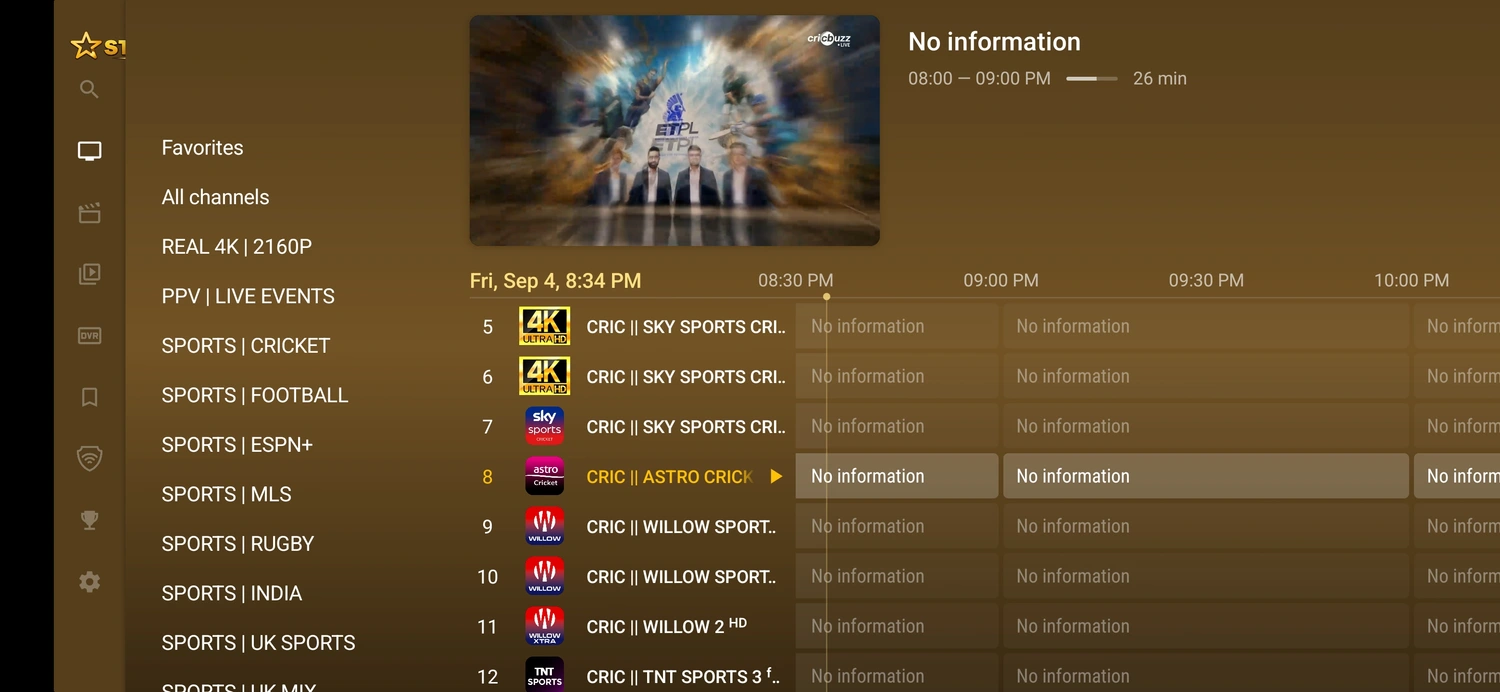
The release documents a television-oriented interface labelled STAR TV and relates it to historical StarShare setup material. That is a real visual reference for a reader who recognises the old screen. The .app release also notes that the historical material contained two application packages with different identities. Its maintainers declined to designate one as the authoritative present download. The practical conclusion is simple: get the current publisher and supported installation source for your own device before acting on an old screenshot or filename.
This question is particularly important after replacing a television. If an old box still shows the gold logo but the new television’s store offers a similarly named app with a different publisher, pause the account setup and identify the intended product. Ask whether the supported route for the new television uses a different compatible player. If the answer involves another licence, find out who charges the fee and whether it applies on future replacement devices. A historically accurate screenshot can help explain the question without settling compatibility for a newer model.
A person reporting a successful move should record both models, the software publishers and whether the original service account continued. They need not post a private download link, device code or account details to make that report useful. A move might preserve the service term while requiring a new player activation. It might instead involve new credentials. Those outcomes look similar once a programme appears on screen, yet they carry different consequences at the next renewal.
When an old StarShare customer requests a renewal
The historical .io identity and the .app release can both appear in discussions about StarShare. A familiar name, the same contact route or the same screen does not establish that an old paid line or unspent reseller balance can migrate. Ask about the specific old order and device. Can the current seller identify the existing expiry and extend it? For a panel, can they see the current balance and explain whether it remains available? A reply identifying the old line and its actual remaining term is evidence a customer can use.
The .app terms in the archive were adapted on 7 November 2026 from a policy dated 30 August. They tie usage to the account period, method and connection allowance in the particular order, and separate third-party player charges. They also point to changes in catalogues and features. A buyer counting on two simultaneous screens, catch-up on one particular source or the continued availability of a preferred programme should ask about those items on the actual offer. The policy does not award an unlimited connection entitlement to everyone with a copy of the app.
The archived refund material describes an order-specific assessment and the possibility of troubleshooting. A useful private report therefore includes the receipt, term, device, app publisher and what happened when the customer attempted to play something. Redact logins, payment details and personal contact details from the public version. Another member can still learn that a particular model needed a different player or that a seller issued a correction. They do not need access to the account in order to learn from the outcome.
Read the screen gallery as a map of one documented interface
The archived gallery distinguishes a blank STAR TV television login, a category screen, channel browsing and a programme guide. There is also an app-selection view and a separate blank web-login reference. These images are useful because the screens are visibly different. An owner who says they cannot get past login may be looking at the television player, a browser sign-in or a selection panel. Ask which image their screen most closely resembles and what they pressed just before the error appeared. No private credentials are needed to narrow that down.
The documented guide screen, for example, tells readers there was a way to display programme information. It says less about a particular evening’s guide coverage. If a television lists a channel but shows no schedule, try another channel on the same player and note whether it has listings. If the schedule appears but the wrong programme is airing, give the time zone and programme name. Those observations identify a precise issue. The original guide image cannot validate current regional data, replay depth or support for a particular audio language.
The app-selection image can be equally useful after a replacement device is introduced. One owner may call the selection stage “my account” while another uses that phrase for the terminal television login. If purchases are also involved, a seller may be discussing the wholesale panel and the customer a retail player. Put the visible screen title or function in the support enquiry. Describe which device shows it. Phrase the issue as an action that failed, such as opening the channel grid after sign-in, rather than a conclusion that the customer account was cancelled.
The archived downloads guidance calls for a current source suited to the exact device and describes a one-day trial request. A dated installation file might keep an old system running but still be unsuitable for a new television or phone. The live listing, publisher name, operating system and account method together identify the supported route more convincingly than a remembered icon. If the seller offers a temporary test, confirm its end time and use the destination device. One day is generally too short to wait for the day itself and start investigating the hardware only afterwards.
File a useful account of an old order while the evidence is available
An owner comparing their recollection with the November release may find a different figure, an unfamiliar player or another hostname on a receipt. Preserve the difference. A “correction” that replaces the old merchant’s name with the current site title can destroy the very clue needed to trace the order. State the purchase month and year, currency, term, issuing domain and what can still be seen on the account. Identify a later change as a separate event. The result becomes a chronology another customer can follow.
For an unresolved refund, the November policy adaptation describes the need to contact support and gives circumstances that can affect eligibility after digital credentials have been issued or used. The current order may have different wording. Give support the original issue, device, steps already tried and the outcome sought, and retain the applicable response. In a public follow-up, separate a promise to investigate, an approved adjustment, and an amount actually returned. An extension of the subscription may solve the customer’s problem while producing a very different financial record.
For a panel owner, the same approach works with quantity. A 100-credit purchase, a visible 100-credit increase, an annual ten-credit debit and a resulting 90-credit balance together tell a useful story if those events occurred. A newly issued quote for the same pack is a different kind of evidence. State which one you have. A later pack that uses a different schedule would be a reason to put dates beside both records, especially if one customer still holds legacy credits. That is how an archive can keep helping readers long after a price card has changed.
Compare a shortened viewing season with a block of unused credits
The historical pricing makes a useful household case for a four-month sports season or a temporary work placement. One three-month term at $14.99 followed by one month at $6.99 would have totalled $21.98 if the same prices remained available for consecutive orders. The half-year was $27.99. The six-month option would therefore have cost $6.01 more for two additional months. Someone expecting to stay through a fifth month might have preferred the half-year, as a quarter and two separate months would have totalled $28.97. The exact end of a placement can be worth more than the phrase “lowest monthly rate.”
Compare that with a reseller trying to serve four months of customers. StarShare’s source gives no direct debit for three months, so the household’s “quarter plus month” comparison cannot simply be copied into the business account. If a customer genuinely opts for four consecutive monthly activations, the archive supports a forecast of four credits, assuming each is granted under the same rule. It does not establish that one four-month product exists, or that an operator can quietly substitute an equivalent schedule without changing the customer’s agreement.
A changed quote can be reported without treating the release as wrong. For example, if a seller now gives a quarterly debit, preserve the exact date, action, package and domain the quote covers. If that same deduction is later observed in the operator’s own panel, say so separately. One statement records a promise; the second records a transaction. If both support the same figure, the next reader gains a useful reference for a question the archived materials left open.
This distinction is most valuable at renewal. A customer whose term ends next week may simply need a seller who can identify and extend a working line. A person shopping from scratch may instead care about the new device setup, current app source and current bill. An old STAR TV screenshot can help the first customer explain what they already own. The direct quote and trial are more important for the second. Keeping both sources in view gives owners and newcomers a fairer basis for comparing experiences.
Put a date on the price before comparing it
An owner-supplied public website release contains a pricing page with the canonical StarShare.app address. Its files are dated 8 November 2026. The checkout route shown there was a WhatsApp enquiry, so the figures are advertised charges in an identifiable release. They are not evidence that a particular customer placed an order or that the same charges are still being accepted. The exact-host live pages could not be verified for this edition. A dated price card is more useful when it is kept with that distinction.
The archived household cards read $6.99 for one month, $14.99 for three, $27.99 for six and $39.99 for twelve. These are totals in US dollars. For an owner reconciling an old charge, the three-month figure is easy to get wrong because several similarly presented services advertise $16.99. The .app release here shows $14.99. When a new purchase is being discussed, ask the responding seller for the complete currency and amount again. If the quote differs, record both dates rather than silently rewriting the old offer.
At the archived figures, two quarters add up to $29.98, or $1.99 more than a half-year. Two half-years add up to $55.98, or $15.99 more than an annual term. That makes the annual choice look attractive for a settled household with a working television player. For someone spending only three months at an address, $14.99 was less than half the annual commitment. A comparison that starts with the period the household will actually use brings a different perspective from one that begins with the lowest monthly average.
Provider material for this report
- Owner-supplied .app household offer in the 8 November 2026 release
- Owner-supplied wholesale pack schedule, 8 November release
- Archived monthly and annual debit rules
- Archived STAR TV interface and package identity evidence
- Terms adaptation dated 7 November 2026 in the owner release
- Refund policy supplied with the November release
- Archived browser-prepared WhatsApp enquiry with no automatic submission
- Archived device-source confirmation and trial route
- Archived player, programme guide and app-selection references
- Archived scope distinctions for distribution enquiries
Planning a viewing window with StarShare
A dated price on an earlier starshare.app page can help identify the product a seller means. A new order still needs an exact amount, a currency, an expiry date and a named billing party. Record the reply against this domain before treating an earlier figure as a budget. A comparison with complete prices on the other side can establish what that other offer costs, while the missing side stays open.
How the 12-month order compares
Read each row as an alternative for this exact duration. Currency and market are shown because they affect eligibility and the amount that reaches your statement. A missing figure means the provider still needs to identify a current offer for that period.
| Alternative provider | Listed market | 12-month total | Relative to this offer |
|---|---|---|---|
| 5G Live | Ask the seller | Current bill unconfirmed | Compare eligibility and currency on the order |
| Rynex Play | Ask the seller | Current bill unconfirmed | Compare eligibility and currency on the order |
| 4K IPTV | EUR listing | EUR 44.99 | Compare eligibility and currency on the order |
| 4K OTT Pro Max | USD listing | USD 54.99 | Compare eligibility and currency on the order |
| 8K IPTV | USD listing | USD 54.99 | Compare eligibility and currency on the order |
| 8K PRO IPTV | USD listing | USD 54.99 | Compare eligibility and currency on the order |
| B1G IPTV | USD listing | USD 44.99 | Compare eligibility and currency on the order |
| Crystal IPTV | EUR listing | EUR 50.99 | Compare eligibility and currency on the order |
| Dino IPTV | USD listing | USD 49.99 | Compare eligibility and currency on the order |
| Dream 4K IPTV | USD listing | USD 49.99 | Compare eligibility and currency on the order |
| Golden OTT | USD listing | USD 49.99 | Compare eligibility and currency on the order |
| Hello Sky IPTV | USD listing | USD 49.99 | Compare eligibility and currency on the order |
| Hot IPTV | USD listing | USD 50.99 | Compare eligibility and currency on the order |
| IPTV Australia | Australia | AUD 71.99 | Compare eligibility and currency on the order |
| IPTV Canada | Canada | CAD 76.99 | Compare eligibility and currency on the order |
| IPTV Europe | Europe | EUR 49.99 | Compare eligibility and currency on the order |
| IPTV USA | United States | Current bill unconfirmed | Compare eligibility and currency on the order |
| Lion OTT | USD listing | USD 44.99 | Compare eligibility and currency on the order |
| MegaOTT.app | USD listing | USD 44.99 | Compare eligibility and currency on the order |
| MegaOTT.io | USD listing | USD 44.99 | Compare eligibility and currency on the order |
| Pro Max 4K OTT | USD listing | USD 54.99 | Compare eligibility and currency on the order |
| Sky Glass IPTV | UK | GBP 40.00 | Compare eligibility and currency on the order |
| Smarter 8K IPTV | USD listing | USD 50.99 | Compare eligibility and currency on the order |
| Strong 8K IPTV | USD listing | USD 54.99 | Compare eligibility and currency on the order |
| Team 8K | USD listing | USD 54.99 | Compare eligibility and currency on the order |
| Trex IPTV | USD listing | USD 54.99 | Compare eligibility and currency on the order |
| UKIPTV | UK | GBP 40.99 | Compare eligibility and currency on the order |
| Ultra 8K IPTV | USD listing | USD 54.99 | Compare eligibility and currency on the order |
| XOTT | USD listing | USD 54.99 | Compare eligibility and currency on the order |
Three alternatives worth reading in detail
5G Live compared with StarShare
5G Live publishes a USD 44.99 year and a clear monthly debit for reseller accounts. Owners of an older subscription face a second question before paying. Which seller has access to the line already on their screen?
What a historical refund page can tell you
The older 4K subdomain's refund page discusses certain first-time direct purchases and distinguishes them from renewals and reseller purchases. That scope is the most valuable piece of information in the document. Someone with a recent direct purchase from a different host, or a line created by a local reseller, cannot assume the subdomain's wording governs their order. Get the policy linked to the actual invoice and check the way a refund request is made.
Consider two people who use what looks like the same player. One obtained a line directly through a checkout. The other went to a reseller who activated it in a panel. The player can present both accounts in almost identical colours, yet the person who received the money may differ. Each customer can trace the order with the seller who took payment. A screenshot of a help page on another address is a clue to investigate and a poor substitute for the original agreement.
The ninth customer and the next pack
An installer who already has eight annual orders faces a familiar change when a ninth customer asks for the same thing. Nine years of customer time require 108 credits. One smallest pack will not cover that. If repeated purchases are available on the same panel on unchanged terms, two starter packs would bring the available amount to 200 for USD 278 and leave ninety-two credits after the ninth customer. A 300-credit order would cost USD 399 and leave 192 credits. The larger pack has a cheaper unit but commits an extra USD 121 at that moment.
That choice depends on the business that will use the remaining stock. An installer with another ten orders already scheduled has a different pipeline from a local shop testing demand for the first time. Ask whether unused balances expire, whether credits are tied to a particular panel and whether a top-up retains the same permissions and debit. Also ask what happens if a customer pays and an activation fails before the account is usable. One supplier answer can change which package is sensible even when all three unit prices stay the same.
The public reseller page mentions examples of line creation, MAG-device management and subreseller forms. A screenshot of a form answers very little about what your own business account will permit. Ask for the role name on the proposed agreement and whether staff can issue renewals, see customer data or allocate credit to a second seller. For a small shop, it may be sufficient for a colleague to see an expiry date without seeing another employee’s customer notes. Price this administrative workload before promising managed support to an entire customer list.
A mixed order book without a spreadsheet
Few small sellers issue only annual subscriptions. Consider an installer facing twelve one-month orders, five quarterly orders, three six-month orders and four annual orders. At the published .app debit, those customers consume 12, 15, 18 and 48 credits respectively, for a total of 93. A 100-credit pack would cover the example and leave seven credits. At USD 1.39 each, the allocated inventory accounts for USD 129.27 of the USD 139 cash purchase. The seven left could support a six-month extension and a single additional month if the same rules apply later.
This is also a valuable test of whether a supplier's statement matches the panel. Ask the issuer to demonstrate one quarterly extension on a dummy line. The opening and closing balances should differ by three credits under the stated standard customer-month rule. Request the new expiry and the treatment of existing days in the same example. If an additional stream or non-standard account incurs another charge, record it as a different product. The standard calculation remains correct for what the site defines, while a business that sells the extra option needs its separate cost.
An owner who regularly needs exactly three starter packs can compare USD 417 spent on three lots of 100 with USD 399 for one lot of 300, assuming top-ups may be combined under the same terms. The saving for buying all 300 together would be USD 18. For 1,000 credits, three packs of 300 and one of 100 total USD 1,336 against USD 1,290 for the large single pack, a difference of USD 46. In each case the smaller route might let the owner delay the next payment until customers actually place orders. What looks cheaper per credit is not automatically the better use of the shop's cash that week.
Three addresses that look convincing in a search result
The exact name of this profile is 5glive.app. A search also brings up the 4k.5glive.app subdomain and a separate website using 5g-live.tv. Their names resemble one another closely enough that a customer looking for a renewal could open all three in good faith. That makes the address on the original purchase record unusually important. Similar designs, an email address containing a familiar word or a page offering an apparently suitable renewal do not establish which business can extend an old account.
Begin with a receipt or order confirmation and read three fields. Which web address issued it? Which name appeared as the payee? What service period and player did the order describe? A returning viewer can give support the date, term and a redacted order reference. There is no reason to put a playlist address, access password or private account token in a public forum post about the problem.
What one hundred credits can deliver on the .app panel
The provider defines the unit clearly enough to do genuine capacity planning. At one credit per month of customer service, an annual account consumes twelve. A 100-credit balance can fund eight twelve-month customers and leave four credits. Those four can still be used as four single months or a three-month term plus one month, subject to the actual account arrangements. The limit applies to what is available in the balance. It does not say when unused credits expire, when support works or how an erroneous activation will be reversed.
The 300-credit and 1,000-credit alternatives have different practical sizes. Three hundred covers twenty-five annual allocations exactly. One thousand covers eighty-three, with four credits left. On the published full pack totals, the nominal credit costs USD 1.39, 1.33 or 1.29 depending on pack. A twelve-month customer allocation consumes USD 16.68, 15.96 or 15.48 of inventory at those rates. That is the inventory component of a job. A shop still pays for the time spent explaining the app, setting it up, answering an evening support message or replacing a failed television.
A seller expecting eight annual customers would spend USD 139 to buy the smallest package. Of that sum USD 133.44 corresponds to the ninety-six credits used, leaving four credits of nominal inventory worth USD 5.56 at the same rate. This distinction between cash paid and cost consumed is easy to miss on a first order. The supplier takes the full package amount even if only six of those eight expected customers actually appear. Decide how much stock to buy from the number of orders you can reasonably deliver and the conditions attached to any unused balance.
Rynex Play compared with StarShare
The supplied RynexPlay.app release gives the four household totals, a monthly reseller unit and a support contact on rynex.tv. It is a valuable dated record for owners. A fresh quote is still needed to establish what a buyer can order on the .app domain now.
A monthly credit rather than an annual one
The RynexPlay.app reseller release is explicit about debits. One month for one customer uses one credit. Three months use three, six use six and a year uses twelve. The archived Starter pack was 200 credits for $170. Professional was 500 for $395. Enterprise was 1,000 for $690. Those figures give $0.85, $0.79 and $0.69 per customer-month respectively. An annual activation therefore consumed credits with an allocated acquisition cost of $10.20, $9.48 or $8.28, depending on which pack supplied the balance.
A new operator cannot put $10.20 into an empty panel and assume twelve units will appear. The smallest pack in that release costs $170. Imagine a desk with twelve confirmed annual customers, six quarterly customers and four monthly ones. The annual group needs 144 credits, the quarterly group needs 18 and the monthly group needs four. A 200-credit block leaves 34 after all three groups are served. That can cover two more annual extensions and ten individual months, assuming the current seller still follows the same deductions for extensions.
The distinction between cash and allocated cost becomes especially important at Enterprise. A business paying $690 and using only 100 credits has committed the full $690. It has assigned $69 of inventory under the historical unit rate and still holds 900 units. The treatment of unused balances determines what that remaining inventory is worth. Before ordering, ask for any expiry, refund, recharge and transfer rules on the actual panel. A digit on a historical price sheet supplies none of those terms for a new account.
A trial and refund in the original terms
The archived terms discuss a 24-hour trial and point purchasers to a separate refund policy assessed for eligibility. For a current buyer, ask whether the trial is available, when its clock starts and whether its account conditions match the planned paid line. A busy weekday trial that expires before a household can watch may settle very little. Arrange the timing around something you actually use, such as a regional guide, an audio language or a programme on the television in the main room.
Keep the trial address separate from the public discussion. If something fails, publish the device, player, time and visible problem while removing credentials. For a private support investigation retain the exact order reference and the action attempted. If the question is an old Rynex purchase, identify it as such. A response saying another party can sell a new annual term is still useful, but it is materially different from a response that locates your old account and honours the remaining months.
What the historical refund route could and could not settle
The separate archived refund page describes an eligibility review, typically estimated at three to five business days after the required information is provided. It distinguishes that review from the time a payment provider might take after approval. A customer comparing collection dates should keep the time they made contact, the time the requested details were supplied and the time a decision was issued. Those dates can tell an entirely different story from a single count of days since the original payment.
That document also treats wholesale balances differently from a retail viewing order. Once wholesale credits or access had been issued or used, it described those purchases as generally non-refundable, subject to applicable law. Treat that as a provision recorded in the old release and ask for the applicable terms for a present purchase. It changes how one should read the Enterprise unit saving. Savings from a $690 purchase exist only to the extent that the operator uses the inventory under the conditions that actually apply to it.
For an ordinary household there is a clearer way to report a problem than starting with a conclusion about eligibility. Suppose the player opens, the account accepts the supplied sign-in, the guide shows listings, and a named programme stops after a few seconds. Record those four facts, the time, device and whether it happened again. Then state the outcome wanted. Someone facing a delay before any credentials are issued has a different problem and a different starting record: a paid order, its expected activation date and the contact already made.
An early renewal can produce another disagreement even when the service works normally. Ask whether the new term extends the existing expiry or starts when payment clears. If support proposes a new line, ask what will happen to any remaining paid days, and whether the replacement will use a different player configuration. These questions are worth settling before the new account is used. People who send the same report to multiple domains without identifying the original seller can otherwise end up comparing different orders and receiving answers that appear contradictory.
How to conduct a useful twenty-four hours on this particular player
The original RynexPlay trial instructions ask for the country, device model and preferred player. They describe capacity and eligibility as variables. That is an important qualification if someone paid for an annual account after hearing that “everyone gets a day free.” A request, an approved trial and a tested account are three separate events. For readers comparing trials, state which of those you reached and when. A waiting period before credentials arrive can be frustrating, but it does not by itself establish that a running test account failed.
Set aside part of the available time for a sequence that crosses the player’s different sections. Try finding a live programme from the guide, an on-demand film from search and an episode inside a series. A working live list does not demonstrate that search can distinguish between two titles with the same name, or that a subtitle setting stays selected when the next episode begins. The archived interface gives a buyer reasons to try all three paths. A pass on one is useful evidence even if another path never becomes available during the trial.
The original app page gives a helpful clue about an empty guide. Guide data varies with the source and the player, and the guidance suggests checking the time zone and any refresh control the player provides. Start by comparing two channels in the same session. If one shows programme names and another has none, record which was which. If both guides are present but every entry is an hour out, note the device time zone and a named programme. These are distinct reports. One is about missing data and the other is about interpreting the clock.
For somebody buying mainly to watch programmes later, open one named item from yesterday, as well as one currently airing. The source describes catch-up as dependent on the account method and the relevant channel. Two channels that look identical in the live list may offer different replay privileges or history. Ask the seller what to expect for the one that matters, and test it during the allotted window. A review that says “yesterday’s evening bulletin opened on this model” describes a check another viewer can repeat. A blanket claim that every programme has catch-up goes well beyond the evidence.
4K IPTV compared with StarShare
The numbers on 4kiptv.app are unusually usable. Its consumer prices cover a complete term, its reseller credits buy customer-months, and its one-day trial starts with an installed player. Picture quality, extra screens and the handling of a failed activation still need an answer for the particular order.
Resolve a renewal while there is still time to choose
Near expiry, check the term that was originally purchased and the expiry the account actually displays. If remaining days are to carry over, ask for the new date before applying the extension. A calendar month can differ from a fixed number of days. Paying early should not leave a customer unsure which date the panel used. If the new expiry looks wrong, retain the original confirmation and report the discrepancy before buying an additional term as a workaround.
For the next forum review, split the commercial result from the viewing result. A reader can report that a EUR-denominated total matched the written order, that the player installed on a particular television, and that one tested programme had no guide entry on a named evening. All three observations are valuable. None needs a speculative star score. Buyers can use the commercial details to compare plans, and someone with the same player can investigate the guide issue without mistaking it for a failure of every channel.
The practical reasons to shortlist this offer are the explicit four-term euro pricing and a wholesale unit that translates cleanly into customer time. A trial can answer the remaining viewing question only if it runs on the hardware and connection you will keep using. A pack can answer the remaining business question only if its purchased quantity fits the renewals you can already identify. Those are two separate decisions, and 4kiptv.app gives readers enough numbers to make each one on its own terms.
Following the bill after a player has been uninstalled
The provider’s support material makes a distinction that regularly matters on a family account. The household might pay the service seller in euros and separately authorise a software charge with a player publisher or app store. Deleting the player removes it from sight; it may leave a store subscription active under the account that bought it. A household hoping to stop a charge should identify the merchant on the payment record, locate the corresponding account and check the cancellation or renewal status there. The billing route for the software is independent of the four-term 4K IPTV price table.
Consider the parent who ordered the service and the adult child who set up the player under their own store account. The parent may have the viewing order and all the information needed to extend it. The child may be the only one able to see a software charge or cancel its recurrence in the store. The arrangement works until the television is replaced or a renewal arrives unexpectedly. Keep the purchaser and the issuer visible on both records without exchanging passwords. There is no need to post either account’s sign-in details to establish which receipt applies.
The same separation helps with a duplicate payment allegation. Two small charges on the same day might be genuinely duplicate payments to one seller or two legitimate charges to two different parties. Identify the currency, amount, biller and product on each. If both payments point to the same 4K IPTV order, take the two references to the contact handling that order. If they point to different products, ask each seller what it supplied. A precise chronology is a better first move than disputing everything associated with the television at once.
What the four terms cost in euros
The listed charges are EUR 6.99 for a month, EUR 18.99 for three months, EUR 29.99 for six and EUR 44.99 for twelve. The annual equivalent works out to roughly €3.75 per month. The actual order is for the full term. A person comparing bank charges or deciding how much to spend this week should put the full price in their budget. Third-party player activation, a higher connection allowance or a cost attached to a chosen payment method belongs on its own line if it appears in the quotation.
There are two sensible ways to read the steepest saving. Paying the displayed one-month rate twelve times would add up to €83.88, assuming the rate and terms stayed the same. Buying one year at €44.99 would leave €38.89 unspent against that particular pattern. But a buyer with a four-month need can cover it with a quarter and a month for €25.98, again assuming consecutive purchases on the same terms. An annual plan saves this household nothing unless they find a use for the other eight months.
A longer term can also make sense before all twelve months are certain. At the displayed prices a half-year and two extra months add up to €43.97. An annual plan costs €1.02 more. For a viewer who already knows they want eight months and is reasonably likely to watch in months nine and ten, that is a small difference in cash. For somebody moving home in two months, the decision is very different. These comparisons assume you can renew the same account at the displayed totals. Ask whether expiry, device, location or renewal price changes that assumption.
When quoting a comparison on the forum, give the currency and the term together. An annual total and a one-month trial of a rival product answer different budget questions. A bank converting euros may show a different amount in the cardholder’s home currency even if the seller has honoured its quote. Record the seller’s euro figure and the amount charged separately. That lets another reader understand the difference without treating a conversion on one card as a new price for every customer.
From a credit balance to an order you can actually buy
The provider’s wholesale page defines one credit as one customer-month. A three-month account uses three, a six-month account uses six and an annual account uses twelve. The smallest advertised block is EUR 85.00 for 100 credits. The middle block supplies 350 for EUR 276.50, and the largest supplies 1,000 for EUR 690.00. Keeping the block size in the sentence matters. An annual activation may consume credits worth €10.20 at the starter rate, but an empty panel cannot be funded with the €10.20 calculation alone.
Consider a new reseller with six confirmed annual customers and four confirmed quarterly ones. The annual accounts need 72 credits and the quarters need 12, for a combined 84. A 100-credit block leaves 16. Those 16 could cover two half-year renewals and four monthly renewals, provided the panel applies the published schedule to those extensions. They cannot cover two more annual customers. The important number after the first batch is the 16 on hand, especially if renewals are due before the next sale settles.
A different pattern produces quite a different result. Twenty-nine annual customers consume 348 credits, leaving two out of a single 350-credit block. At the published rate the allocations total €274.92; the purchase itself still cost €276.50. The two-credit difference is inventory. If policy permits another suitable customer to use it later, its value can be realised then. Until then the reseller has spent the whole invoice. This also illustrates why dividing the full pack cost by one month of retail sales produces an unhelpful impression of profit.
A buyer who needs exactly ten annual activations needs 120 credits. The source offers 100, 350 and 1,000. There is no published 120-credit selection in this schedule. If the seller permits two of the smallest top-ups on the same panel, that route would cost €170 and leave 80 credits. A 350-credit purchase would leave 230, with €276.50 paid. Obtain the actual repeat-purchase and expiry rules before using either scenario to quote a customer. A calculator can price each credit; only the order specifies which balance you will receive.