
The amount on the order
Dream 4K IPTV lists USD 49.99 for 12 month(s). Dividing that bill by 12 gives USD 4.17 per month. The full bill is the amount to compare with your budget for the order.
| Alternative at the listed rate | Combined total | Difference from this term |
|---|---|---|
| 12 × 1-month order | USD 107.88 | USD 57.89 |
| 4 × 3-month order | USD 95.96 | USD 45.97 |
| 2 × 6-month order | USD 77.98 | USD 27.99 |
Repeat-order examples use the same listed rate each time. They do not assume a renewal price, uninterrupted eligibility or a future discount.
What changes the value of this term?
The FAQ asks buyers to confirm their connection allowance.
Which account issuer and pricing route will be written on the reseller invoice, and what does one credit buy on that route?
Which Dream 4K offer are you actually buying?
A household can price a month or a year from the Dream 4K subscription FAQ. A reseller has a harder job. The same site quotes a price for a credit without saying what the panel will issue for it. That missing detail determines its value.
Six months before the television goes
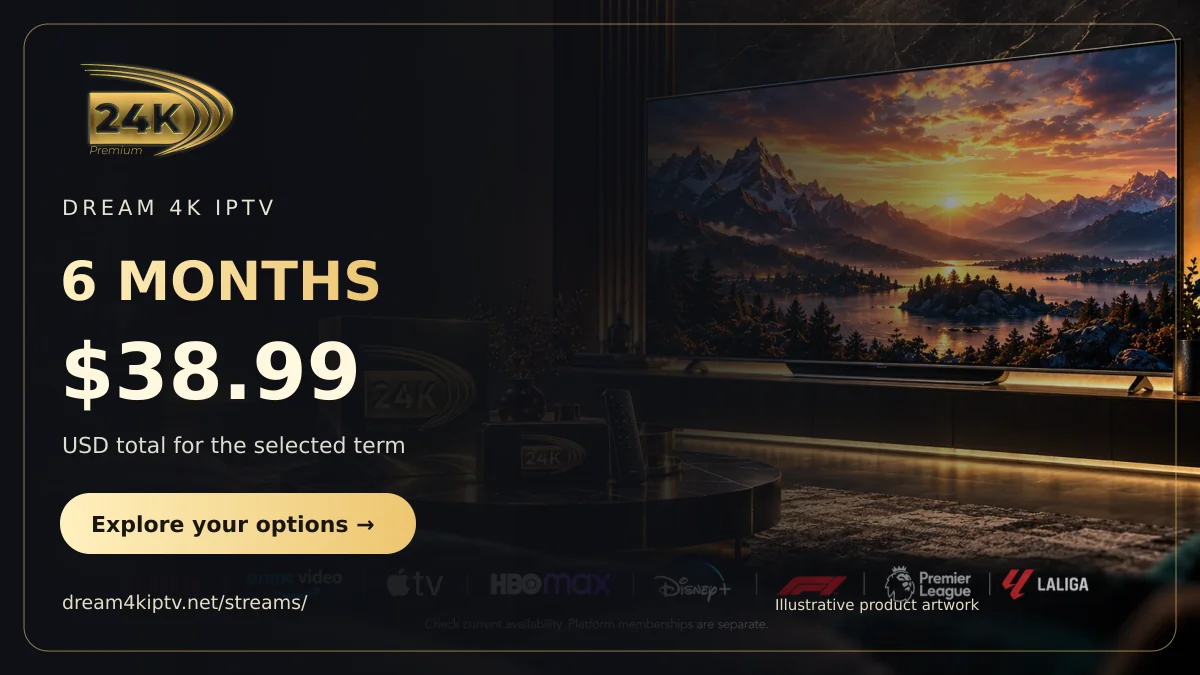
The private side of the decision is more straightforward. Dream 4K's /streams/ FAQ lists full-term USD totals of USD 8.99 for one month, USD 23.99 for three, USD 38.99 for six and USD 49.99 for twelve. Its order terms direct buyers to confirm the connection allowance. Someone planning to watch live television in two rooms at once needs the total for that scope of service before using this table. A plan sold for a fixed term still has to fit the viewing routine.
Suppose the equipment will be replaced in around five months. On the November cards three months plus two individual months cost $41.97. Buying six cost $38.99. Provided consecutive orders could be applied to the same account with no surprise charges, the six-month plan covered the intended dates at a $2.98 saving. There is no need to value the unused sixth month at a made-up price. The buyer can simply compare the money that would leave the account under each arrangement.
If the television will stay for seven more months, six months and an additional individual month came to $47.98. An annual purchase cost $49.99, only $2.01 more for the stated service. What happens to an existing account when the hardware changes now matters more than that difference in arithmetic. Ask which player is recommended for both sets, whether that player has a transferable licence and whether the seller will move the service credentials to the replacement device. A cheap extension on paper is of little help if the new screen cannot use it.
Work back from the first evening
The Dream ordering pages invite an enquiry. Their terms explicitly distinguish that step from a completed payment or an activated account. For a household hoping to watch on a particular evening, that distinction matters. Record when a service representative confirms the order, when any payment is received, when the account is issued and what start and end dates are attached. Someone who has submitted an enquiry but received no order confirmation has a different question for support from someone with a receipt and a login that does not work.
The site directs customers to establish compatibility, install the appropriate player and then request a free one-day trial. Start with the model and app-store region of the screen in use. If an external streaming box does the work, give its model too. The device driving the picture may be years newer than the television itself. A support reply aimed at an app running inside the television can send the owner on a fruitless tour of settings when the player is actually installed on the box.
Set aside a little of the trial for ordinary tasks somebody else in the family can try unaided. Can they find the regional bulletin they expect? Can they select the audio they understand? Will the guide show the next programme at the right local time? If a phone is available as an approved alternative, it can help narrow a problem later. The primary test should still take place on the main screen using its usual remote, network and listening arrangement. That is where the household will live with its choice.
The trial can settle a narrower question about 4K
Picture quality is a reasonable interest when the service has 4K in its name. Dream's terms place it in the context of the individual source and the path to the screen. A television reporting a 4K signal from a streaming box is reporting something about the box's output. Its owner still needs to know what the particular programme supplied. Ask the seller to identify a source suitable for an authorised household trial and the player view, if any, that reports the incoming stream information.
Try the same scene with the normal seating distance, picture mode and network that you will actually use. If a scrolling caption is hard to read or an evening bulletin appears soft, write that down in those words. A comparison in which the television changed display modes and the user switched from a live programme to a different film has too many moving parts to settle what caused the result. A modest observation tied to one source might help the next reader with the same setup.
Access to a title is a separate question from resolution. Dream's order terms explain that a platform logo or poster does not establish a particular catalogue or another platform's membership. Ask about the programme, country edition, language and time you want. A trial can confirm what a screen played at that time and how it handled captions. Someone considering a six-month subscription for a future competition should get the scope of what the seller is offering in writing before treating the artwork as a promise for that event.
The receipt after the screen changes hands
Replacement televisions and house moves both create an awkward overlap between a service account, a player installation and the person who paid. A household may have purchased its player through a store account belonging to one family member and its Dream time through another. Before dismantling the old setup, record the player title and publisher, how to recover the store purchase, the Dream expiry date and the private order reference. A photograph of the app's opening screen alone is unlikely to settle any of those questions later.
For a reseller taking over customer support, the equivalent exercise is a handover. List which accounts are due, who can add credits, which written terms apply and who can escalate a failed extension to the issuer. Ask what can be exported or viewed through the specific role before promising a complete migration to a client. If the old panel used the euro offer and the new quote points to /streams/, seek written confirmation of how any existing balances or lines are treated. The shared domain gives no automatic answer about transfers.
Dream's refund and billing page asks buyers with a dispute to give the private support team their order details, date, amount and reason. Its distinction between the player seller and service seller matters when a household has paid twice for different things. The public version of the same story can name the plan, player and symptom and describe whether the matter was resolved. Remove account references, URLs containing login values, device registration codes and personal payment details before adding a screenshot to a forum thread.
When an order changes between enquiry and payment
A shopper may set out for a quarter and be offered a year in the private conversation. The public term amounts make it easy to check the change, but the other terms of the earlier offer also deserve another look. Was the intended account for the same number of concurrent viewers? Will the longer term activate on the same date? Is the payment going to the same merchant? Ask for the final version in one message or invoice so the dates in one conversation cannot accidentally be attached to a price from another.
The change can be even more significant for a dealer. A quote may begin with an appealing unit price and finish with a different quantity, a new panel, a setup fee or a commitment to buy future stock. Keep a short record of each change as the discussion progresses, then check only the final proposal against the customer's needs. A first payment that includes setup can have a different effective rate from later top-ups, even if the quoted per-unit balance stays the same.
A useful Dream 4K review can end before somebody spends money. A household may have established its exact full-term total and discovered that the recommended player is missing from its television's store. A dealer may have obtained a perfectly clear dollar quote while still waiting for the debit on a one-year line. Both have learned something concrete. A dated report that identifies the route, the question asked and what the provider has actually settled is much more useful to the next reader than assigning stars to the unanswered parts.
The question a price tag cannot settle
Consider two readers looking at the same Dream 4K page. One wants a subscription until a new television arrives in six months. The other has agreed to quote six annual accounts to customers. The first reader can make a meaningful start with the four household totals. The second needs another piece of information before quoting a penny. Dream 4K's own credit-planning page says its published figures do not establish the conversion from a reseller credit to a subscription term.
That gap is easy to overlook because the arithmetic on the page is complete. Sixty multiplied by $1.59 really does produce $95.40. The missing step comes after the multiplication. How many standard one-year customer accounts will sixty of these particular credits activate? Will issuing a one-month test use a proportion of a credit, one credit, or a different allowance? The reseller FAQ directs buyers to get the term and account rules from support. A familiar credit convention from another provider cannot supply the missing answer.
There is a further complication for anyone bringing an old order to the comparison. The research record includes a different reseller offer on a root-level Dream 4K page in euros. The newer family of pages under /streams/ quotes US dollars. A buyer can show the seller both, but combining one page's currency, another page's number of credits and a third supplier's debit rule would describe an imaginary package. Give the seller the actual link you intend to use and ask which price sheet will govern the invoice.
Four dollar totals and a missing unit
The reseller page in the /streams/ section records four USD pack totals. Its November schedule showed $95.40 for sixty units, $178.80 for 120, $417 for 300 and $774 for 600. The corresponding rates were $1.59, $1.49, $1.39 and $1.29 per unit. The credit-planning page reproduces the arithmetic and says that its calculation stops before converting a balance into customer months. These are dated figures from that particular route and need reconfirmation for the account offered.
Two sixty-unit purchases would have cost $190.80 on that schedule. The 120-unit pack reduced the bill for the same quantity by $12. A buyer with a confirmed use for just sixty units, however, would have had to lay out an extra $83.40 immediately to take the larger pack. The difference between those two figures is important. Twelve dollars describes a potential reduction over two eventual purchases. Eighty-three dollars and forty cents is the extra payment due at once.
A similarly tempting comparison appears at the top of the schedule. Two lots of three hundred came to $834 against $774 for a single six-hundred-unit purchase. That was a $60 difference in the price of the units. It establishes neither how many households the purchase could serve nor how much the business could earn. Before assigning an account cost to any of those units, get the actual debit for a named customer term and the terms that decide how and when the balance can be used.
Provider material for this report
- Dream 4K household prices, trial steps and request for a confirmed credit conversion
- Dream 4K order, connection and playback terms
- Dream 4K USD reseller packages under the streams section
- Dream 4K unit price calculations and limits of the published conversion
- Earlier Dream 4K root reseller route recorded separately
- Dream 4K cancellation and billing enquiry procedure
- Dream 4K and Dream 24K Android app guidance
- Dream provider guide to guide timing, source resolution, audio and replay
Planning a viewing window with Dream 4K IPTV
A season rarely lasts exactly one, three, six or twelve months. The table finds the least expensive combination of the available terms that covers each viewing window. It allows unused months when a longer order costs less. Equal totals favour fewer purchases, then less unused time. Some combinations require a second purchase. Every example assumes today’s published amounts still apply to that later purchase.
| Viewing window | Months wanted | Orders at the listed rates | Combined bill | Unused months |
|---|---|---|---|---|
| Two months between moves | 2 | 2 × 1-month | USD 17.98 | 0 |
| A four-month season | 4 | 3-month + 1-month | USD 32.98 | 0 |
| Five months in a second home | 5 | 6-month | USD 38.99 | 1 |
| Seven months away at work | 7 | 6-month + 1-month | USD 47.98 | 0 |
| An academic year | 9 | 12-month | USD 49.99 | 3 |
| Twelve continuous months | 12 | 12-month | USD 49.99 | 0 |
| A year and a three-month extension | 15 | 12-month + 3-month | USD 73.98 | 0 |
| An eighteen-month stay | 18 | 12-month + 6-month | USD 88.98 | 0 |
4 months of viewing. On these figures, 3-month + 1-month comes to USD 32.98. The purchased periods end at the planned finish. Buying separately at the listed one-month amount would total USD 35.96, a difference of USD 2.98.
7 months of viewing. On these figures, 6-month + 1-month comes to USD 47.98. The purchased periods end at the planned finish. Buying separately at the listed one-month amount would total USD 62.93, a difference of USD 14.95.
15 months of viewing. On these figures, 12-month + 3-month comes to USD 73.98. The purchased periods end at the planned finish. Buying separately at the listed one-month amount would total USD 134.85, a difference of USD 60.87.
How the 12-month order compares
Read each row as an alternative for this exact duration. Currency and market are shown because they affect eligibility and the amount that reaches your statement. A missing figure means the provider still needs to identify a current offer for that period.
| Alternative provider | Listed market | 12-month total | Relative to this offer |
|---|---|---|---|
| Dino IPTV | USD listing | USD 49.99 | Same listed total |
| Golden OTT | USD listing | USD 49.99 | Same listed total |
| Hello Sky IPTV | USD listing | USD 49.99 | Same listed total |
| Hot IPTV | USD listing | USD 50.99 | USD 1.00 more |
| Smarter 8K IPTV | USD listing | USD 50.99 | USD 1.00 more |
| 4K OTT Pro Max | USD listing | USD 54.99 | USD 5.00 more |
| 8K IPTV | USD listing | USD 54.99 | USD 5.00 more |
| 8K PRO IPTV | USD listing | USD 54.99 | USD 5.00 more |
| B1G IPTV | USD listing | USD 44.99 | USD 5.00 less |
| Lion OTT | USD listing | USD 44.99 | USD 5.00 less |
| MegaOTT.app | USD listing | USD 44.99 | USD 5.00 less |
| MegaOTT.io | USD listing | USD 44.99 | USD 5.00 less |
| Pro Max 4K OTT | USD listing | USD 54.99 | USD 5.00 more |
| Strong 8K IPTV | USD listing | USD 54.99 | USD 5.00 more |
| Team 8K | USD listing | USD 54.99 | USD 5.00 more |
| Trex IPTV | USD listing | USD 54.99 | USD 5.00 more |
| Ultra 8K IPTV | USD listing | USD 54.99 | USD 5.00 more |
| XOTT | USD listing | USD 54.99 | USD 5.00 more |
| IPTV USA | United States | Current bill unconfirmed | Compare eligibility and currency on the order |
| 4K IPTV | EUR listing | EUR 44.99 | Compare eligibility and currency on the order |
| 5G Live | Ask the seller | Current bill unconfirmed | Compare eligibility and currency on the order |
| Crystal IPTV | EUR listing | EUR 50.99 | Compare eligibility and currency on the order |
| IPTV Australia | Australia | AUD 71.99 | Compare eligibility and currency on the order |
| IPTV Canada | Canada | CAD 76.99 | Compare eligibility and currency on the order |
| IPTV Europe | Europe | EUR 49.99 | Compare eligibility and currency on the order |
| Rynex Play | Ask the seller | Current bill unconfirmed | Compare eligibility and currency on the order |
| Sky Glass IPTV | UK | GBP 40.00 | Compare eligibility and currency on the order |
| StarShare | Ask the seller | Current bill unconfirmed | Compare eligibility and currency on the order |
| UKIPTV | UK | GBP 40.99 | Compare eligibility and currency on the order |
Three alternatives worth reading in detail
Dino IPTV compared with Dream 4K IPTV
Dino publishes two Android players, an unusually large illustrated catalogue and a separate set of subscription and reseller prices. Its own image credits explain which screens document an interface and which pictures were made to sell an idea.
The report worth returning to after renewal
Dino has enough public product art to make a first purchase feel familiar before a buyer has touched the player. A later review has something the art cannot supply. It can document what a household actually chose, what the seller confirmed and what changed after an ordinary period of use. A useful update might say that the buyer kept DinoIBO, moved to an external box, renewed for three months and needed assistance with one regional feed. Add which facts were observed and which were supplied by support.
For a reseller, report one measurable outcome. An anonymised renewal for a known duration with the debit confirmed in a private quote can help others judge what they still need to establish. Keep the customer’s personal data and identifiers off the page. If the supplier advised that a particular permission applied to the business login, make the date and scope clear. An operator granted a special arrangement cannot promise the same terms to every person looking at the public sixty-credit card.
Finish by checking the customer’s own handover. Can they identify which of the two players they now use? Does somebody in the household know the end date and where to find the private order record? Is the support route the one that supplied the account? These are modest questions, but a provider with two named apps, hundreds of art cards and separate business and domestic menus makes them unusually important. A reader who can answer them can find the right evidence quickly when something changes.
A green icon is a poor way to identify the app
The first choice on dinoiptv.app is easy to miss. DinoPro and DinoIBO are separate Android applications. The provider shows a home screen for each and presents them as two routes to its service. Installing both would put two sets of controls on the device. It would also give a buyer two setups to explain when asking for help. Choose the one suited to the television and the person who will use the remote, then use the same player throughout the first account enquiry.
A useful way to decide is to follow one viewer through a normal evening. They open the app, look for a live channel, switch to a series and return to the home screen. Dino’s published comparison shows DinoPro separating live programmes, films and series on its home interface. DinoIBO has its own layout and activation workflow. Compare how easy those actions look to the viewer and ask which account entry method support will supply. Familiarity with a similar app may be worth more than a long list of optional controls.
A player carries the interface and the subscription carries the account. That becomes relevant if one of the two apps asks for activation while the other opens immediately. Find out who issues the requested activation and whether any app licence is already in place. Avoid buying another service term just to answer a prompt whose title names a player. Keeping track of which app you opened is the cheapest diagnostic step on this particular provider.
Two files with two identities
Dino’s download centre records precise details. For DinoPro it gives the package identifier shadeed.dinopro, version 1.35 and build code 41. For DinoIBO it gives com.shadeed.dinoibo, version 2128.0 and build code 2128000. Those version numbers come from different applications. The larger number on DinoIBO provides no sensible basis for calling it newer, faster or more capable than DinoPro. Use the version to identify a build within the correct product’s history.
The recorded sizes are also different, 57,162,316 bytes for DinoPro and 57,664,885 bytes for DinoIBO. Each has its own published SHA-256 value. If support asks which file a reader received, the current publisher page provides a reference to compare with the file under discussion. A matching checksum establishes that the compared bytes match. It cannot establish service rights, whether the application will work with a particular remote, or whether a given software publisher merits the buyer’s trust.
The centre records Android minimum SDK values of 24 for DinoPro and 21 for DinoIBO for these specific builds. That distinction can matter when asking about an older Android device. Give the model and software version to support. A file clearing a listed minimum is only one requirement for a usable television installation. App controls, device services and login support still matter. An Android file is also the wrong starting point for a native Tizen, webOS or Apple installation. Ask about a compatible route for that platform instead of using the TV brand as shorthand for its operating system.
Four images that answer four different questions
Dino describes a collection of 500 promotional cards. One published example, DINO-0031, identifies the one-month subscription. DINO-0061 depicts the sixty-credit business offer. The site also carries original player and reseller screenshots, with private fields removed where necessary. Its image-credits page explicitly describes the card suite as digitally created promotional artwork, and its earlier viewing scenes as project artwork. That disclosure makes this collection easier to use. A prospective buyer can see abundant visual material and still tell what kind of evidence each image supplies.
A plan card can show the term and price printed on it. An original app screenshot can locate a menu item on the interface the provider chose to publish. A panel screenshot can illustrate where an operator may expect to find a customer section on the photographed layout. A sports or platform mark identifies a subject the site discusses. It does very little on its own to establish a current programme entitlement, a separate membership or a permission held by the buyer’s particular account.
Look closely at captions when switching from the gallery to an offer. If an illustration directs the reader towards “reseller access”, open the business price and terms page before calculating a cost. If an app screenshot shows a catch-up category, check a named, completed programme on a trial before deciding how reliable the category will be for your needs. The gallery is unusually good at helping a visitor find those questions. Its sheer size would be a bad reason to skip them.
Golden OTT compared with Dream 4K IPTV
Golden OTT has an unusual way of counting a year. One annual activation uses a whole credit, while twelve individual months use 1.2. That difference changes the working budget for a reseller and the questions a subscriber should ask about renewal.
A quarter is three tenths and a year is one
Golden OTT's calculator and named credit packs agree on the following standard scale. A one-month activation uses a tenth of a credit, a quarter uses three tenths, half a year uses six tenths and a year uses one whole credit. At the ten-credit rate published in November, $13.90 bought a standard annual debit. The credit allocated to a quarter cost $4.17. These are amounts attributed to the credit used when issuing a line. A business still has to buy the actual pack and meet any other costs of selling or supporting the account.
Four quarterly activations for a customer who stays a full year consume 1.2 credits. Two half-year activations use the same 1.2. So do twelve individual months. Issuing a single annual activation uses one. At the ten-credit pack rate, the difference in credit used across the year was $2.78 per customer. That small amount is useful when pricing a renewal service, particularly if most customers choose shorter terms. It should never be taken as a reason to issue a twelve-month line to someone who ordered only a quarter.
The calculator's capacity of 100 monthly activations from ten credits can also be misunderstood. They are 100 individual one-month orders. If you keep eight people active through twelve consecutive monthly renewals each, you have already used 96 of them. Four more single-month activations remain. A business promising a year to ten people while issuing each month separately would need twelve credits on this schedule. The number of active households, renewal frequency and subscription length each need their own column in the records.
Small renewals can arrive in a cluster
A ten-credit account that spends all its units has no room left for the next quarter. Go back to the opening example of eight quarterly customers. Suppose they all return together when their terms end. At 0.3 each, those eight renewals need 2.4 credits. That demand was there from the moment the initial accounts were sold, even though each renewal still depends on the customer's choice. A sensible planning sheet can call them expected renewals and keep them separate from paid orders.
Now introduce a late decision. Seven of those customers renew for another quarter and the eighth decides to take a year. The debit becomes 3.1 credits instead of 2.4. A person who simply counts eight returning names may be caught short, while a person recording the actual requested lengths will see the extra seven tenths before anyone has promised activation. The same reasoning applies when an annual customer prefers to renew for one month. The change frees up stock but also brings forward the date by which another decision is needed.
A useful quote can therefore be quite plain. It names the term bought by the household, the number of simultaneous connections, the amount paid today and the new expiry date once issued. Behind the scenes the reseller attaches the activation debit and the remaining stock. The household has no need to care why its quarter cost the operator three tenths of a credit. The business has every reason to care, because that fraction determines whether it can fulfil the next order.
The first renewal deserves a small rehearsal
Picture a reseller who sold a customer a quarter and now has to extend it by a further three months. The published standard debit gives 0.3 as the expected figure. The customer also cares about where the next three months begin. Will an early renewal extend the existing end date or begin on the day the operator presses confirm? The public conversion table answers the first question. Ask the supplier to demonstrate the second using a training account with its current expiry date visible.
A service desk can record the result without storing a customer's login in its notes. Give the training order a local reference, enter its starting date, current expiry, requested extension and displayed balance before the operation. Compare the preview with the expected 0.3 debit. Then record the resulting expiry and remaining balance. If the preview is missing a date or shows a different deduction, raise that precise point with the panel issuer before applying the same procedure to a paying customer.
This exercise is particularly valuable near the end of a month. A customer who pays on the last day may talk about a renewal on the last day of the next month. The operator might be thinking in calendar months or in a defined period from activation. Ask the seller to show the dates for one real month-end example under its terms. Use those dates on the customer's written confirmation. That single record will settle more enquiries than an abstract argument over how every television provider ought to count a month.
What fits into a ten-credit pack
Imagine opening a Golden OTT reseller panel with a balance of ten credits and a list of eighteen orders. Four customers want a year, six want half a year and eight want a quarter. It sounds like more trade than a ten-credit pack can handle. With the standard debits on Golden OTT's named product sheets, the orders fit exactly. The four annual customers consume four credits, the six half-year customers use 3.6 and the eight quarterly customers account for the remaining 2.4. No estimate of how many months a credit ought to buy was necessary.
There is another detail hiding in that example. The eighteen orders together cover 108 customer-months. A different book of business, ten people buying full years, would obtain 120 customer-months from exactly the same starting balance. A reseller who wants to compare this offer with a supplier selling individual customer-month credits needs the actual mix of orders. In that comparison, treating one Golden OTT credit as a fixed twelve-month bundle will work only for the annual activations.
Golden OTT's published calculator deals with whole activations when counting how many customers can be served. Dividing ten by 0.3 gives a little over 33. That buys 33 standard quarterly activations with 0.1 credit still on the balance. Whether that remainder is useful depends on whether another one-month order arrives and whether unused balances remain available. The calculation can tell a business owner how much is left. Only the supplier's terms can tell them how long they have to use it.
Hello Sky IPTV compared with Dream 4K IPTV
Hello Sky publishes a straightforward set of household terms. The reseller side needs a closer look. Two editions of the site give different credit rates, and only the dedicated package pages put the price, block size and customer-month deduction on the same page.
How reviews of the same billed year can disagree honestly
Consider two households charged the advertised annual total with the same single-connection allowance. One family uses a single streaming stick that moves between two rooms. The other tries to run two sets together and sees a limit message when the second viewer starts a film. Their reported experiences could sound like opposite verdicts on Hello Sky, while both are entirely consistent with the written offer. A forum review needs the pattern of use alongside the model and price. A reader looking for simultaneous viewing can then compare the right case.
There is an equally ordinary explanation for two different monthly averages. A household might divide $49.99 by twelve and report about $4.17 a calendar month. A household that bought a year and stopped using the service after six months actually spent roughly $8.33 per month that it used. Neither figure changes the billed total. The first is a comparison of advertised terms; the second is the buyer’s personal usage cost. This makes a particularly good follow-up after someone has had the service for a while. State how often the television was actually used before calling the long purchase good or poor value.
For an owner whose renewal quote differs from the first-order total, check whether the change is in the service term, a second active stream, a separate player charge or another condition. Then make the comparison on matching terms. A reader can learn something practical from “the original one-screen year cost $49.99 and the new quote added a second simultaneous stream.” A headline saying only that Hello Sky raised its yearly price leaves out the change in what the customer asked to buy. The same principle applies to the old wholesale rate pages: a package quantity and the conditions attached to it are part of the figure.
What the first block would let a reseller sell
A Starter pack could fund twenty complete annual terms and leave ten credits. Alternatively, ten annual terms would use 120 credits, ten half-year terms would use 60, twenty quarterly terms would use 60, and ten monthly terms would use the last ten. This second pattern fills the same 250-credit balance with fifty customer transactions. It puts thirty customers on one- or three-month schedules. Before choosing it, think about who will answer the enquiries and confirm the renewals when the first short terms come due.
Professional can fund 41 annual terms and leave eight. Enterprise can fund 83 and leave four. Reserving renewals first changes those figures. An operator holding 500 credits and facing 18 confirmed half-year extensions should reserve 108. The remaining 392 could fund 32 additional annual activations and leave eight. Counting out all 41 new annual lines first would oversell the time already promised to existing customers. Keeping one expiry list for existing accounts and a second list for prospective ones exposes that mistake before any customer is charged.
The dedicated pages ask buyers to confirm panel configuration, expiry and refund terms. The general pages describe trial tools as dependent on configuration. For a shop whose main selling method is a short trial, ask whether the particular panel can create one, what debit it incurs, when it expires and how a paid extension is applied. A customer account being technically possible in a dashboard does not establish that the wholesale operator can issue unlimited free trials or convert one without using inventory.
What a useful owner review would contribute
A good Hello Sky review gives the exact plan, currency, player and device model. If two screens mattered, state how many streams the order allowed and describe what happened within that allowance. If an annual price was agreed after an initial quarter, record whether it extended the same line and how the new expiry was calculated. Publishing the provider’s written price and a later observed account result contributes much more to the forum than repeating a promotional image with a verdict attached.
For the reseller, the most informative counterpart is a comparison between the package ordered and the balance delivered. Record the exact page used to enquire, the written quote, the opening balance, the amount added, and the debit for the first customer term. A customer name, password or panel URL belongs in a private support conversation. A clean report saying which edition of the rate card was honoured allows other operators to compare the next quote intelligently, even when the public pages continue to disagree.
A plan for the television that is actually on
Hello Sky’s household offer starts with a practical restriction. Its general pricing material treats one active connection as the starting point unless a different allowance is confirmed on the order. A person who moves from the kitchen television to the lounge may have one requirement. A family with a football match in the lounge and a film running in the kitchen at the same time has another. Describe the second arrangement in the enquiry if that is what you expect to do. The answer can change the price comparison completely.
The listed costs are USD 7.99 for a month, USD 19.99 for three, USD 34.99 for six and USD 49.99 for twelve. The first leap in term length saves relatively little cash. Paying three separate $7.99 months would cost $23.97 against $19.99 for one quarter, a difference of $3.98. The annual term costs $19.99 less than two $34.99 half-years. Both comparisons assume the same connection allowance and the ability to renew at those figures. Get the price for any second simultaneous screen before deciding that the annual figure fits a two-screen home.
Something easily missed is the gap between six and twelve months. The extra six months on the annual option add $15 to the six-month total. If a person knows they want six months and is deciding whether to add just two more, a half-year and two monthly terms would cost $50.97. That is already $0.98 above the whole year at the displayed prices. On the other hand, somebody who needs only a quarter pays $30 more for the year than for the quarter. The same annual card suits the first household far better than the second.