
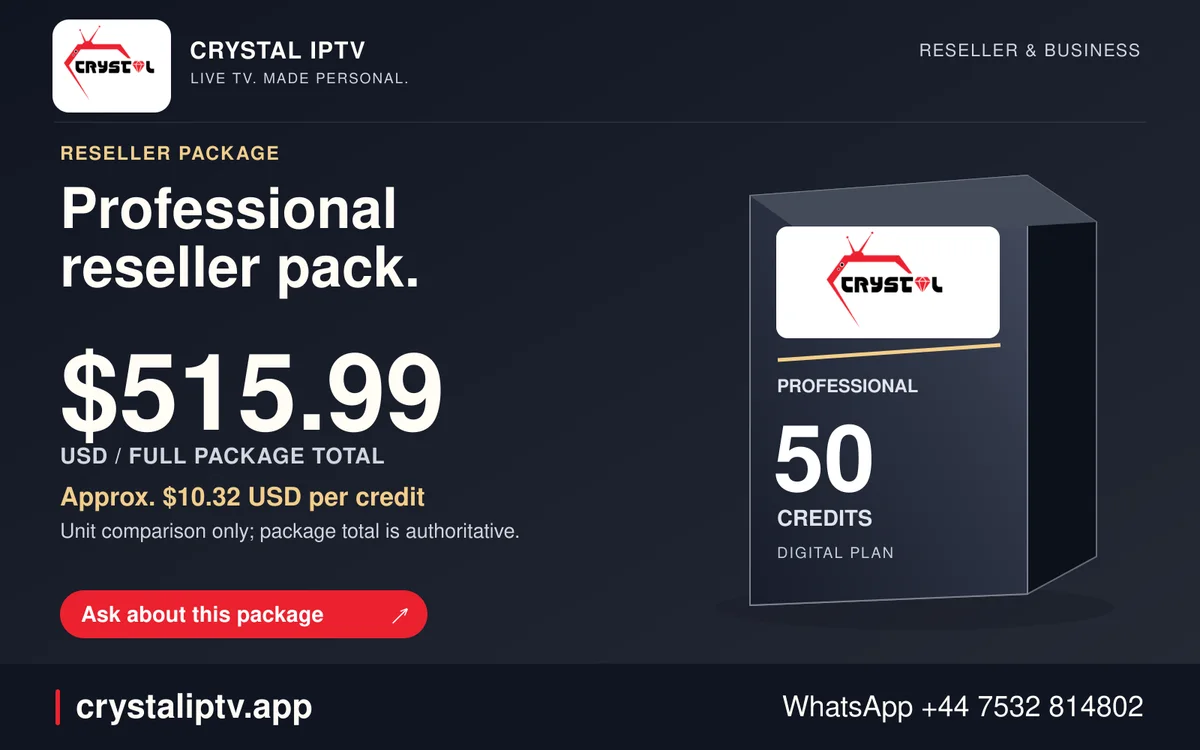
Pack size, credit debit and usable stock
The pack list shows quantities and amounts in EUR. That does not establish whether one credit buys a month, a year or only part of a term. Ask for an example of the exact debit and card amount for five annual customers before comparing quotes.
Provider material via the public search index. Capacity assumes the published standard credit rule and excludes order-specific fees.
| Listed credits | Pack total | Per credit | Annual capacity |
|---|---|---|---|
| 100 | EUR 199.00 | EUR 1.99 | Term mapping unconfirmed |
| 300 | EUR 499.00 | EUR 1.66 | Term mapping unconfirmed |
| 1,000 | EUR 999.00 | EUR 1.00 | Term mapping unconfirmed |
Before the panel is funded
The source gives 100-, 300- and 1,000-credit packs. It does not clearly establish the usable customer terms behind a nominal credit. A reseller buying five annual customer terms should request the number of credits it will leave available after those activations. Also distinguish an optional branding service from an outright permission to reuse the provider's marks. Keeping that scope in the quote helps identify what the service can actually supply without promising capabilities based on artwork.
Ask who can issue, extend and suspend a customer line. Have the operator show the debit for one new line and one renewal with personal details removed. Keep the opening balance, debit and closing balance together so the number of usable terms can be reconciled.
Crystal IPTV and the €1.01 question
At Crystal’s published prices, two quarterly subscriptions cost just €1.01 less than a full year. The hard part is deciding how much a year of the right language, regional feed and playback setup is worth to the household that will use it.
The reseller ladder has prices and one missing number
The business page names three stock tiers. Starter is EUR 199.00 for 100 credits, Professional EUR 499.00 for 300 and Enterprise EUR 999.00 for 1,000. It describes panel access, account creation and renewal, a credit balance and provider support. It also tells operators to request the current conversion from credit to customer duration. That last point is consequential. A stock unit has a price on the website. A particular customer term still needs a confirmed debit.
Consider a small business with five people asking for a year each. The first question is the debit for the exact annual product. Purely to show why the answer matters, a hypothetical system debiting one credit for a year would use five credits, while a system debiting twelve would use sixty. Both are arithmetically compatible with a seller offering 100 credits. Neither conversion should be attributed to Crystal from its pack totals. Ask for the account type, term, connection count and credit debit together in the quotation.
There is arithmetic the published offers do support. Buying three Starter packs at the displayed rate would cost €597 for 300 credits. Professional costs €98 less for that stock quantity. The switch still requires €300 more than a single Starter purchase. Choose between them using confirmed activations and renewal timing. A customer who might come back in six months cannot pay the supplier invoice today. A larger balance is worth its lower rate only to the extent the business can use it on the agreed terms.
A panel photograph and a customer handover
Crystal’s marketing pages include an image of a business operator at a laptop. The site describes that scene as illustrative. It helps a visitor recognise the business part of the site. It cannot tell a manager which actions the business login may perform, who can see clients or whether an accidental renewal can be reversed. The package card’s listed ability to create and renew customers is a more relevant starting point for that conversation.
Ask for an example handover with private names and credentials removed. Take a household with one service term that expires next month. What does the operator enter for an early renewal? Which screen shows the original end date and where does the new date appear? How much credit is reserved or deducted, and can the same staff member repeat the operation by accident? A demonstration on an equivalent account or a written worked example makes these questions answerable without requiring a public image of a real customer.
If the operator plans to sell in two languages, go a step further. Decide who supplies first-line device help in each language, how the end customer reaches that person and where the issue goes if guide listings differ between regional feeds. Put those answers beside the stock quote in the operating budget. A cheaper pack does little for a business whose staff must translate every installation call or reconstruct the same unrecorded device details. The quality of a handover matters most on the second support call, when another person picks up the case.
What the extra euro actually changes
Buy a quarter at EUR 24.99 and repeat it once at the current price. Six months of service would cost €49.98 that way. An annual purchase is EUR 50.99, just €1.01 more. That comparison makes the year look like an obvious choice until you ask why someone might buy two quarters in the first place. One possibility is a household that wants three months now and freedom to decide later. The second payment would come after three months of evidence about the service. Buying the year asks for the whole commitment today.
The other two prices make the picture clearer. A single month is EUR 11.99 and six months bought together are EUR 39.99. For a viewer who knows they want exactly half a year, the half-year term saves €9.99 against two successive quarters. For someone weighing half a year against a full one, the difference is €11. The €4.25 monthly equivalent shown on the year is a way to compare the price per month. The household still needs €50.99 for the initial purchase.
Think of a specific viewer. A parent wants the evening news from the region they grew up in and occasionally watches a film with the grandchildren. They may give a dozen unrelated channels no weight at all. If the right news edition is missing, another six months of access has little value, however small the difference in price. Crystal’s own pricing page asks buyers to confirm the particular language, event or channel they want. That is a better place to start the conversation than the annual figure.
Write the programme question in the language you watch
A language can mean four different things on a television. It can be the language of the app menus, the speech on a particular channel, a selectable audio track for a film or the subtitles that appear on screen. A service can satisfy one of those requirements and leave the other three open. Put the one that matters to the household into the order enquiry. “Can we watch this programme with its original dialogue and English subtitles on our LG set?” gives the person answering something specific to check.
When regional editions matter, include the exact programme and its place of origin. Picture two viewers in the same house who want different local news bulletins from a broadcaster with one national brand. Seeing that brand in a catalogue tells them very little about which edition plays after the national headlines. Give support the edition name as it appears in the broadcaster’s schedule, its usual starting time and the household’s country. Ask what appears on the proposed account and whether the earlier edition is also available as a replay.
Save the answer with the date. A language promise that referred to one film edition can become an accidental claim about an entire service when repeated in a forum. Share the programme title, episode where relevant, player used and date. If a subtitle option appeared in the menu but showed no text while the programme played, include that observation too. It distinguishes a label in an interface from an accessibility feature somebody could actually use for that programme.
Test the guide against one recognisable evening
Crystal’s FAQ explicitly ties electronic programme guide coverage to the way a channel is mapped and to the player reading it. A good way to test the guide is to choose a scheduled event with a clear start, such as an evening bulletin. Write down the time and region from the broadcaster’s own schedule. At that time, open the feed directly, note what is on screen, then open the programme listing and read the title beside the same channel. These are three observations that can agree or differ in revealing ways.
Suppose the right programme plays on the right feed, but its title appears an hour later in the guide. Check the device’s time zone and whether other listings are shifted by the same amount. If three unrelated entries share the offset, tell support that. If only one local channel is affected, send that precise name. A guide covering many regions can have one incorrect mapping while the rest works. An account renewal is an expensive first response to what might be a single schedule error.
Try the catch-up action separately if catching up is the reason for buying. A listing visible in yesterday’s guide does not establish that a replay has been made available. Look for a particular programme at a stated time after transmission and observe how it opens. A same-day replay says nothing definite about next week or another feed. The useful forum report records how far after broadcast the reader tried, whether the desired language survived into the replay and what the player offered when the entry was selected.
The remote control is part of the buying decision
A player can technically run on a smart TV while being frustrating for the person who has to use it every night. Crystal mentions a range of supported player environments and asks for the exact model and market. Go to the device itself, open its own app store and find the suggested application under its exact name. Write down the publisher and the controls it expects. Two similarly named players can treat the programme guide, favourite channels and subtitle selection quite differently.
For an older family member or anyone who relies on captions, try one evening’s routine from beginning to end. Can they return to a favourite without scrolling through multiple categories? Can they change subtitle size or choose an audio track with the remote they already know? Does the setting persist after the television is turned off? A buyer checking only a brief live picture can miss the one interaction that determines whether the service gets used after the first week.
Ask who supplies any app licence required for that installation. Crystal’s pricing guidance warns that a third-party player can have a separate charge. A €50.99 annual service beside a second payment for the TV app may be perfectly workable, provided the household knows both amounts, who collected them and what each unlocks. Keep the app-store receipt and the service confirmation separately. If a replacement TV uses a different platform, the account and the software may each need a different conversation. Knowing the publisher’s name helps determine where to start.
One household account and the second television
The pricing page describes a single account and asks buyers to confirm its simultaneous connection allowance. That wording leaves a practical question for a kitchen-and-lounge household. Both sets may accept the same account details when used one at a time. The complication appears on Saturday afternoon when one person wants a match and another wants a film. A successful setup in both rooms on Friday evening gives no answer about what happens when both play together.
Describe the pattern to support in plain terms. “We want two televisions to play different programmes at the same time in one home. The lounge uses this player and the kitchen uses that one. What is the full price and permitted connection count for this arrangement?” Ask the seller to write its answer beside the price and term. This avoids drawing a conclusion from phrases like “works on many devices”, which describe compatibility across hardware and tell you very little about concurrent use of the account being quoted.
If the two sets have different jobs, split the test accordingly. The lounge may need the right commentary on sport, while the kitchen needs a particular broadcaster’s subtitles. Each feature belongs to a combination of source, programme and player. A television capable of displaying high resolution can still receive a lower-resolution source. Describe the evidence the device supplies, or simply describe what you saw. A photograph of a TV carrying a 4K badge gives another reader no direct measure of the feed you watched.
Planning a viewing window with Crystal IPTV
A season rarely lasts exactly one, three, six or twelve months. The table finds the least expensive combination of the available terms that covers each viewing window. It allows unused months when a longer order costs less. Equal totals favour fewer purchases, then less unused time. Some combinations require a second purchase. Every example assumes today’s published amounts still apply to that later purchase.
| Viewing window | Months wanted | Orders at the listed rates | Combined bill | Unused months |
|---|---|---|---|---|
| Two months between moves | 2 | 2 × 1-month | EUR 23.98 | 0 |
| A four-month season | 4 | 3-month + 1-month | EUR 36.98 | 0 |
| Five months in a second home | 5 | 6-month | EUR 39.99 | 1 |
| Seven months away at work | 7 | 12-month | EUR 50.99 | 5 |
| An academic year | 9 | 12-month | EUR 50.99 | 3 |
| Twelve continuous months | 12 | 12-month | EUR 50.99 | 0 |
| A year and a three-month extension | 15 | 12-month + 3-month | EUR 75.98 | 0 |
| An eighteen-month stay | 18 | 12-month + 6-month | EUR 90.98 | 0 |
4 months of viewing. On these figures, 3-month + 1-month comes to EUR 36.98. The purchased periods end at the planned finish. Buying separately at the listed one-month amount would total EUR 47.96, a difference of EUR 10.98.
7 months of viewing. On these figures, 12-month comes to EUR 50.99. This buys 12 months of access, leaving 5 unused after the planned finish. Buying separately at the listed one-month amount would total EUR 83.93, a difference of EUR 32.94.
15 months of viewing. On these figures, 12-month + 3-month comes to EUR 75.98. The purchased periods end at the planned finish. Buying separately at the listed one-month amount would total EUR 179.85, a difference of EUR 103.87.
Other panels to put beside this quote
Begin with the unit and the billing currency. A matched customer term is more informative than a match on the printed credit count. The table identifies the smallest listed balance for each candidate so you can see the initial commitment before asking for a full quote.
| Compare this panel | First documented pack | Meaning of one credit |
|---|---|---|
| 4K IPTV | 100 credits · EUR 85.00 | One customer month |
| Hot IPTV | 100 credits · EUR 199.00 | Customer-term debit to confirm |
| IPTV Europe | Request pack terms | Customer-term debit to confirm |
| 4K OTT Pro Max | 60 credits · USD 117.00 | Customer-term debit to confirm |
| 8K IPTV | 120 credits · USD 222.00 | One customer month |
| 8K PRO IPTV | 120 credits · USD 222.00 | One customer month |
| B1G IPTV | 100 credits · USD 99.00 | One customer month |
| Dino IPTV | 60 credits · USD 72.00 | Customer-term debit to confirm |
| Dream 4K IPTV | 60 credits · USD 95.40 | Customer-term debit to confirm |
| Golden OTT | 10 credits · USD 139.00 | One annual-equivalent term |
| Hello Sky IPTV | 250 credits · USD 287.00 | One customer month |
| Lion OTT | 25 credits · USD 249.75 | One annual-equivalent term |
| MegaOTT.app | 25 credits · USD 199.75 | One annual-equivalent term |
| MegaOTT.io | 25 credits · USD 199.75 | One annual-equivalent term |
| Pro Max 4K OTT | 10 credits · USD 228.90 | One annual-equivalent term |
| Sky Glass IPTV | 180 credits · GBP 180.00 | Customer-term debit to confirm |
| Strong 8K IPTV | 120 credits · USD 222.00 | One customer month |
| Team 8K | 60 credits · USD 107.40 | One customer month |
| Trex IPTV | 60 credits · USD 111.00 | One customer month |
| Ultra 8K IPTV | 60 credits · USD 107.40 | One customer month |
| XOTT | 60 credits · USD 107.40 | One customer month |
| 5G Live | Request pack terms | Customer-term debit to confirm |
| IPTV Australia | Request pack terms | Customer-term debit to confirm |
| IPTV Canada | Request pack terms | Customer-term debit to confirm |
| IPTV USA | Request pack terms | Customer-term debit to confirm |
| Rynex Play | Request pack terms | Customer-term debit to confirm |
| Smarter 8K IPTV | Request pack terms | Customer-term debit to confirm |
| StarShare | Request pack terms | Customer-term debit to confirm |
| UKIPTV | Request pack terms | Customer-term debit to confirm |
Three alternatives worth reading in detail
4K IPTV compared with Crystal IPTV
The numbers on 4kiptv.app are unusually usable. Its consumer prices cover a complete term, its reseller credits buy customer-months, and its one-day trial starts with an installed player. Picture quality, extra screens and the handling of a failed activation still need an answer for the particular order.
From a credit balance to an order you can actually buy
The provider’s wholesale page defines one credit as one customer-month. A three-month account uses three, a six-month account uses six and an annual account uses twelve. The smallest advertised block is EUR 85.00 for 100 credits. The middle block supplies 350 for EUR 276.50, and the largest supplies 1,000 for EUR 690.00. Keeping the block size in the sentence matters. An annual activation may consume credits worth €10.20 at the starter rate, but an empty panel cannot be funded with the €10.20 calculation alone.
Consider a new reseller with six confirmed annual customers and four confirmed quarterly ones. The annual accounts need 72 credits and the quarters need 12, for a combined 84. A 100-credit block leaves 16. Those 16 could cover two half-year renewals and four monthly renewals, provided the panel applies the published schedule to those extensions. They cannot cover two more annual customers. The important number after the first batch is the 16 on hand, especially if renewals are due before the next sale settles.
A different pattern produces quite a different result. Twenty-nine annual customers consume 348 credits, leaving two out of a single 350-credit block. At the published rate the allocations total €274.92; the purchase itself still cost €276.50. The two-credit difference is inventory. If policy permits another suitable customer to use it later, its value can be realised then. Until then the reseller has spent the whole invoice. This also illustrates why dividing the full pack cost by one month of retail sales produces an unhelpful impression of profit.
A buyer who needs exactly ten annual activations needs 120 credits. The source offers 100, 350 and 1,000. There is no published 120-credit selection in this schedule. If the seller permits two of the smallest top-ups on the same panel, that route would cost €170 and leave 80 credits. A 350-credit purchase would leave 230, with €276.50 paid. Obtain the actual repeat-purchase and expiry rules before using either scenario to quote a customer. A calculator can price each credit; only the order specifies which balance you will receive.
The first wholesale recharge should answer two separate questions
The reseller page explicitly distinguishes taking payment from applying the credits. Plan a top-up so that those events can be reconciled without customer pressure. Suppose a desk has 17 credits, pays for the 100-credit Starter pack, and is also handling a three-month extension. If the extension goes through before the pack lands, the balance might show 14 before reaching 114. If the pack arrives first, it might show 117 before dropping to 114. The final number is the same. The two transaction references show which action actually occurred first.
This matters if a staff member sees 14 and assumes the purchase has failed, or sees 117 and assumes both operations have finished. Match the amount paid, the nominal pack quantity and the line extension independently. If the support team can locate the funding transaction but the line still has its old expiry, that is now a defined customer-account problem. If the line has the new expiry but the top-up is missing, report an inventory purchase discrepancy. Neither case requires guessing whether the published unit price changed.
For a shop trading across currencies, preserve the original euro amount alongside the local bank debit. A €276.50 Professional order buys the published 350 customer-months. The acquiring bank’s converted total changes the reseller’s real cost in its own books, while the nominal credit quantity should still match the package. A retail sale billed in the shop’s local currency introduces a further exchange-rate decision. Tracking those amounts separately prevents an operator from promising a retail margin based only on a headline of €0.79 per customer-month.
One last distinction is the gap between receiving an enquiry and accepting a binding order. The site’s contact page asks buyers to establish the contracting operator and order conditions in writing and offers no fixed response time. A prospective reseller with a waiting list should therefore confirm the panel has been funded and customers can be provisioned before promising a particular start hour. A household choosing the one-day trial has the parallel concern: the advertised duration becomes useful for that evening only when the seller has confirmed the start and the account actually works on the intended device.
Decide how much unused credit your business can carry
Even when every activation takes the published debit, a lower unit price can create an expensive mismatch with demand. A single 1,000-credit block works out at €0.69 per customer-month. Spending €690 to serve a committed 100 months ties up cash for the other 900. The small pack would have cost €85 for the immediate requirement. A new operator deciding between those two figures should know what they expect to do with the difference and how long the balance is allowed to sit.
The economics change for a busy desk that already has renewal dates. Suppose 48 half-year renewals and 15 quarterly renewals are genuinely due in the next billing window. That is 288 plus 45, or 333 credits. One 350-credit block would leave 17. A pile of enquiries is weaker evidence than an expiry list with customers who have actually accepted an extension. Keep the two groups separate. Taking payment for a long personal term also brings the responsibility for support over the whole period, however quickly the corresponding panel debit posts.
At purchase, record the balance before the top-up, the package ordered, the amount paid, the payment reference and the total credited. At activation, add the line reference, period and balance change. When the first total moves but the second one does not, the provider can investigate the top-up. When an existing balance decreases but a line stays inactive, the provider can examine that individual activation. Both cases can look like “my panel is broken” to a customer. They need different evidence and often a different answer.
A particular risk is retrying a slow operation while a household waits on the phone. Verify whether a new expiry or line reference already exists before submitting another paid action. If the balance moved twice, send support the two references and ask how the duplicate will be treated. The public pack figures do not settle reversal, cash refund or inventory-expiry policy. Those are part of a resale order, especially where the operator plans to carry several hundred unallocated months across a season.
Hot IPTV compared with Crystal IPTV
A television subscription, a player licence and a balance of reseller credits can all surface in the same enquiry. The first move is to identify which one you are paying for. That distinction shapes the cost, the support conversation and the refund terms.
Compare a 300-credit quote with the household budget
A local business could easily encounter a domestic customer ready to pay in dollars and a supplier asking euros for stock. Start with the commercial records in their own currencies. List the full euro price of the stock pack, the business account’s billed amount if a conversion occurs, and any separate transaction cost. On the sales side, record the agreed customer payment in the money actually received. A figure converted for a spreadsheet is a calculation. Keep the original amount beside it so the result can be followed later.
Take the €499 pack. If the business expects to use only 180 of the 300 credits during its first selling season, it will still have paid €499 and will hold 120 units after those deductions, provided the balance carries forward under the agreed rules. Some money is sitting in inventory. Dividing the supplier invoice only by the 180 credits already used gives a different figure from the pack’s printed unit price. Both figures can answer a legitimate question, but one describes cash paid per unit used so far and the other the purchase rate for all stock.
A second calculation needs a term conversion. Suppose those 180 credits relate to twelve-month customers. Without knowing the seller’s debit per standard annual order it is impossible to say how many households the business has served. Ask for that conversion while discussing a 300-credit quotation. Then ask which customer service, region and connection count the example assumes. Only after those details are agreed does it make sense to put a customer price beside a supplier cost and consider whether the business has allowed enough for support.
The euro menu is a purchase of stock
The reseller page lists €199 for 100 credits, €499 for 300 and €999 for 1,000. These are business allocations. A residential annual subscription is separately priced in US dollars. When comparing invoices, preserve each currency as written. Mixing the annual household sticker into a calculation in euros would silently introduce an exchange rate as well as an assumption about what the reseller can charge.
The useful calculation from the stock page is the price of a displayed credit. The first pack works out to €1.99 a unit. The middle pack is about €1.66 a unit. The largest is just under €1 before rounding. Three small packs would cost €597 for 300 credits at the displayed prices. The middle pack lowers that outlay by €98 for a buyer who needs all three hundred. A buyer with a modest waiting list pays €300 extra up front by moving from the smallest to the middle allocation.
One number remains essential for anyone promising an activation. How many credits does this seller debit for the exact service and term being offered? The public reseller and terms pages leave that detail for confirmation. They also leave material questions about credit expiry, transfer and operator permissions. Dividing €199 by 100 tells you precisely what one ledger unit costs. To work out the stock needed for ten renewal orders, you also need to know how many of those units the panel takes at each renewal. A seller can settle that with a current written debit schedule or a worked, redacted example.
Put one real renewal through the quotation
A shopkeeper considering this stock could request a quotation for one narrowly defined case. The customer has one household connection, an existing service ending on a known date and wants another six months. Ask the seller for the exact debit, the date from which the extension runs and what the customer sees afterwards. Ask whether any separate player fee falls due in the same period. An answer stated in credits and dates can go into an order book. “It includes panel access” leaves the customer’s renewal price unresolved.
Then change one fact. The same customer renews a week early. Does the added term start after the existing expiry or when the operator activates it? If the operator selects the wrong duration, who can reverse it, and is the credit restored? If two staff members handle the request, where can the second see the first action? These are questions about a real account lifecycle. A product photograph or a row of attractive service cards cannot demonstrate a permission held by the business login on offer.
Treat answers as part of the commercial quotation. Record the currency, stock quantity, customer duration, debit and the level of support the seller has agreed to supply. Where customer sales are planned, obtain the applicable commercial permission and regional terms in writing. An operator can then decide how many months of stock to hold and what information can honestly go on a customer bill. Until the arithmetic and authority are clear, a calculation that ends in a monthly earnings figure has skipped the expensive part.
Start with the name on the receipt
Imagine switching on the television after a few weeks away. The HotPlayer icon is still there. A payment message appears before you reach a channel. It would be easy to buy another month of Hot IPTV to get past that screen. First read who is asking. The company that supplies a television account and the publisher that unlocks a player can each have a billing relationship with you. One can expire while the other is current. A perfectly valid subscription offers little help with a prompt that belongs to an app’s licence screen.
Hot IPTV’s own FAQ makes this distinction. It treats the subscription as access supplied by the seller and HotPlayer as software that can be subject to its own activation. The site also has a reseller desk for people buying stock. The household pricing page displays US dollars. The business stock page displays euros. Those details make it possible to give an otherwise vague support enquiry an address. A player-store receipt goes with an app question. The order conversation and payment reference go with an account question. An allocation recorded against a reseller balance belongs with the business order.
For someone helping a parent set up a television, keep two lines in the household’s records. On the first, note the service term, order reference and contact that confirmed it. On the second, note the app name exactly as it appears in the store and the account that bought its licence, if applicable. Keep login details private. When the television next asks for money, read the wording alongside those records. That takes much less time than trying to recover a year-old chat by remembering what the logo looked like.
IPTV Europe compared with Crystal IPTV
A euro price travels easily between browser tabs. The viewing country, television store, language track and business territory do not follow it automatically.
A panel quote for a business with customers in two countries
Imagine an installer serving customers in France and Belgium. Before negotiating a bigger balance, choose two representative jobs. The first is a single television renewal in France with no equipment change. The second is a new Belgian customer who needs help setting up a compatible app. Ask for the customer term, debit and included support on both. Include the language in which the customer will receive the setup instructions. An installer quoting both jobs at the same retail figure may need very different amounts of staff time to complete them.
The European reseller page invites enquiries for quantities including 60, 120, 300 and 600 credits. A 60-credit proposal would support five annual accounts under a hypothetical twelve-credit annual debit, or sixty under a one-credit annual debit. Neither conversion follows from the enquiry form. A written example with an opening balance, activation and closing balance is enough to settle the unit. Repeat for an early renewal and a failed issue before working out what to charge. A cheap nominal unit may still produce an expensive completed sale.
Territory can change the business decision independently of unit cost. Ask who may advertise in each country, in which languages brand material may be used, who issues invoices and who handles the customer's first contact when a programme disappears. Where a distributor will appoint another reseller, get the rights and responsibilities of that second business in the agreement too. A screenshot of an administrative panel can show that a menu exists. It leaves the authority to grant customer accounts and represent a supplier entirely open.
An invoice that has to make sense in two countries
A shop purchasing stock in euros may still present customer bills in another currency. The retailer needs the supplier's quoted currency, pack amount, number of credits, period for which the quote is valid and any separate charges. The customer needs the final amount they will actually pay, the activation date and what the store agrees to support. Record those two transactions separately. If a future order costs more in the shop's operating currency, it should be possible to tell whether the cause was an exchange difference, a new supplier quote or a change in the service sold.
Ask who will issue the supplier invoice and which business details will appear on it. If a VAT amount or other tax treatment matters to the business, request an invoice for the stated purchasing country and take any accounting question to the person who prepares its accounts. A euro sign on a public page does not answer an individual business's tax question. The site also distinguishes reseller, wholesale and distributor enquiries. The name on the form should match the activity in the agreement, particularly if a shop intends to appoint other sellers.
A regional installer can make one example durable enough to use twice. Write an anonymous job description with the customer country, device, term and support language. Obtain the quote, then repeat with the same information at renewal. Comparing those two written orders can reveal a higher debit, a changed renewal process or support that now has to go through a distributor. Merely comparing the website's headline household price would miss all three. Keep the quoted unit and remaining balance in the file so another employee can understand what changed.
A distributor needs a territory in writing
IPTV Europe's business pages distinguish distributing, wholesaling and reselling. A shop creating customer lines needs a usable balance and a panel role. A distributor offering a service through other shops needs an agreement about territory, branding, escalation and the businesses it can supply. A reseller form with a field for a country cannot grant those rights on its own. The distributor page specifically invites a proposal describing the intended relationship.
For a practical first enquiry, name two towns or countries where you actually expect to sell and say which activities you want permission to undertake. For example, issuing renewals through a local shop and authorising another shop to do the same are different responsibilities. Ask who signs the agreement and who resolves an account dispute. A lower nominal credit price is of little value if the business has no agreement covering its intended customers.
Start with an address and a programme
A household in Brussels might have French and Dutch speakers sharing a television. A family in Dublin might care most about a particular Irish evening bulletin. Both households can read the euro prices on IPTV Europe's homepage. They are unlikely to arrive at the same shortlist. Name the country where the account will be used, the programme that matters and the language or edition you expect. Only then can a provider's answer be tested against a particular need.
The current site quotes EUR 8.99, EUR 21.99, EUR 35.99 and EUR 49.99 for its four personal terms. An older indexed pricing page gives a materially higher sequence. Comparing the annual price from one generation with the advertised connection count from another creates an offer the seller may never have made. Use the current full-term total as the basis for a written enquiry, and have the connection allowance confirmed for the same order.
What the extra half year actually costs
At today's recorded figures the twelve-month charge is EUR 14 more than the six-month charge. A person expecting to move country after six months might see that as inexpensive insurance against wanting more time. It buys no documented right to carry an account across that move. The question for that person is whether the same plan can be used at both addresses, under what conditions and with which catalogue. If the answer is unclear, an attractive marginal cost cannot settle the decision.
For somebody who will stay at the same address and use the same television, the six-month comparison is more practical. Two six-month terms at the observed price would total EUR 71.98. The annual card is EUR 49.99. A buyer who is confident about twelve months of actual use can see the cash difference. An occasional viewer can instead price the two periods in which they actually watch. There is little point comparing a continuous annual account with twelve single months if most of those months would never be purchased.