


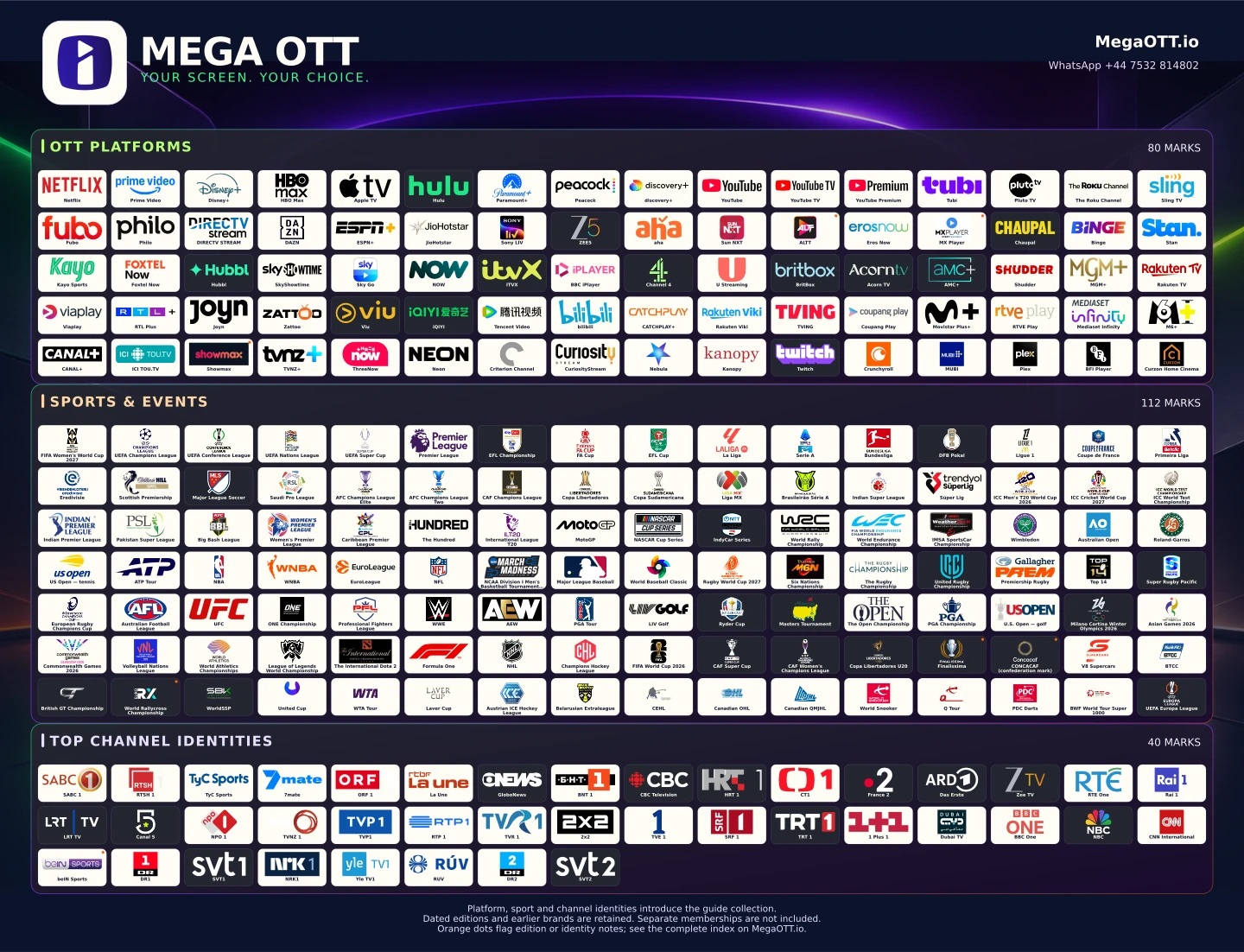

MegaOTT.io wins on listed price
The listed total for one month is USD 1.00 lower in the same currency and billing term.
Lower published charge for a 1-month first commitment when both offers fit the same device and location.
Includes indexed provider terms. Fees, renewal, availability and service performance are outside this price verdict.
| Criterion | B1G IPTV | MegaOTT.io |
|---|---|---|
| Published package total | USD 7.99 | USD 6.99 |
| Relative price score, out of 5 | 4.37 | 5.00 |
| Weight of the full price category | 25% · initial price only | 25% · initial price only |
For a different setup, compare B1G IPTV on its published terms and confirm the required features.

Subscription terms side by side
| Term or condition | B1G IPTV | MegaOTT.io |
|---|---|---|
| 1 month | USD 7.99 | USD 6.99 |
| 3 months | USD 19.99 | USD 16.99 |
| 6 months | USD 34.99 | USD 29.99 |
| 12 months | USD 44.99 | USD 44.99 |
| Connections | The pricing table lists one connection on each term. | The /4k/ pricing source describes one simultaneous connection for a standard plan. |
| Market or listing | USD listing | USD listing |
Buying scenarios
For a first-month purchase
B1G IPTV lists USD 7.99 for the first month and MegaOTT.io lists USD 6.99. That is the price row to use when you are setting up a new television or player and expect only to test the first term. Ask each seller which party supplies the viewing account and what happens if that device cannot activate it.
Match the customer inventory
The strongest like-for-like reseller comparison covers 100 complete twelve-month customer terms. B1G IPTV lists USD 948.00 for the qualifying pack and MegaOTT.io lists USD 699.00. Confirm how panel access, fees and customer support are assigned on those orders.
Which offer fits your situation?
B1G IPTV
At USD 44.99 for twelve months on the indexed plan table, B1G shares a headline price with some competing providers. Its first month is USD 7.99. If the annual prices tie, that shorter commitment can help a buyer who needs a month to evaluate activation and regularly used viewing slots.
MegaOTT.io
The /4k/ comparison page lists a USD 6.99 full month and USD 44.99 for twelve months, with a compatibility trial described on the site. Check which checkout and cancellation terms apply to the .io domain if you have previously used the .app site.
Reseller and panel terms
Reseller pack price: MegaOTT.io
The two packs fund the same number of annual customer terms. The lower advertised pack costs USD 249.00 less up front.
Lowest listed pack price for 100 whole one-year standard customer terms, for an eligible reseller.
Includes indexed provider terms. Fees, renewal, availability and service performance are outside this price verdict.
| Criterion | B1G IPTV | MegaOTT.io |
|---|---|---|
| Published package total | USD 948.00 | USD 699.00 |
| Relative price score, out of 5 | 3.69 | 5.00 |
| Weight of the full price category | 25% · initial price only | 25% · initial price only |
For a different setup, compare B1G IPTV on its published terms and confirm the required features.
B1G IPTV
A pack of 100 customer-month credits covers eight annual customers with four credits left. That remainder is useful only if it can fund shorter terms or carry into another order. For an exact 60-credit comparison, the B1G entry pack is a different purchase size.
See reseller termsMegaOTT.io
The /4k/ schedule lists 0.1, 0.3, 0.5 and 1 credit for one, three, six and twelve months respectively. Two six-month issues use one credit at this rate. Similar branding on MegaOTT.app does not establish that accounts or credits can be transferred between the domains.
See reseller termsWhat to verify before buying
- Verify current checkout, service eligibility and cancellation for your purchase.
Confirm the actual seller and written terms before relying on account, support or content claims.
Which term works for your calendar?
For each viewing window, the calculation checks combinations of the published subscription periods. It allows unused months when a longer period costs less and assumes each later purchase can be made at the listed rate. Compare the full order total alongside the number of times you would need to buy again.
| Viewing window | B1G IPTV | MegaOTT.io | Difference in comparable totals |
|---|---|---|---|
| Two months between moves | 2 × 1-month · USD 15.98 | 2 × 1-month · USD 13.98 | USD 2.00 |
| A four-month season | 3-month + 1-month · USD 27.98 | 3-month + 1-month · USD 23.98 | USD 4.00 |
| Five months in a second home | 6-month · USD 34.99 | 6-month · USD 29.99 | USD 5.00 |
| Seven months away at work | 6-month + 1-month · USD 42.98 | 6-month + 1-month · USD 36.98 | USD 6.00 |
| An academic year | 12-month · USD 44.99 | 12-month · USD 44.99 | USD 0.00 |
| Twelve continuous months | 12-month · USD 44.99 | 12-month · USD 44.99 | USD 0.00 |
| A year and a three-month extension | 12-month + 3-month · USD 64.98 | 12-month + 3-month · USD 61.98 | USD 3.00 |
| An eighteen-month stay | 12-month + 6-month · USD 79.98 | 12-month + 6-month · USD 74.98 | USD 5.00 |
Stock for a small reseller
The first question is how much cash the operator has to commit. The second is how much of that first purchase would actually be issued. A quotation for more stock can lower an average rate while increasing the amount sitting unused. This worksheet considers one standard connection for each customer and one continuous year of service.
| First group | B1G IPTV | MegaOTT.io |
|---|---|---|
| 3 annual customers | 100 credits · USD 99.00 · 64 left | 25 credits · USD 199.75 · 22 left |
| 8 annual customers | 100 credits · USD 99.00 · 4 left | 25 credits · USD 199.75 · 17 left |
| 12 annual customers | 500 credits · USD 445.00 · 356 left | 25 credits · USD 199.75 · 13 left |
| 25 annual customers | 500 credits · USD 445.00 · 200 left | 25 credits · USD 199.75 · 0 left |
Each line chooses the least expensive single listed pack large enough for that group. It excludes future recharges, multi-screen additions, taxes and recoverable activation errors. The unused balance is inventory. Its value depends on whether credits carry forward and which shorter renewals you may issue. A quote-only supplier may still suit the group. Its side of the worksheet stays open until there is a usable rate sheet.
B1G IPTV: from the smallest to the largest pack
The entry listed here is 100 credits for USD 99.00. The largest is 1,200 for USD 948.00. Across those endpoints the nominal unit cost falls, from USD 0.99 to USD 0.79 per credit, rounded. Moving between them ties up an additional USD 849.00. Check any different service privileges attached to those tiers before treating that extra cash as a bulk discount.
MegaOTT.io: from the smallest to the largest pack
The entry listed here is 25 credits for USD 199.75. The largest is 100 for USD 699.00. Across those endpoints the nominal unit cost falls, from USD 7.99 to USD 6.99 per credit, rounded. Moving between them ties up an additional USD 499.25. Check any different service privileges attached to those tiers before treating that extra cash as a bulk discount.
b1giptv.ioB1G IPTV buyer’s notes
A polished B1G graphic can be genuine and still quote a pack the provider no longer lists. B1G itself calls out two superseded quantities. That makes its site a good case for comparing artwork, order terms and actual credit movements, whether you are buying an evening's viewing or funding a shop's next batch of renewals.
Read the full provider reviewCheck the number printed on the artwork
B1G's current reseller table lists 100 credits at USD 99.00, 500 at USD 445.00 and 1,200 at USD 948.00. Its own article on the three packages identifies older graphics showing 350 or 1,000 credits. The middle and largest quantities have changed. An image can still have the familiar name, colours and layout after the commercial terms move on. If an image is the only detail somebody sent you, ask for the current order page and the written price for the intended quantity.
It matters which part of the card you read. A pack quantity, a unit price and a pack total answer three different questions. The current 500-credit tier has a published unit price of $0.89. The money needed to buy that pack is $445. Multiplying 350 by the current middle-tier price would produce a plausible-looking number, but it combines a retired quantity with a newer published rate. B1G has an enquiry route for custom quantities. A bespoke 350-credit purchase, if offered, would need its own quote.
When working from a screenshot, take a moment to record where it came from. A photograph attached to a six-month-old forum post is relevant to what that poster may have been offered then. The provider's present order table and the response issued for your own account are better evidence for a purchase now. Archive the old image with its original context. Labelling it with the date and superseded quantity preserves a meaningful account of the change without encouraging the next person to order from it.
Retail plans buy extra time on one connection
B1G's retail terms are USD 7.99, USD 19.99, USD 34.99 and USD 44.99 for one, three, six and twelve months. Each published plan includes one simultaneous connection. That makes the term comparison straightforward for a single viewer. It makes it equally clear where a comparison must stop. A year does not add a second active television under these advertised terms. A family expecting two people to watch separately at the same time needs a price and conditions for that arrangement.
A student wanting two months has a choice between two one-month orders, $15.98 together at the reviewed prices, and a three-month order at $19.99. The extra month costs $4.01 in that particular comparison. Someone certain to leave after eight weeks pays less on the shorter route if the price still applies at renewal. Somebody whose accommodation may be extended has a reason to take the quarter. This is a decision about four dollars and a possible extra month, not the percentage printed on a banner.
For a longer stay, six months cost $5 less than two separate three-month purchases at these figures. Doubling the six-month period to a full year costs an additional $10 when choosing the original term. Ask whether an existing account can be extended at the displayed price and when the extension begins. A customer buying six months today has committed only to that term. A possible later renewal at a price seen now is an assumption and should be marked as such in a budget.
Match the player's operating system before requesting the trial
B1G's FAQ sends people looking for its Android installer to its own app route and support. It also explains that an Android package does not run on an iPhone, Apple TV, Samsung Tizen or LG webOS. A Samsung television with an Android streaming stick plugged into it has two different installation targets. The name on the front of the television is then only half the story. Decide which remote the viewer will pick up and identify which device that remote actually controls.
A support request can describe the television model, the attached device where applicable, its operating system and the app presently visible. An account may be delivered through a username and server, a playlist link or another supported device format. Entering one type into a screen that expects another can look like a service failure. Have support match the player to the account method first. For a public forum photograph, a cropped view of the input field labels is enough. Activation codes and the full server or playlist details belong in private.
The site offers a one-day trial after the player is installed. Spend it on the ordinary tasks that make a television usable. Find the channels you watch by the names you know, compare guide times with your own time zone and look for the spoken language or captions on a programme that matters. If a replay is essential, try an eligible programme that has already ended. B1G describes both guide coverage and catch-up as dependent on the source and player. A decorative channel tile settles neither question.
Decide whether an empty pack really is empty
B1G publishes a simple wholesale rule for standard customer periods. One credit covers one customer-month, so a year uses twelve. The 100-credit starter pack can provide eight complete years and leave four credits. It does not provide eight and a third annual subscriptions that can all be handed to customers. Those four credits might instead fund a quarter and a month, or sit ready for short renewals. Their value to the shop depends on what its customers actually buy next.
A 500-credit pack provides forty-one whole annual allocations and eight credits remain. A 1,200-credit pack divides cleanly into one hundred annual allocations. At the reviewed unit prices annual stock costs work out to $11.88 on the smallest pack, $10.68 on the middle and $9.48 on the largest. Each of those numbers is an allocation from a wholesale balance. The consumer's published twelve-month price is a different transaction. Neither the gap between the two prices nor the number of potential allocations states how much a shop will earn.
A simple way to stay honest is to keep three figures beside each other. Start with the amount actually paid to the supplier. Add the units visible in the account after the purchase. Then record what each completed customer order consumed. Imagine buying a hundred, completing eight annual orders and finding the panel shows only three credits. Under the published single-customer rule the expected balance is four. That one-credit discrepancy is a specific enquiry. The customer list, order references and opening balance give the supplier something it can investigate.
Buy around the next set of renewals
A shop expecting 110 customer-months and holding no credit could cover that demand with two starter packs at $198 at the reviewed prices. That buys 200 credits and leaves ninety available after the expected work. Buying 500 at $445 instead would leave 390 available. The lower unit rate on the bigger pack is real. So is the additional $247 leaving the shop before any of the extra customers have arrived. Write down when those later renewals are likely to happen and ask about expiry of the unused balance.
At exactly 500 customer-months, five starter packs cost $495 compared with $445 for the standard middle pack. The $50 difference is a meaningful comparison if the same role and debit rules apply to both. At 1,200 customer-months, two 500 packs and two starter packs total $1,088. The current 1,200-credit price is $948, a difference of $140. These examples deliberately use complete advertised packages. A quote for an intermediate volume might change the arithmetic and the provider invites such enquiries.
When preparing an order, split certain renewals from likely enquiries. Eight existing customers with paid annual renewals require ninety-six credits. Three households who have only asked whether a trial is available represent possible future volume. Do not add thirty-six credits to confirmed demand solely because those households might take a year. A business may still choose to buy ahead. Recording the difference means it can later tell whether an idle balance came from a deliberate stock decision, a lower renewal rate or an order that was never fulfilled.
Follow one customer's renewal all the way through
B1G instructs existing customers to contact support with their current account reference and chosen period. Its guidance for resellers similarly stresses identifying the account before activating it. This is particularly important when two people have the same first name or a customer has changed their chat number. Look up the original order privately and confirm the intended account and current expiry. A new contact name is a weak replacement for an established customer reference.
Consider a customer with a six-month renewal due. At the published rule, the expected balance change is six credits. Record the starting balance and existing expiry, make the agreed renewal and compare both results with the requested order. A debit can occur even if the customer has not yet opened the confirmation message. Conversely, a receipt showing the customer paid the shop does not show that the service account was extended. A short message confirming which login still works and the new expiry closes the loop.
If the balance moves and the expiry looks unchanged, save the references before trying the operation again. The display might need refreshing, or a different action may have been applied than intended. A second blind attempt could spend another six credits. Ask support to trace the first movement and describe any correction against the original reference. The next person looking at the account should be able to see why a debit and a later adjustment both exist, rather than finding an unexplained difference in the stock balance.
Keep the sales channel and payment route straight
B1G's subscription page describes choosing a term, preparing a WhatsApp request and receiving the payment and activation details from support. It says the site does not collect card details. Selecting the twelve-month card therefore identifies what a customer wants. The seller's confirmation identifies the amount, recipient and account to which it is meant to apply. If a customer is paying an independent shop, ask who will handle a renewal or a billing query later and retain that seller's receipt.
A player may have a licence or renewal of its own. B1G's FAQ separates the cost of the software from service access. If the television suddenly opens a player activation screen, the original subscription may still have time remaining. Check which software is asking for payment, which account or device it names and whether the service expiry has changed. A person who pays the service again before checking may extend the viewing term while leaving the original player prompt on the screen.
Business enquiries need the same precision. B1G advertises panel access, activation, renewal and records with the published packs. It directs wider arrangements to a distributor enquiry. A request to give another shop its own access, establish a territory or change branding therefore needs a written answer specific to that arrangement. A large order may improve the credit price. It tells the purchaser very little about the right to appoint other businesses or the support response that a customer should expect on a weekend.
The annual amount is 44.99 in two different currencies
There is another way an old B1G reference can mislead even a careful reader. The older /4k/ material on the same domain lists an annual plan in euros at €44.99. The current root pricing page gives the annual USD amount as USD 44.99. Cover the currency symbol and the two figures look identical. Neither page supplies an exchange rate or states that a particular order will accept either currency. A display on the same website can represent an older offer under different terms.
The shorter terms expose the difference more clearly. The older /4k/ page shows €6.99, €18.99 and €29.99 for one, three and six months. The root USD prices differ in both currency and amount. When reviewing a prior purchase, preserve the actual page, seller and currency named on the receipt. When requesting a fresh purchase or renewal, ask for the amount and billing currency that apply to that account now. A conversion made later by a buyer's bank belongs in a separate record from the seller's invoice.
The wholesale pages show the same pattern. An older /4k/reseller/ page gives €276.50 for 350 credits and €690 for 1,000. The current root reseller page lists 500 and 1,200 in their place at USD totals. The two sources illuminate why a genuine old product image might survive. They cannot settle what a reseller will pay for precisely 350 credits today, or whether an old EUR balance may be combined with a USD order. Those are appropriate questions for the issuer of the specific panel account.
Imagine an old customer emailing a picture from their previous annual renewal. If the picture shows only the number 44.99, ask for the currency and seller reference privately before updating the customer's record. Then send them the proposed new term, currency and price for approval. A forum reader reporting a change can put the earlier and later currencies in the same sentence. That small detail prevents somebody in a different country from mistaking a change of offer for an increase or decrease of a known amount.
A full top-up can look short after a busy morning
B1G's guidance on reconciling a credit purchase makes a useful point about timing. Two balance screenshots alone can hide several different transactions. Suppose the panel showed 26 credits before a 500-credit top-up. One colleague then renews two annual lines, another six-month line and one quarterly line while the supplier is adding the pack. The four customer actions use thirty-three credits under the standard mapping. With no other activity the closing balance should be 493, an increase of 467 even though the entire 500 may have arrived.
A shop that compares only 26 with 493 could mistakenly report a short delivery. Capture the purchase reference and, separately, the references for the four agreed customer actions. The starting 26 plus the 500 purchased less the 33 consumed explains the final 493. If it shows 492 instead, the remaining question is one credit rather than thirty-four. Identify whether a one-month action, a correction or another transaction occurred in that interval before asking the supplier to trace a missing unit.
The customer side deserves an independent look. If one of those two annual renewals was planned but never submitted, the expected total should be twelve higher. A payment received from the customer proves that the shop has an obligation to fulfil. It does not put a deduction into the provider's records. Likewise a confirmed debit on the wrong customer could balance the stock perfectly while leaving the intended viewer without an extension. Reconcile both the quantity and the intended account expiry before closing the support job.
A public write-up can report the opening balance, pack size, term mix and eventual explanation using fictional customer references or none at all. Keep the actual references with the parties who can trace the operation. This kind of post does more than recommend a particular tier. It gives a small business a way to decide whether a top-up was received in full and whether every customer paid for in the same interval received the agreed service.
Give the forum evidence it can keep current
When posting a price correction, point to the provider page, identify the relevant tier and explain what changed. A reader who sees “the middle pack went from a graphic showing 350 to a live listing of 500” can decide whether an old order is relevant. A bare claim that somebody posted a fake card is both less accurate and less useful. B1G has given a concrete explanation for the two old quantities. Preserve that distinction where the origin of the artwork can be established.
A viewing report gains from the same care. Identify the subscribed term, tested device, app and whether any other stream was active. Record the exact guide entry or programme and the local time where a problem appeared. If another app on the same supported account gave a different result, explain the order in which the tests ran under the one-connection allowance. A single household can tell a credible story about one evening. It cannot verify every region, programme or future season.
A reseller post can add the price actually accepted, the standard or custom quantity and the credit movement on a completed authorised order where the information may be shared. Remove customer identifiers, account balances belonging to somebody else and private links. The next reader mainly needs to know which public claim the transaction tested. A dated, modest piece of evidence can survive a change of artwork because it tells readers exactly when and how the original conclusion applied.
Provider material for this report
- Four retail terms, one connection and how an order is confirmed
- Device compatibility, trial, guide, catch-up and account guidance
- Current reseller packs, credit mapping and partner roles
- Wholesale quantities, custom enquiries and account records
- Provider identifies the superseded 350- and 1,000-credit graphics
- B1G guidance on preparing a specific customer's account
- Older EUR retail listing retained for comparison with the root USD offer
- Older euro-denominated 350- and 1,000-credit offers
- Provider guide to schedule data, eligible replay and local recording
- Matching a stock recharge to concurrent account activity
megaott.ioMegaOTT.io buyer’s notes
A viewer sees a one-month option at USD 6.99. A reseller sees 25 credits at USD 199.75. Both offers sit under the same MegaOTT.io comparison, yet the word “month” does very different work in each. For households the choice concerns the length of a purchase. For partners the way customers divide the year can actually change how much stock they use.
Read the full provider reviewBegin with the .io receipt
MegaOTT is a name a returning buyer may have seen under more than one web address. This review follows the .io site and its /4k/ material. For someone starting afresh, keep the address of the order page together with the seller confirmation and the account reference. For someone renewing, look at the earlier receipt first. Two nearly identical prices say little about which operator can locate or extend an old account.
There is a simple way to phrase the enquiry. Give the seller the earlier order reference privately and ask which account will be extended, what the new end date will be and whether the existing player setup will remain usable. A reply that only repeats the advertised annual amount leaves the account question unanswered. Moving to a newly issued account could mean re-entering details or organising favourites again. Those details can outweigh a small saving, particularly for someone setting up a television for a relative.
The .io site itself uses separate places to describe subscriptions and partner access. A business login is useful only to a partner with the corresponding permissions. A retail customer waiting for a renewal needs the contact responsible for their order. Preserving the original issuer also helps when an app publisher bills for software separately. The company that sells a player upgrade may never have seen the transaction for the viewing account.
When eight weeks are cheaper than three months
MegaOTT.io lists USD 6.99, USD 16.99, USD 29.99 and USD 44.99 for the four standard terms. Its comparison page describes a single supported connection. The published totals are the starting point for one account on a practical one-screen budget. The displayed reference prices and percentage discount do not establish how long the selling price will last. For the buying decision, keep the amount the seller is prepared to charge on the order.
At the November figures, two separate one-month purchases cost USD 13.98 if the opening rate remains available. Someone who needs access for two service months can compare that amount against the three-month total of USD 16.99. An extra USD 3.01 buys a third month and removes the need to arrange a renewal after the first. If the television is being put away after eight weeks, the third month may have little value. If a family visit might extend into the following month, that same difference may be worth paying.
A different pattern appears over a longer period. Two three-month terms cost USD 33.98 at the listed rate, against USD 29.99 for six months in one transaction. Moving from six to twelve months raises the current initial payment by USD 15. A person expecting six months of use can ask whether the extra six will actually be used. Someone certain of a full year can compare USD 44.99 with two six-month purchases totalling USD 59.98. The figures describe a choice at today’s terms. The contract still needs to establish renewal pricing.
Spend the one-day trial on your hardest requirement
MegaOTT.io describes a 24-hour trial requested after installing a suitable player. Give the most demanding requirement its share of that time. For one household this could be searching for a specific regional news edition with the television remote. For another it could be reading subtitles at a comfortable distance, using an audio track in a preferred language or finding yesterday’s programme through an available replay feature. A person who cannot do the thing that matters has little use for a long list of unrelated successes.
A trial starts when the supplier activates it under the agreed conditions. Find out the start and expiry before planning the evening. Prepare the television and normal network ahead of the request. If the service arrives in a player-compatible account format, use it only through the intended private setup. Avoid sharing a playlist address or a screen that shows credentials when asking someone to help. A photograph of the app’s name, version and an error message usually gives a forum contributor a better place to start.
MegaOTT’s published price information describes EPG support as depending on both source and player. When a programme opens correctly but its guide timing looks wrong, write down the exact edition, the player time zone and the time shown on a separate schedule. If another channel in the same region is correct, include that detail. It narrows the enquiry. A service trial can establish what the household saw on that device at that time. It cannot establish the permanent availability of a programme or a live right in every market.
A single connection is a capacity limit
A television, phone and tablet may all appear on a compatibility guide even though a standard purchase covers one simultaneous connection. A person moving from the living room to a tablet can ask what ends the original session and whether device switching is allowed. A family expecting different programmes on both screens at once needs an offer for that concurrent use. Ask for the combined price and permission in writing before using a one-connection figure to compare household plans.
The return visit to an app is worth trying. Some people leave the television at its home screen and assume all playback has stopped. Others turn off the television but leave a streaming device powered. Use the trial arrangement to test the ordinary household routine, within the stated allowance. If support needs to check a session, give the time and the sequence of actions. A clear description of what happened on two devices is more useful than a broad report that multi-device viewing failed.
A potential player fee introduces a separate calendar. Note the provider account issue date, the app developer and any app licence renewal date. If a valid MegaOTT order appears to stop working, the owner can check the account’s entitlement, the software’s own licence and the device’s connection against those notes. Changing all three at once can turn a short support question into a complete setup from scratch.
Twenty-five annual credits can fund very different order books
The .io reseller schedule gives a one-month customer term a debit of 0.1 credit. Three months uses 0.3, six uses 0.5 and twelve uses one. Calling the unit a yearly credit is a convenient reference, but the shorter debits do not all equal the corresponding fraction of a calendar year. Use the line for the actual product the customer will receive.
Take a starter balance of 25. Ten annual customers consume ten credits. Eight six-month customers consume four. Ten three-month customers use three. Twenty monthly customers use two. The complete batch debits nineteen credits and leaves six. On the observed starter unit price of USD 7.99, the credit allocated to the batch is USD 151.81. The amount paid for the whole package remains USD 199.75. The residual six credits have a recorded allocation cost of USD 47.94, subject to their remaining usable under the agreement.
Those numbers give a reseller two budgets to maintain. The first is the payment the business must make before the stock arrives. The second assigns part of that payment to each completed customer term. A line item can consume only USD 0.80 of starter credit after rounding, while a new reseller still needs the entire package to fulfil that first order. Keep the underlying fractions when adding a group. Rounding every allocation too early can leave the bookkeeping a few cents away from the package balance.
What changes when customers prefer shorter terms
On the published schedule, two six-month activations consume exactly one credit. Four three-month activations consume 1.2. Twelve one-month activations also use 1.2. All three examples add up to twelve customer months, yet they make different demands on stock and staff time. A shop that sells flexibility should understand what that flexibility costs before setting its own selling price.
Consider twelve customers who plan to renew quarterly. Their first three-month periods require 3.6 credits in all. If every one of them completes four paid quarters at the same debit, the year consumes 14.4 credits. Twelve annual activations would consume twelve credits immediately. The business should weigh the extra 2.4 credits, the later timing of some allocations and the possibility that people will not renew. Customers who leave after one quarter have bought one quarter. Counting the other three as committed demand would make a larger stock purchase look easier to justify than it is.
The larger pack totals are USD 375.00 and USD 699.00. At the recorded figures, two 25-credit starter packs would cost USD 399.50, against USD 375 for one 50-credit package. The difference is USD 24.50 if the business uses the whole amount. At the 100-credit level, two 50-credit purchases would cost USD 750 against USD 699 for the larger package. A reseller expecting to allocate only 25 credits in the near term has a different problem. It must decide whether a potential later saving is worth funding unused stock now.
Look closely at the dashboard image
MegaOTT.io identifies the dashboard image on its plans comparison as illustrative. Its value is in explaining the kind of work being discussed, such as issuing periods and tracking balances. It supplies no evidence about the exact buttons a particular partner will receive or which actions an employee is authorised to take. The provider describes partner access as subject to approval. Treat approval and the credit quote as separate items until both are confirmed for the intended account.
A better panel question than “Does it manage customers?” is what happens to a renewal entered against the wrong line. Ask whether the change can be reversed, which reference a partner should keep and who has the authority to correct it. Then ask how successful renewals show up to the person providing support the following day. Being able to see the new expiry and the corresponding debit in one record saves time when a customer says a payment went through but the service period did not change.
Keep each reseller balance attached to its actual issuing account. A .io customer considering an unrelated offer carrying similar artwork should not count one balance against the other until transferability is confirmed by the issuer. The same principle applies to delegated staff accounts. If two people can work on the same customer, the business needs a way to identify the completed action before the second person repeats it.
When the replacement box has the same badge as the old one
Mega OTT's device directory places two MAG families beside each other and gives them quite different setup routes. It describes the MAG544 family as Linux receivers and the MAG555 as a Google TV device. For the person replacing a broken receiver, both boxes may have been sold as a MAG. An old photograph of a working portal screen does not establish that the same sequence exists on the replacement. Read the complete model number off the unit before asking the supplier to move the account.
The guide also distinguishes MAG544 and MAG544w3 on wireless connectivity. That difference becomes important when a shop prepares a box on a wired counter and the customer expects to set it up across the house from a router. Record whether the test used a cable and whether the household intends the same arrangement. If the customer can navigate the box but cannot establish its network connection, buying another service term will do little to answer that immediate problem.
At the counter, ask support what account method it will issue for that model and whether an existing account can continue through that route. Wait for the answer before retiring the old setup. A customer may have purchased an annual term through the .io service and still need a different player or an approved device change to use the replacement. Keep the account expiry visible in the order record while the hardware question is resolved, so a working new device cannot be mistaken for an extension of the term.
For a forum post, an image of a model label can be more useful than an attractive image of the box's front. Transcribe the model into the post and crop out serial numbers or device identifiers. State whether you used the provider's documented family guide, whether the buyer received an applicable account route and whether playback actually worked. Another reader can then recognise a useful comparison with their own hardware without assuming that every box from that maker operates the same way.
Why two quotes for twenty-five credits are different orders
MegaOTT.io lists a 25-credit package and Pro Max 4K also publishes a 25-credit option. Both schedules describe a year as one credit. If a shop fills all its orders as six-month periods, the resemblance breaks down. The MegaOTT.io schedule uses 0.5 credit for a half-year, while Pro Max's published table uses 0.6. A ledger of forty such terms would consume twenty credits with the former and twenty-four with the latter. Both shops could honestly tell their customers they sold 240 customer-months.
The balances left behind are different too. At MegaOTT.io, five whole credits from a new pack would remain. Under Pro Max's rule one would remain. If the next customer wants a year, both balances can fulfil it. If a second annual order arrives before the shop replenishes, only the five-credit balance can fulfil that second order under these assumptions. A difference of a tenth of a credit on the original half-year transaction has become an important stock difference by the end of the batch.
The packages also have different purchase totals and commercial conditions. Under the reviewed MegaOTT.io starter rate of $7.99 per credit, the twenty credits consumed in this scenario allocate $159.80 of stock. The remaining five carry $39.95 of the original pack cost. Pro Max sets its own much different unit price on its 25-credit package. Comparing the two for a real customer also requires the supported device, promised connection count, local availability and who will assist with an activation. Cheap unused credit has no practical value to someone whose account cannot be fulfilled under that agreement.
Keep any cross-provider arithmetic beside the source for each individual debit rule. A reader should be able to replace the forty half-year customers with their own order mix and see precisely which total changes. A useful comparison tells the shop what stock it must purchase and what it will have left after committed orders. It leaves the retail price, customer satisfaction and eventual earnings to the actual business and account evidence.
Keep the written cancellation route with the order
The .io refund information directs a buyer to the seller for review and makes the applicable purchase conditions important. It gives no basis for treating the price page as a universal refund promise. Before starting a long term, ask which conditions apply to the exact sale and whether the player fee, if any, belongs to a separate company. A business considering inventory should ask specifically about unused credits. A residential answer is of limited use when the purchase is a partner balance.
If a transaction needs attention, assemble its timeline. Record the order reference, purchase date, account activation date if known and the nature of the issue. Include the response already received from the seller. Keep financial details in the private conversation. A public question might simply ask how other readers distinguished app activation from service expiry on a particular device. A seller’s private staff member can match the actual receipt to the actual account.
MegaOTT.io makes the strongest case where a reader can point to the exact thing being purchased. For a single-screen household, that might be two months of viewing at a manageable total. For a reseller, it might be a book of six-month orders whose combined debit is easy to predict. Once the buyer needs several concurrent screens, portable credits between domains or an assured cancellation outcome, the next piece of evidence must come from whoever will issue that particular order.
Provider material for this report
- MegaOTT.io household offers and partner packages
- Mega OTT connection allowance and full-term pricing
- MegaOTT.io partner credit schedule
- Mega OTT trial, software licence and activation questions
- Mega OTT cancellation and refund enquiries
- Exact-model directory, including MAG544, MAG544w3 and MAG555
- Windows player and external display troubleshooting
- Pro Max term debits for the cross-provider half-year comparison