


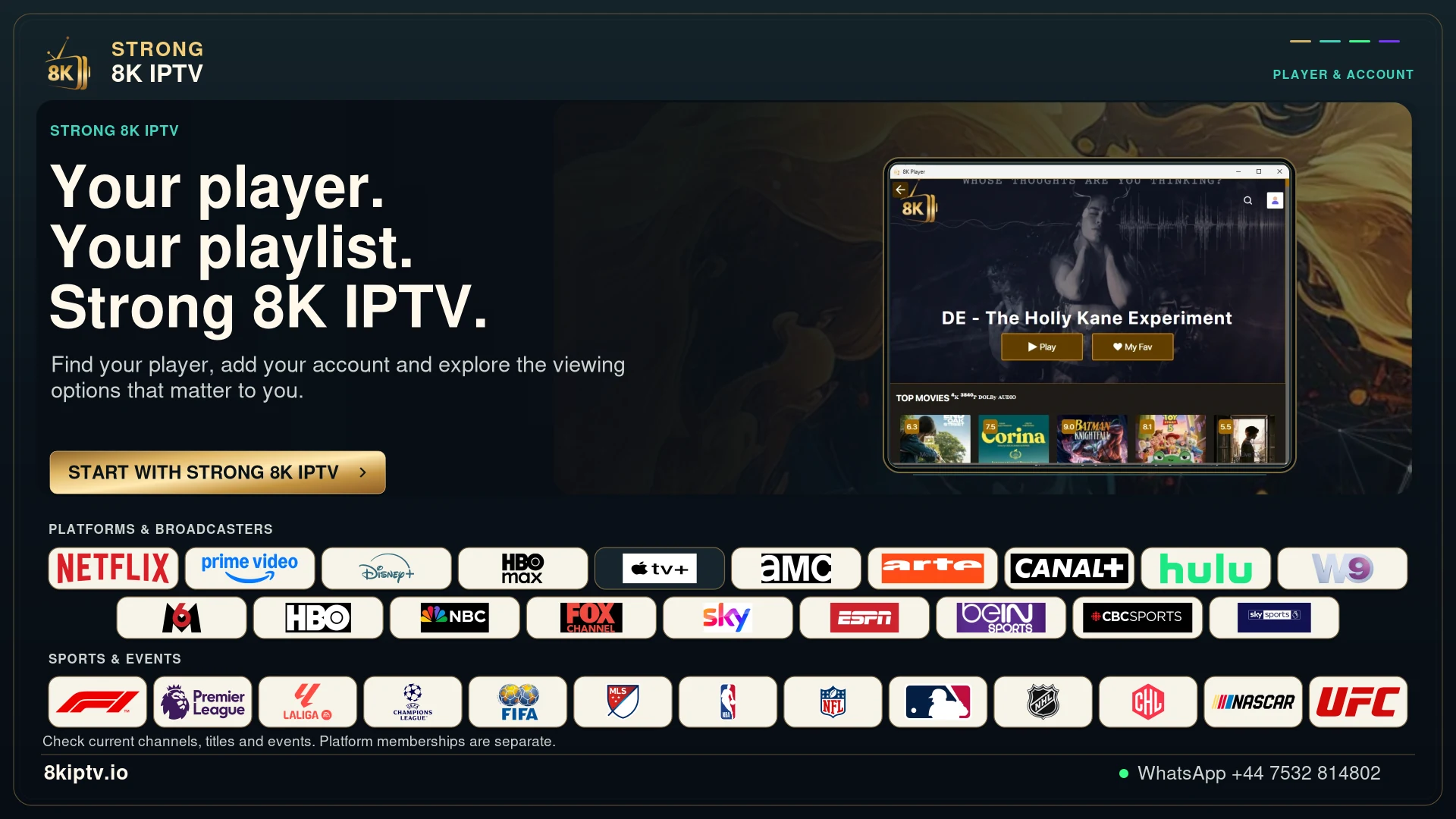

Strong 8K IPTV · Check a quoted regular price
Which published record helps someone check whether a salesperson’s quoted USD 73.32 annual reference price belongs to the Strong 8K promotion?
Strong 8K’s FAQ identifies the regular and discounted annual amounts together. The 8kiptv.app plan card shows the full new-order price for its own subscription.
| What changes | 8K IPTV | Strong 8K IPTV |
|---|---|---|
| Published terms | This exact-domain listing identifies the new 8K IPTV subscription, its complete term cost and a separately licensed player where applicable. | Strong 8K’s FAQ gives both a USD 73.32 regular annual figure and a discounted USD 54.99 figure. It does not promise the regular figure will be the next renewal bill. |
| What the primary source establishes | Dated primary source | Dated primary source |
Read the two named documents against the question at the top of this comparison. The recommendation is tied to the positive statement in each source.
This verifies the reference used in a named promotion. The actual renewal price must be quoted by the issuer. It says nothing about which subscription costs less today.

Subscription terms side by side
| Term or condition | 8K IPTV | Strong 8K IPTV |
|---|---|---|
| 1 month | USD 9.99 | USD 9.99 |
| 3 months | USD 24.99 | USD 24.99 |
| 6 months | USD 39.99 | USD 39.99 |
| 12 months | USD 54.99 | USD 54.99 |
| Connections | The indexed provider listing specifies one active connection. A separately licensed player may add a charge. | Confirm the connection allowance on the selected order. |
| Market or listing | USD listing | USD listing |
Buying scenarios
For a first-month purchase
8K IPTV lists USD 9.99 for the first month and Strong 8K IPTV lists USD 9.99. That is the price row to use when you are setting up a new television or player and expect only to test the first term. Ask each seller which party supplies the viewing account and what happens if that device cannot activate it.
What a reseller quote needs
Send the same number of expected customer renewals and the same intended term to 8K IPTV and Strong 8K IPTV. Ask for the panel currency, the exact debit for one annual line, the smallest pack they can actually sell to your business and any additional access fee.
Which offer fits your situation?
8K IPTV
The published one-month total is USD 9.99. The annual plan is USD 54.99, billed at the beginning of the term. A reader who has yet to test their device can use the shorter term to limit their first payment. The listing describes a one-day trial after installation. Confirm the player and start time with the provider.
Strong 8K IPTV
The pricing source sits at the domain root even though the brand's supplied entry point is /strong/. Compare the short purchase if the player is untested. If you have twelve months of viewing planned, the published annual total is USD 54.99. The site also shows regular prices separately. Ask which total and renewal terms will apply to your actual order.
Reseller and panel terms
8K IPTV
The homepage lists three fixed USD balances. One standard credit funds one customer month. The 120-credit pack can fund ten twelve-month accounts, or a mixture using the same total. A volume wholesale enquiry has separate negotiated terms.
See reseller termsStrong 8K IPTV
The smallest listed pack funds ten complete annual lines at twelve credits each. The largest pack only lowers the credit rate if the reseller can make use of the extra inventory. Ask about expiry and debit for additional connections.
See reseller termsWhat to verify before buying
- The verified published term totals provide no price difference. Obtain a documented difference in connection fit, renewal, cancellation, activation or direct support for the same audience.
- Confirm the lowest purchaser-eligible packs of the same annual capacity and currency, or document a panel capability with equivalent access.
Confirm the actual seller and written terms before relying on account, support or content claims.
Which term works for your calendar?
For each viewing window, the calculation checks combinations of the published subscription periods. It allows unused months when a longer period costs less and assumes each later purchase can be made at the listed rate. Compare the full order total alongside the number of times you would need to buy again.
| Viewing window | 8K IPTV | Strong 8K IPTV | Difference in comparable totals |
|---|---|---|---|
| Two months between moves | 2 × 1-month · USD 19.98 | 2 × 1-month · USD 19.98 | USD 0.00 |
| A four-month season | 3-month + 1-month · USD 34.98 | 3-month + 1-month · USD 34.98 | USD 0.00 |
| Five months in a second home | 6-month · USD 39.99 | 6-month · USD 39.99 | USD 0.00 |
| Seven months away at work | 6-month + 1-month · USD 49.98 | 6-month + 1-month · USD 49.98 | USD 0.00 |
| An academic year | 12-month · USD 54.99 | 12-month · USD 54.99 | USD 0.00 |
| Twelve continuous months | 12-month · USD 54.99 | 12-month · USD 54.99 | USD 0.00 |
| A year and a three-month extension | 12-month + 3-month · USD 79.98 | 12-month + 3-month · USD 79.98 | USD 0.00 |
| An eighteen-month stay | 12-month + 6-month · USD 94.98 | 12-month + 6-month · USD 94.98 | USD 0.00 |
Stock for a small reseller
The first question is how much cash the operator has to commit. The second is how much of that first purchase would actually be issued. A quotation for more stock can lower an average rate while increasing the amount sitting unused. This worksheet considers one standard connection for each customer and one continuous year of service.
| First group | 8K IPTV | Strong 8K IPTV |
|---|---|---|
| 3 annual customers | 120 credits · USD 222.00 · 84 left | 120 credits · USD 222.00 · 84 left |
| 8 annual customers | 120 credits · USD 222.00 · 24 left | 120 credits · USD 222.00 · 24 left |
| 12 annual customers | 240 credits · USD 429.60 · 96 left | 240 credits · USD 429.60 · 96 left |
| 25 annual customers | 1,200 credits · USD 2,028.00 · 900 left | 1,200 credits · USD 2,028.00 · 900 left |
Each line chooses the least expensive single listed pack large enough for that group. It excludes future recharges, multi-screen additions, taxes and recoverable activation errors. The unused balance is inventory. Its value depends on whether credits carry forward and which shorter renewals you may issue. A quote-only supplier may still suit the group. Its side of the worksheet stays open until there is a usable rate sheet.
8K IPTV: from the smallest to the largest pack
The entry listed here is 120 credits for USD 222.00. The largest is 1,200 for USD 2,028.00. Across those endpoints the nominal unit cost falls, from USD 1.85 to USD 1.69 per credit, rounded. Moving between them ties up an additional USD 1,806.00. Check any different service privileges attached to those tiers before treating that extra cash as a bulk discount.
Strong 8K IPTV: from the smallest to the largest pack
The entry listed here is 120 credits for USD 222.00. The largest is 1,200 for USD 2,028.00. Across those endpoints the nominal unit cost falls, from USD 1.85 to USD 1.69 per credit, rounded. Moving between them ties up an additional USD 1,806.00. Check any different service privileges attached to those tiers before treating that extra cash as a bulk discount.
8kiptv.app8K IPTV buyer’s notes
The gold subscription cards on 8kiptv.app settle the price and the number of simultaneous streams. A household still has to choose a player, fit a trial around its viewing and decide who gets the television when two programmes overlap.
Read the full provider reviewStart in the room where someone actually watches
Think of the television that everybody knows how to use. Its remote has a worn button, the inputs have accumulated names over the years, and somebody has favourites arranged in a sensible order. This is the screen on which an 8K IPTV subscription has to earn its place. An impressive demonstration on a recent phone answers very little about opening a programme guide from the sofa with that remote. The seller offers a one-day trial by request. It makes sense to spend that day on the screen you care about.
The site describes a particular sequence. Pick the player for your device, install it, then ask for the trial through the provider's WhatsApp contact. Get the model and operating system from the television settings first. Two televisions sold by the same manufacturer can have different software and different stores. If the suggested app is absent, send the model, software version and store country privately and ask for the exact store listing or another supported choice. An app icon with similar colours is a poor basis for handing over an account.
It helps to choose a small job for the evening. For one family it might be finding tomorrow's local news, turning on captions during the bulletin, switching to a second channel and returning. Someone who watches a series after work may care much more about finding the right episode and resuming it the following night. Tell the seller what you want to check when requesting the trial. Ask when the day starts and ends in your time zone. A trial issued shortly before you leave for work is an awkward way to evaluate evening viewing.
The app, the player licence and the account
On its homepage, 8K IPTV distinguishes the service subscription from any licence required by the developer of the player. That can mean two amounts paid to different recipients, with different renewal dates. If the player wants a fee before you can enter account details, check the publisher, the device it covers and whether a trial mode is available. Get the service total separately. The published one-month service price is USD 9.99. Any player fee belongs in a different line of the household budget.
A family replacing an older television also needs to know where the licence lives. Does the player developer recognise a store account, a device registration or a particular installation? Can the same purchaser move it to a replacement set? Those are questions for the app publisher. Whether the viewing account may be moved, and how an old session is released, are questions for the service seller. Save both answers and both receipts if there are two purchases. The next person to change the television should be able to find them without guessing.
The difference shows up in ordinary support conversations. An app that asks to be bought again after a television reset points first to the paid player receipt and its publisher. A player that opens normally but shows an expired viewing account points first to the service activation record. A player that opens with an empty list could involve either side. Read the precise message on the screen and note what you were able to do immediately before it appeared. A description of the stage where it stopped usually gets a more relevant reply than a photograph of the whole room.
Decide who watches at eight o’clock
The standard offer on 8kiptv.app specifies one active connection. Installing a player upstairs and downstairs does not create a second simultaneous stream. A couple who watch a film together fit the advertised connection count. A household with one person watching a live programme in the living room while another wants a different stream in the kitchen has a different requirement, even if they watch together the rest of the week. Ask for the total for that arrangement before comparing year prices.
For a household that only wants to move between rooms, find out what ending the first session looks like on the actual player. Some remotes make it very easy to switch a television to standby without noticing which app is still open. During the trial, use the seller's recommended exit procedure on the first screen, then open the approved player on the second if the trial permits that switch. If it reports an active session, note the exact times and ask whether you missed a sign-out step or the service has a release delay.
The same question is worth asking before leaving home for a few days. A second installation for use away may involve additional rules on devices, networks or region. The advertised connection number alone cannot answer them. Give support a plain description of where and how you want to watch, and keep the reply with the order confirmation. A buyer who needs viewing in two locations at once should ask explicitly about simultaneous use in those locations. A reply that says the app can be installed in both places covers only part of that request.
Buy the months you can put on a calendar
8K IPTV publishes full-term bills of USD 9.99, USD 24.99, USD 39.99 and USD 54.99 for one, three, six and twelve months respectively. The monthly average on a longer plan can be useful for comparison, but the amount charged up front is the figure that belongs on this month's statement. A household that uses the service only through a particular series or season has a better question than which card has the smallest monthly average. What is the smallest sensible payment for the dates we actually need?
At the November prices, a three-month term plus two individual months came to $44.97. The six-month card cost $39.99. Someone confident of using five consecutive months could therefore spend $4.98 less and have a sixth month available on those published figures. Someone unsure they will get past the first fortnight might still reasonably start with a month. The lower total depends on keeping the service for the period in the example. It says nothing about the value of a future month you may never want.
A seven-month period tells a different story. Six months plus one was $49.98, or $5.01 less than the annual card. Add a second individual month and that combination rose to $59.97, or $4.98 more than the listed year. Anyone weighing these combinations should ask what happens to the original account when another term is bought. The fit is good only if consecutive orders can be applied as intended, the rates still stand and the new purchase covers the calendar dates required. A separate player renewal during that period also belongs in the comparison.
Work out what a reseller pack could issue
The same homepage also publishes a wholesale unit that has an intelligible meaning. Its standard model uses one credit per customer-month. A three-month activation consumes three credits and an annual activation consumes twelve. The listed packs contain 120, 240 or 1,200 credits. Their published up-front totals are USD 222.00, USD 429.60 and USD 2,028.00. The household one-connection subscription and the wholesale balance answer different questions. A reseller still needs the account scope, permissions and any additional charges in the written offer for their account.
Consider eight households ready for a year and eight more ready for a quarter. The first group requires 96 credits and the second group requires 24. All sixteen activations together would consume the smallest pack exactly under the stated standard rules. Only six months of the year have passed when the eight quarterly households have already had two opportunities to renew. A reseller who promises those renewals will need another available balance. The original 120 credits cover the initial orders. Money expected from an extension is a separate entry in the business's accounts.
Someone expecting 180 customer-months has a different choice. One 120-credit purchase covers the earliest commitments while leaving sixty credits to find later. The 240 pack could fund all 180 at once and leave sixty unassigned. At November's prices, buying two small packs would cost $444 against $429.60 for the 240 pack. The $14.40 difference has to be weighed against the extra $207.60 needed to buy the larger pack on day one. Ask when unused credits expire, who can add funds and whether a receipt identifies the panel account credited. These answers determine whether the timing is workable.
When the price page is enough and when a written answer matters
The homepage identifies 8kiptv.app as the website for this particular 8K IPTV offer. Save the precise address, plan title, quoted total and billing currency with any payment confirmation. Several services use similar names in search results. A receipt bearing a different merchant name may have a straightforward explanation. Get the seller's written identification of who takes the money, who issues the login and who can help with a renewal before paying. Familiar artwork and a remembered contact name are poor substitutes six months later.
The provider also invites wholesale and distributor enquiries. Someone who intends to sell subscriptions to households needs a different agreement from someone hoping to appoint other resellers. Ask which role the quoted account contains. Ask whether that role can issue renewals, correct an order or create other accounts, and whether each action carries a debit. For a colleague who will supply customer support, request a demonstration with dummy details and look specifically at which customer records the colleague can see. A screenshot of a dashboard alone leaves those questions open.
A useful forum contribution from a household can be modest. Record the model, store region, player version, dates, term and what happened with one clearly identified task. A useful business review might say that the panel preview showed a three-credit deduction for a standard quarter and identify which written pack sheet the account used. Payment references, activation messages, account URLs and customer names belong in the private support exchange. With those details withheld, the reader still has enough context to understand whether the observation applies to their own screen or order.
A server label in the player is a surprisingly good clue
8K IPTV names 8K VIP+, Fast 8K, Prime and desktop player entries in its setup guidance. Its FAQ also explains something easy to miss in a photograph of the login screen. A label such as Cloud, KSA or one containing VPN may appear inside a supplied player as an account or server selection. Somebody who is already in the right app can waste an evening looking for a second app with the name of an item they were meant to select from a menu.
When you ask for a trial, give the seller the title on the screen and ask which choice in that player belongs to the trial account. If the seller returns an account in three fields while the app shows only one box, describe the mismatch. Are you on the right account-entry screen? Is there a separate choice for a complete playlist address? Sending a cropped picture of the empty fields, with the labels visible, can answer more quickly than sending any actual login values. Once the fields are filled in, the same picture becomes a private document.
Keep the instructions for that exact configuration. A household may want a desktop installation for occasional use and a television installation for every evening. The two players can present the same service in different ways. The provider specifically distinguishes Android packages from native apps on Tizen, webOS, iOS and tvOS. A code that points to an Android package cannot on its own tell a television owner where to find an equivalent in another store. Ask for the published route for the device at hand and check the developer before deciding whether a player fee is applicable.
If the seller later changes a server selection, ask whether the existing subscription, expiry and number of connections carry over. A new label might simply change how the same provisioned account opens. A new paid order is a different proposition. Until the supplier explains what is changing, leave the working configuration alone, keep the original instructions privately and identify the change by the date it was requested. The next family member to help with the television will have a much clearer record.
The platform gallery and the household streaming budget
The provider's homepage includes familiar television and entertainment names alongside its own viewing guides. It also says that memberships from those companies are separate and that specific availability must be confirmed. For a household already paying for one of those memberships, this matters straight away. Seeing its logo in the gallery gives no reason to cancel the external subscription. First identify what you use it for. It might be a particular series, a language track, easy access to the next episode or shared household profiles.
Take a family partway through season three of a series. The useful questions are whether that exact season and episode are available under the offered viewing account in their region, what audio and captions it carries and how they would find the following episode using the television remote. Even a successful trial of that episode answers only those questions on the trial date. It does not establish that the family will receive a publisher account, gain access to the publisher's app or keep the same catalogue next season.
The service's own gallery also distinguishes a device name from a content service that may use similar wording. Apply the same care in a forum review. Someone can say that a programme played through the approved player on a particular streaming box. They should identify the separately billed publisher membership only if that membership was actually part of the experience. Readers trying to budget for two existing subscriptions and one proposed IPTV service need to know exactly which bill they might still have to pay.
A practical trial note can be very short. Write the episode or programme, edition, language options seen, whether playback completed, device and date. If a single feature made the difference for a family, such as the ability to read dialogue from the usual seating position, describe that. A row of logos in a provider comparison cannot convey any of it. An accurately labelled paragraph from one home can.
A large credit pack with a long quiet tail
The 1,200-credit offer looks different once unsold inventory is visible. Imagine a dealer with sixty confirmed annual customers under the standard month-credit model. Those orders require 720 credits. At the November pack prices, three 240-credit packs supplied exactly 720 for $1,288.80. One 1,200-credit pack cost $2,028. The bulk purchase asked for $739.20 more cash immediately and left 480 credits available against future orders. Whether that is worthwhile depends on the next forty annual customers or an equivalent mix of shorter terms.
If only ten more annual customers arrive, the business will issue another 120 credits and still have 360 from the large pack. Under the original 240-pack route it could have purchased a 120 pack later if the prices and terms remained available. Its cumulative payment in that particular sequence would be $1,510.80 for 840 credits. This is a deliberately narrow comparison of stock outlay. It leaves customer payments, support time, taxes, additional account options and the value of unsettled future orders out of the calculation.
On the other hand, a dealer expecting all one hundred annual orders quickly can compare one 1,200 pack with five lots of 240. At the recorded prices the single purchase was $120 cheaper for the same number of standard customer-months. Ask the issuer to confirm the pack expiry, the debit that applies to those orders and whether the dealer's role can supply exactly the promised service. The volume saving belongs to the business only to the extent that it can use the stock in time and under the permissions it bought.
A dealer that does buy a large pack can make the first account its cross-check. Confirm that one authorised annual activation produced a twelve-credit debit, the agreed end date and the expected customer connection. A discrepancy on a single order is far easier to trace while the remaining balance is untouched. Keep the seller’s answer with the pack confirmation before issuing the rest of the batch.
Provider material for this report
8kiptv.ioStrong 8K IPTV buyer’s notes
Strong sells viewing time to a household and customer-months to a reseller. Looking at the two calendars side by side explains why a large discount on paper can still be the wrong purchase.
Read the full provider reviewStart with the months somebody will actually watch
A television in a holiday flat and a television used every evening can look identical on an order form. The arithmetic for Strong 8K changes as soon as you put the dates on a calendar. A household expecting three consecutive months of use can buy the listed quarter for USD 24.99. At the November prices the same three months bought singly would come to $29.97. The quarter saves $4.98. If the flat will be occupied in March, July and December, however, one continuous quarter cannot cover the three visits. Buying three separate months can make the better use of the money even though its price per month looks higher.
The twelve-month listing is USD 54.99. Someone comparing it only with twelve monthly payments will see a considerable difference. The fairer comparison for a viewer reluctant to commit is often two six-month purchases. At the recorded rates those cost $79.98 between them. The difference over a full year is $24.99. At the halfway point the buyer on the six-month plan can still walk away having spent USD 39.99. A household paying the annual charge accepts another $15 at the outset in exchange for six additional months. The two questions are how much use those months will get and whether the account is likely to suit the same equipment by then.
A family replacing its television in three weeks has a good reason to keep the first order small. The person already using the same player and television every night has a different decision. Nothing about a longer term upgrades the source of an individual programme. A price calculation can establish how to buy time cheaply. Only the household can say whether that time will be useful.
A route worth putting on the receipt
Strong’s service pages live under the /strong/ section of 8kiptv.io. A separate pricing document is also available at the domain root. The domain matters more than the numeral in the name. A search for “8K IPTV” can turn up another seller, a TV feature or a player download. A reference to the same phone number in two places would still leave open which account an order will extend. Start with the domain on the original receipt, then use the price page and renewal instructions belonging to that domain.
For a first purchase, a short written confirmation should settle the term, full amount, currency, permitted simultaneous streams and the event that starts the clock. Strong’s terms refer buyers to the checkout or written order for the conditions of that purchase. Keep that confirmation next to the receipt. A screenshot of the public pricing page answers what a visitor could see that day. The order answers what the seller agreed to issue. Both can be useful if a question arises months later.
A returning buyer can supply the existing account reference privately. If an order issues a fresh username when the intention was to extend the old one, favourites and settings can appear to vanish simply because the player is reading a different account. Ask for the expiry associated with the existing reference before confirming renewal. Repeat the check in the player after the extension. It is an inexpensive way to spot an account mismatch while the order conversation is still open.
What moves when you change the screen
Strong publishes a device-change guide because changing the device can involve two separate suppliers. One supplied the service account. A player developer may separately control an app licence, the list of favourites or a device registration. Before resetting the old television, check which player opens successfully and how the account was entered. A server address with separate username and password fields is a different setup from a device-linked portal. Keep any private details in a secure place rather than in a photo shared with the family group.
Make the replacement simple to diagnose. Close playback on the old device and try the new one without starting another stream. If it works then, the subscription itself may already be fine. A later difficulty when both are running is a question about the connection allowance. If the new TV displays a player activation screen before it reaches the service login, read the developer name on that screen. The required action may sit with the player company. A second service purchase would leave the player activation unresolved.
Before giving away the old device, verify the new one opens the right account, shows its expected expiry and can start a programme you recognize. If the old player has a documented way to export favourites, use that while it still opens. Some preferences belong to the device and cannot be reconstructed from the service login alone. Write down any favourite station by edition and language so it can be found again even if the channel order changes.
The three packs start at ten annual customers
Strong’s smallest listed inventory purchase contains 120 credits for USD 222.00. Under the published standard schedule, a credit is a month on one customer account. Ten twelve-month accounts use the entire starter balance. So do forty three-month accounts. Those two businesses would have very different work to do. If all customers renewed at the end of each term, the one selling quarters would handle more renewal conversations for the same number of customer-months. The word “credit” says nothing about the time required to deliver each order.
Consider a reseller with confirmed orders for six annual accounts, four six-month accounts and eight three-month accounts. The three groups consume 72, 24 and 24 customer-months. The total is exactly 120. At the dated starter rate of $1.85 per credit, the wholesale amounts attributable to the groups are $133.20, $44.40 and $44.40. The figures allocate the reseller’s wholesale cost across the three groups. The reseller sets the retail price separately. If one annual order falls through, twelve credits remain on the panel. There is no cash refund in that calculation.
A larger pack changes the economics if enough customers are ready. Two starter packs would cost $444 at the observed prices. One 240-credit purchase is USD 429.60, a difference of $14.40 for the same nominal stock. But the reseller with demand for only 120 credits must advance an extra $207.60 to buy the larger pack. That additional commitment is the number worth weighing against the saving. Ask how long unused stock lasts and whether the supplier has a minimum top-up before treating the second half as money already saved.
Read the enterprise rate against the order book
The 1,200-credit offer is USD 2,028.00. At standard debit it represents one hundred annual customer terms. At the recorded prices it costs $120 less than purchasing five 240-credit packs. That difference matters to someone who has orders approaching that size. It says little to someone hoping to sell the first ten lines. The larger pack collects the benefit of a lower rate only as credits are actually used for customers who pay.
Suppose a reseller bought the enterprise pack, issued sixty annual accounts and had no further orders during the period being evaluated. The accounts would consume 720 credits and leave 480 in stock. Dividing the original cheque by sixty gives $33.80 of cash paid so far per activated customer. The nominal wholesale contribution of each twelve-month line, at $1.69 per credit, is $20.28. Both figures are correct. One describes cash committed relative to current orders. The other allocates cost to the credits used. Keeping both measures helps an owner explain why the balance on screen can look healthy while cash is tight.
A failed activation is another reason to keep a small audit record. Make a note of the opening credit balance, the customer’s requested term, the actual debit and the new expiry. If a line appears not to work, establish whether the balance changed before trying again. A second click can turn a playback question into two customer records. Ask who is allowed to correct the original transaction and keep that conversation private. A forum can help interpret a debit rule without seeing the customer’s username or a usable login link.
One good support question beats a folder of screenshots
Start a service query with the thing that is visible. A channel that plays the wrong regional news is different from a channel that never opens. A guide entry that displays the correct title beside yesterday’s programme is different again. Supply the edition, device, app version and local time. If a second programme on the same account worked at that moment, mention it. That single comparison can spare the next person from taking the whole installation apart.
For a question about renewal, remove the television from the story unless it is relevant. Give the seller the private order reference, requested term and expiry shown before and after the transaction. For a public forum post, omit the reference and share only the pattern another buyer can use. A short account of the billed period and the result is more helpful to readers than a photograph of credentials that must later be removed.
Our reading of Strong comes down to two practical decisions. For a household, match a continuous term to consecutive months of real use and settle the device arrangements before committing. For a reseller, match customer-month inventory to collected orders and keep enough cash for the work that follows activation. The published calendar is quite precise in both cases. The information still worth obtaining in writing is the allowance on the actual line, the renewal terms and what happens to credits if a customer order needs correcting.
Choosing the right soundtrack for a bilingual household
The Strong FAQ makes a distinction that often gets lost when a family asks whether a service comes in its language. The words on a player's menus, the spoken audio sent with a programme and the text available as captions each have their own source. A viewer can have a beautifully translated interface and still hear a bulletin in the wrong language. Another may want to hear the original dialogue and read a translation. Start with a real programme and the combination that the person watching actually wants.
During a trial, a short piece of dialogue is a better test than a studio ident or a football crowd. Let the viewer listen, switch to the alternative audio track if it is available and see if the language actually changes. Try the caption choices separately. One may describe dialogue while another also identifies speakers and sounds. The presence of the desired language on a menu settles the choice of interface. The actions during that one programme settle what the source and player could do together at the time of the test.
Now leave the programme and return using the normal route from the player's home screen. Does the chosen audio remain selected? Does a new programme need its captions enabled again? Someone willing to make two extra choices before a weekly film may find them far more tiresome when moving between news channels every few minutes. A useful account for the forum might explain that the desired language was present, yet the player had to be set again after each channel change. That is much more precise than giving Strong a single rating for language support.
If the trial happens during a quiet afternoon and the programme the family cares about airs on Friday night, the gap should remain visible in the decision. Ask the seller about that feed and edition before paying. Keep its answer separate from material the household saw on the screen. A person weighing the annual card can then see exactly how much of their expected use the trial covered and which part still depends on an answer about future availability.
Getting a renewal through a busy afternoon
Strong's reseller guidance asks the operator to match the customer, approved term and earlier expiry, then reconcile the debit and resulting expiry. Take two households with the same surname where one orders a quarter and the other a year. The requests represent fifteen standard credits between them. A balance falling by fifteen is necessary for the batch to reconcile, but it cannot tell you that the right household received twelve months. Compare the individual account references and new end dates as well as the overall balance.
The distinction matters when someone interrupts the process. Suppose a colleague takes a call just after the first renewal is submitted. When they return to the screen they see a changed balance, but are unsure whether the second account was processed. Look at the individual transaction history and existing end dates before submitting another action. If the role does not have access to a history, send the panel issuer the private order reference and the approximate time. Repeating a renewal just to see whether the screen responds can commit a second set of credits.
At that point the best customer message is a small factual one. Confirm receipt of the request, name the term the household ordered and explain whether the extension has appeared on the existing account. Send the new expiry after it has been verified. A statement that the person paid is meaningful straight away. A statement that the new year is active has to wait until the panel shows the outcome. A business processing a hundred annual customers with the largest pack has a hundred reasons to keep that distinction clear.
Before buying inventory, a new dealer can use this scenario to assess the proposed role. Ask to see how the account selects a line, displays its old end date, previews the debit and records the result. Do it once for an active line and once for an expired one using demonstration details. Someone who will be selling early renewals to regular households cares deeply about when the extra term begins. The quoted price per customer-month is only one part of that service.
A realistic decision when use is seasonal
There is another way to use the holiday-flat example. Assume the occupant expects three one-month visits every year, in spring, summer and winter. At November's prices three separately bought months cost $29.97. Renting the annual term at $54.99 would add $25.02 to the service payment. Some buyers might happily spend that extra amount to avoid reactivation on each arrival. Others would prefer to save the money and accept that they need an order confirmation before every visit. Both decisions make sense once the convenience has an actual price.
Four separate one-month visits came to $39.96. That is very close to the listed $39.99 six-month price, yet the two choices cover quite different dates. If three visits lie inside one continuous six-month period and the fourth is in December, the six-month plan alone still misses one. Put the visits in calendar order, mark which are adjacent and price only combinations that cover the dates. For this household, comparing the standard average per month can obscure the real cost more than it helps.
One small wrinkle comes from setup. A player licence may run on its own calendar even when service time is purchased intermittently. Before treating three visits as the entire cost, ask whether the approved player needs a renewal and whether that renewal is per device. Put that charge on the dates when the developer actually bills it. The result will be a sensible household budget even if the owner changes the number of visits next year.
An occasional viewer can also make the one-month price of USD 9.99 work as a cost ceiling for a visit with uncertain dates. A guest staying for three weeks may find that easier to budget than buying a quarter and hoping for another trip before it runs out. If the service is renewed each time the guest returns, keep one working account reference and confirm whether an expired line can be reactivated. Continuity may help preserve player settings, though the seller and app developer each need to confirm the part they control.
Write the expiry date on the house information sheet beside the player name. A guest arriving a week later can then distinguish an expired service from a broken television without needing access to the owner's order history or private messages. That is a modest benefit, but a tangible one for a screen used only on occasional visits.
Provider material for this report
- Strong 8K service entry
- Strong’s subscription terms and pricing
- Activation and order processing
- Changing the viewing device
- Programme-guide help
- Reseller deductions and renewals
- Renewing the existing account
- Strong service and order terms
- Strong 8K answers about player settings, audio and subscriptions
- Strong account-by-account renewal reconciliation guidance