



4K OTT Pro Max · Lower published pack entry price
What is the smallest quoted payment that buys any listed reseller pack from either seller?
4K OTT Pro Max has the lower advertised opening payment by USD 105.00. The published pack sizes are 60 and 120 credits.
| What changes | 4K OTT Pro Max | Strong 8K IPTV |
|---|---|---|
| Published terms | 60 nominal credits for USD 117.00. | 120 nominal credits for USD 222.00. |
| Least cash to buy a listed pack | 117.00 | 222.00 |
Select the least expensive published pack for each provider and keep its nominal quantity beside the price. This is a comparison of initial cash required to buy a listed package.
Nominal credits, line capacity and panel permissions can differ. This comparison cannot tell you which provider has the lower cost per customer. Ask about fees, expiry and access before purchasing.

Subscription terms side by side
| Term or condition | 4K OTT Pro Max | Strong 8K IPTV |
|---|---|---|
| 1 month | USD 9.99 | USD 9.99 |
| 3 months | USD 24.99 | USD 24.99 |
| 6 months | USD 39.99 | USD 39.99 |
| 12 months | USD 54.99 | USD 54.99 |
| Connections | Confirm the number of active connections before ordering. | Confirm the connection allowance on the selected order. |
| Market or listing | USD listing | USD listing |
Buying scenarios
For a first-month purchase
4K OTT Pro Max lists USD 9.99 for the first month and Strong 8K IPTV lists USD 9.99. That is the price row to use when you are setting up a new television or player and expect only to test the first term. Ask each seller which party supplies the viewing account and what happens if that device cannot activate it.
What a reseller quote needs
Send the same number of expected customer renewals and the same intended term to 4K OTT Pro Max and Strong 8K IPTV. Ask for the panel currency, the exact debit for one annual line, the smallest pack they can actually sell to your business and any additional access fee.
Which offer fits your situation?
4K OTT Pro Max
The FAQ lists the same initial household charges as the Pro Max 4K OTT .tv FAQ, but each domain keeps its own review. Before paying, confirm the exact domain that issues the login and the actual seller responsible for ongoing support.
Strong 8K IPTV
The pricing source sits at the domain root even though the brand's supplied entry point is /strong/. Compare the short purchase if the player is untested. If you have twelve months of viewing planned, the published annual total is USD 54.99. The site also shows regular prices separately. Ask which total and renewal terms will apply to your actual order.
Reseller and panel terms
4K OTT Pro Max
This domain lists nominal packs from 60 to 600 credits. Its unit rates are much lower than the .tv site's displayed annual-credit rates, which makes a unit check particularly important. Treat a quoted 60-credit amount as an inventory price until the account confirms the debit.
See reseller termsStrong 8K IPTV
The smallest listed pack funds ten complete annual lines at twelve credits each. The largest pack only lowers the credit rate if the reseller can make use of the extra inventory. Ask about expiry and debit for additional connections.
See reseller termsWhat to verify before buying
- The verified published term totals provide no price difference. Obtain a documented difference in connection fit, renewal, cancellation, activation or direct support for the same audience.
- Obtain a current reseller pack quote with usable credit quantity, term mapping and panel eligibility for both sellers.
Confirm the actual seller and written terms before relying on account, support or content claims.
Which term works for your calendar?
For each viewing window, the calculation checks combinations of the published subscription periods. It allows unused months when a longer period costs less and assumes each later purchase can be made at the listed rate. Compare the full order total alongside the number of times you would need to buy again.
| Viewing window | 4K OTT Pro Max | Strong 8K IPTV | Difference in comparable totals |
|---|---|---|---|
| Two months between moves | 2 × 1-month · USD 19.98 | 2 × 1-month · USD 19.98 | USD 0.00 |
| A four-month season | 3-month + 1-month · USD 34.98 | 3-month + 1-month · USD 34.98 | USD 0.00 |
| Five months in a second home | 6-month · USD 39.99 | 6-month · USD 39.99 | USD 0.00 |
| Seven months away at work | 6-month + 1-month · USD 49.98 | 6-month + 1-month · USD 49.98 | USD 0.00 |
| An academic year | 12-month · USD 54.99 | 12-month · USD 54.99 | USD 0.00 |
| Twelve continuous months | 12-month · USD 54.99 | 12-month · USD 54.99 | USD 0.00 |
| A year and a three-month extension | 12-month + 3-month · USD 79.98 | 12-month + 3-month · USD 79.98 | USD 0.00 |
| An eighteen-month stay | 12-month + 6-month · USD 94.98 | 12-month + 6-month · USD 94.98 | USD 0.00 |
Stock for a small reseller
The first question is how much cash the operator has to commit. The second is how much of that first purchase would actually be issued. A quotation for more stock can lower an average rate while increasing the amount sitting unused. This worksheet considers one standard connection for each customer and one continuous year of service.
| First group | 4K OTT Pro Max | Strong 8K IPTV |
|---|---|---|
| 3 annual customers | Pack total listed; annual debit unconfirmed | 120 credits · USD 222.00 · 84 left |
| 8 annual customers | Pack total listed; annual debit unconfirmed | 120 credits · USD 222.00 · 24 left |
| 12 annual customers | Pack total listed; annual debit unconfirmed | 240 credits · USD 429.60 · 96 left |
| 25 annual customers | Pack total listed; annual debit unconfirmed | 1,200 credits · USD 2,028.00 · 900 left |
Each line chooses the least expensive single listed pack large enough for that group. It excludes future recharges, multi-screen additions, taxes and recoverable activation errors. The unused balance is inventory. Its value depends on whether credits carry forward and which shorter renewals you may issue. A quote-only supplier may still suit the group. Its side of the worksheet stays open until there is a usable rate sheet.
4K OTT Pro Max: from the smallest to the largest pack
The entry listed here is 60 credits for USD 117.00. The largest is 600 for USD 1,050.00. Across those endpoints the nominal unit cost falls, from USD 1.95 to USD 1.75 per credit, rounded. Moving between them ties up an additional USD 933.00. Check any different service privileges attached to those tiers before treating that extra cash as a bulk discount.
Strong 8K IPTV: from the smallest to the largest pack
The entry listed here is 120 credits for USD 222.00. The largest is 1,200 for USD 2,028.00. Across those endpoints the nominal unit cost falls, from USD 1.85 to USD 1.69 per credit, rounded. Moving between them ties up an additional USD 1,806.00. Check any different service privileges attached to those tiers before treating that extra cash as a bulk discount.
4kott.app4K OTT Pro Max buyer’s notes
The seller publishes an Android player file, a four-term subscription menu and a separate reseller credit table. A TV owner needs only one compatible route to playback. An operator needs a confirmed unit cost for the service being sold. The same logo appears on both journeys.
Read the full provider reviewRead the address before reading the offer
“Pro Max” and “4K” are easy words to remember after an evening spent looking at televisions. They are poor details to rely on when finding a subscription seller again. This review covers the offers on 4kott.app, which calls its service 4K OTT Pro Max and names a player Promax Android IBO Player Edition. If a payment enquiry or renewal leads to a different domain, return to the confirmation from the original order. Ask which seller supplied the account and which service the new payment will extend.
The distinction is especially important on this forum because a separate listing uses the similar name Promax 4K. Similar term lengths or dollar totals give a reader no reliable way to decide which contract an existing login belongs to. Keep the original service URL with the private purchase reference. Retain the chosen player name separately. When asking for help in public, identify the domain and service title. That is usually sufficient for another reader to find the right product without needing access to the payment record.
A single household might therefore have three useful identifiers. One belongs to the service seller, another to the player software and another to the television or box doing the playing. “4K Pro stopped working” gives support few clues. “The Android player from the 4kott.app downloads page opens on my box, but the subscription end date did not change after renewal” points to a concrete account question. It also avoids a needless detour through similarly named applications.
Separate a source label from a picture on the screen
The 4K in the service name does not settle the resolution of a programme. The provider says available quality depends on the source, device, codec, player and network. In a normal living room there can be an extra point of confusion. The box may be set to output a high-resolution picture to the television even when the particular source it receives is lower resolution. The display can report that it is accepting a high-resolution signal while the programme contains much less original detail.
Give an important programme a fair, practical check. Choose an authorised source you want to watch on the final television. If the player supplies playback information, note what it actually reports for the selected item. Observe a high-motion scene as well as a still picture. A sharp menu or a clear film poster is relatively undemanding. A match, a ticker or a moving camera can reveal a different experience. Record whether the label came from the playlist, the player’s playback information or the television’s input display.
If the picture cuts out, make a narrower comparison before deciding what caused it. Try another relevant item in the same player, then return to the first. Note whether audio persisted, whether the interface remained responsive and how long the interruption lasted. If another device in the home is downloading during every failed test, include that context. Such observations can identify a pattern worth investigating. They cannot turn a brief trial into a measured service-wide uptime result, and the provider’s public material supplies no basis for publishing one here.
The price to keep watching after a trial
The household term table is straightforward. One month is USD 9.99, a quarter USD 24.99, half a year USD 39.99 and a full year USD 54.99. The FAQ invites readers to request a 24-hour trial. Use the period to settle the questions that could make a paid term unusable. Can the intended app open the supplied account? Does the remote reach the guide and audio options? Is the household’s essential programme available on the relevant regional edition? If two sets need to play together, get the simultaneous connection count confirmed for the paid quote.
There is a $15 difference between the displayed half-year and annual totals. Four successive quarters at the current price would cost $99.96 compared with $54.99 for a year purchased in one go. A person who wants access for a known three-month season has an obvious reason to spend only the quarter amount. Someone buying all four quarters solely because they have overlooked the annual total may appreciate knowing what the extra flexibility will cost. A short commitment has a price and a purpose. Set those beside one another.
The seller says activation follows payment and order checks, with timing confirmed separately. For a buyer whose intended programme is tomorrow, the start time is material. Ask when credentials will be ready, what time zone applies, and whether any player activation is still outstanding. A message accepting an enquiry, a payment receipt and a working service account are three different milestones. Keep the confirmation that establishes the paid term. It will matter more at renewal than the picture of the plan card.
A day in front of a family television
Consider how a family might divide one trial. One person wants an evening live event, another needs subtitles on a weekly show, and the child who usually operates the streaming box is going away. Give the eventual day-to-day viewer time with the remote. Open the app from the ordinary TV home screen, find a familiar programme, change the track if available, return to the guide and close the application. Repeat the route after switching the box off and on. A setup that requires an expert to reconstruct the menu each evening is worth discovering before the annual order.
The programme guide and catch-up deserve distinct entries in the notes. Check a live programme against its scheduled local time. Later, look for one already completed programme for which replay has been represented as available. Guide text for a past slot can be present even when selecting that slot opens the current live feed or no replay at all. Write down which result you saw. Add how long after the scheduled broadcast the attempt took place. That is more informative than one tick beside “catch-up works.”
When two rooms matter, agree the test with the seller. The website explains that installing a service on multiple compatible devices and watching on them simultaneously can have different order conditions. Decide whether the household needs parallel live play, a simple transfer between sets, or occasional use of a different player while travelling. Ask for the conditions that match that actual use. The conclusion from a well-used trial may simply be that one room works and the second arrangement still needs a written quote.
Four stock packs in dollars
The reseller page gives four price points. Sixty credits cost USD 117.00, 120 cost USD 222.00, 300 cost USD 537.00 and 600 cost USD 1,050.00. That puts the single-unit figures at $1.95, $1.85, $1.79 and $1.75 respectively. The largest saving per unit comes from the first step up, where the price drops by ten cents. Between 300 and 600 it drops by four cents. A large typography treatment for the biggest pack can obscure how little that last increment changes the unit economics.
Buy two sixty-credit packs at the listed price and 120 units cost $234. Buying the single 120-credit pack lowers the outlay by $12. Two 300-credit packs would cost $1,074. The 600-credit pack saves $24 for the same stock volume. The buyer who orders just 300 first keeps $513 available on day one compared with buying 600. The eventual $24 saving has to be weighed against when the next 300 units are actually needed and whether another top-up can arrive in time.
This is arithmetic about prepaid stock. 4kott.app asks resellers to obtain the mapping from credit to customer duration and the permitted actions for the issued panel. Until an operator has that answer, the fact that a unit costs $1.75 gives no defensible cost for a twelve-month account. A similar-looking seller elsewhere may use months, annual equivalents or a different debit for connection options. Bring that seller’s table into this calculation and even correct multiplication will produce a misleading quote.
Ask the panel to account for one customer
A reseller can make a quotation easier to assess by sending one concrete example. Take an existing customer with an expiry at the end of next month. The customer wants another year at the same connection count. Ask 4kott.app how many credits the action takes, where the operator sees that amount, which date the extension starts from, and what record proves that the original line received it. Add a question about correcting a wrong duration. None of this requires a supplier to expose private data from a real person.
The seller’s reseller pricing guide explicitly describes one of its purple control-panel images as fictional. That is a useful caption to keep with the image. Treat the art as an illustration of the product category. To judge how an issued login works, ask the seller to describe or demonstrate the actual actions available at the quoted role level. Trial creation, access for a second staff member, allocating stock to another operator and reversing a customer change are different permissions. The reseller page itself asks buyers to confirm several of them.
There is a good reason to ask about roles before the first customer pays. A business planning to handle evening renewals while its manager is away needs either a supported staff arrangement or a clearly agreed way to escalate. If only the manager can apply credits, describe that service window honestly to the customer. A pack of 600 prepaid units can fund a large quantity of panel activity, yet it does nothing by itself to ensure that an authorised staff member is around on a Sunday evening.
Give the customer a handover that survives a new box
At the end of the setup, leave the household a small record containing the seller name and domain, their service term and end date, the chosen player and where to seek help. The person who owns the TV may never have seen the private order conversation if a relative or installer organised it. They still need to know what they can safely reinstall and who can recognise the service purchase. A note saying “Promax player on Android box attached to input two” can be more useful than a photo of an app icon.
A box replacement needs a little extra care when the old one remains available. Note the current service expiry and app version first. Ask whether the player activation follows a store account, a device or a separate publisher arrangement. Confirm how to move the service to the new device within the order’s connection conditions. Once the new setup works, remove private account details from equipment leaving the household using its normal settings. This keeps a routine hardware replacement from becoming an accidental second annual purchase or an exposed account.
A reseller handling that handover also needs to know when a change consumes credit. If moving a customer between compatible players can leave the same service line in place, opening a new annual line would affect both the customer and the business. If the supplier requires a paid action to change device details, the business should quote it before starting. Ask that question alongside the ordinary term mapping. It belongs in the customer support budget just as much as the cost of a first activation.
Build a useful report from three records
An installer reporting an issue can often narrow it to one of three records. The first is the software identity. Quote the exact player name and version if available, the device operating system and the page or store through which it was obtained. The second is the service record. Give the seller domain, term and whether the account is in trial, first purchase or renewal. The third is the viewing observation. Include the exact programme or category, time and symptom. Each record points to a different person who might be able to help.
Be particularly careful with photographs of the Android setup. A file information screen can usually be shown with its identifying technical details visible. A screen that also displays a private activation key, playlist address, device identifier or account name needs a crop or covering before it appears on a public forum. The same applies to a panel balance report containing a row of customer names. Preserve the original privately when needed for the seller and share only the part relevant to the public question.
End the review at the point the evidence ends. A buyer may know that a particular published file matches the provider’s dated description. A viewer can describe the audio and picture on a named programme. A reseller may know an exact debit from an issued quotation. These are useful, concrete contributions to the next person’s decision. None requires turning one evening, one illustrative dashboard or one displayed pack price into a claim about every 4K OTT Pro Max customer.
A delivery record for an equipment installer
An installer who prepares several televisions should leave the owner more than a shortcut labelled 4K. Record which device runs the app, which HDMI input it uses if applicable and whether the program came from the device’s store or the provider’s named Android download. Where the household chose the Promax Android edition, include the file record date and installed app version if shown. Do not place private credentials on a shared service sheet. The owner needs enough information to identify the installation, even if the person who did the work is unavailable.
For the first support call, distinguish the installation charge, any app licence and the viewing subscription. If a future correction involves only a remote shortcut, the record can keep the household from contacting a subscription seller about the display settings. If the software record matches and a service expiry is wrong, the same note quickly directs them to the relevant order. This modest handover preserves the most useful part of the detailed download listing after the new TV is no longer new.
A second look before paying for another year
Return to the purchase when the current term is close enough to expiry that the memory of setup has faded. Open the actual service record before the app store. Compare the end date the seller confirmed with what the customer sees now. Find out whether renewing early adds the next term after that end date or starts a new calculation from the payment day. If the buyer replaced the box in the meantime, identify the player that is in everyday use. It may differ from the Android edition originally explored.
A useful renewal decision starts with what changed over the year. Did the family add a second television? Did one person lose access to the subtitle control after an app update? Is the local programme that justified the first order still available in the right edition? A year renewing at a similar price can still represent a materially different purchase if the household now needs two simultaneous connections or an additional player licence. Ask for one current quote covering all the changed requirements.
A forum update after renewal can be especially valuable. Readers can compare the original trial, the first customer order and the later support experience without assuming those events happened on the same day. Give each observation its own date. If support confirmed a transfer, say whether that confirmation was for this account and device. If the provider’s software page now describes a different file size or date, link the current record and keep the previous detail attached to the previous build. That small discipline makes a heavily branded product much easier to recognise over time.
Provider material for this report
- 4K OTT Pro Max household prices, devices, activation and connection FAQ
- Dated Promax Android IBO Player Edition file record
- 4K OTT Pro Max trial scope and preparation
- Panel credit pricing, mapping and actions
- Provider caption and guidance for its illustrated reseller panel
- 4K OTT Pro Max product catalogue
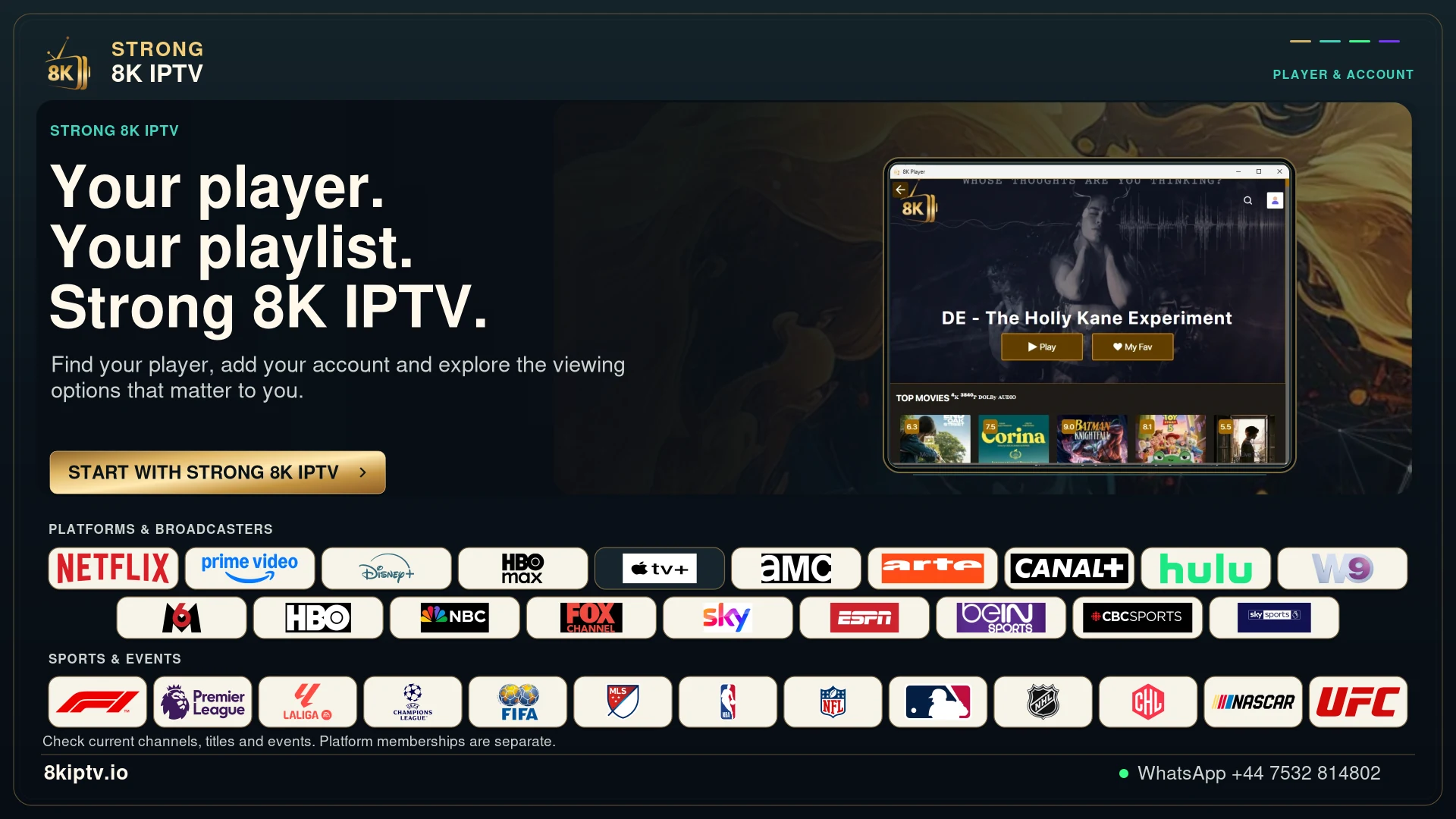
8kiptv.ioStrong 8K IPTV buyer’s notes
Strong sells viewing time to a household and customer-months to a reseller. Looking at the two calendars side by side explains why a large discount on paper can still be the wrong purchase.
Read the full provider reviewStart with the months somebody will actually watch
A television in a holiday flat and a television used every evening can look identical on an order form. The arithmetic for Strong 8K changes as soon as you put the dates on a calendar. A household expecting three consecutive months of use can buy the listed quarter for USD 24.99. At the November prices the same three months bought singly would come to $29.97. The quarter saves $4.98. If the flat will be occupied in March, July and December, however, one continuous quarter cannot cover the three visits. Buying three separate months can make the better use of the money even though its price per month looks higher.
The twelve-month listing is USD 54.99. Someone comparing it only with twelve monthly payments will see a considerable difference. The fairer comparison for a viewer reluctant to commit is often two six-month purchases. At the recorded rates those cost $79.98 between them. The difference over a full year is $24.99. At the halfway point the buyer on the six-month plan can still walk away having spent USD 39.99. A household paying the annual charge accepts another $15 at the outset in exchange for six additional months. The two questions are how much use those months will get and whether the account is likely to suit the same equipment by then.
A family replacing its television in three weeks has a good reason to keep the first order small. The person already using the same player and television every night has a different decision. Nothing about a longer term upgrades the source of an individual programme. A price calculation can establish how to buy time cheaply. Only the household can say whether that time will be useful.
A route worth putting on the receipt
Strong’s service pages live under the /strong/ section of 8kiptv.io. A separate pricing document is also available at the domain root. The domain matters more than the numeral in the name. A search for “8K IPTV” can turn up another seller, a TV feature or a player download. A reference to the same phone number in two places would still leave open which account an order will extend. Start with the domain on the original receipt, then use the price page and renewal instructions belonging to that domain.
For a first purchase, a short written confirmation should settle the term, full amount, currency, permitted simultaneous streams and the event that starts the clock. Strong’s terms refer buyers to the checkout or written order for the conditions of that purchase. Keep that confirmation next to the receipt. A screenshot of the public pricing page answers what a visitor could see that day. The order answers what the seller agreed to issue. Both can be useful if a question arises months later.
A returning buyer can supply the existing account reference privately. If an order issues a fresh username when the intention was to extend the old one, favourites and settings can appear to vanish simply because the player is reading a different account. Ask for the expiry associated with the existing reference before confirming renewal. Repeat the check in the player after the extension. It is an inexpensive way to spot an account mismatch while the order conversation is still open.
What moves when you change the screen
Strong publishes a device-change guide because changing the device can involve two separate suppliers. One supplied the service account. A player developer may separately control an app licence, the list of favourites or a device registration. Before resetting the old television, check which player opens successfully and how the account was entered. A server address with separate username and password fields is a different setup from a device-linked portal. Keep any private details in a secure place rather than in a photo shared with the family group.
Make the replacement simple to diagnose. Close playback on the old device and try the new one without starting another stream. If it works then, the subscription itself may already be fine. A later difficulty when both are running is a question about the connection allowance. If the new TV displays a player activation screen before it reaches the service login, read the developer name on that screen. The required action may sit with the player company. A second service purchase would leave the player activation unresolved.
Before giving away the old device, verify the new one opens the right account, shows its expected expiry and can start a programme you recognize. If the old player has a documented way to export favourites, use that while it still opens. Some preferences belong to the device and cannot be reconstructed from the service login alone. Write down any favourite station by edition and language so it can be found again even if the channel order changes.
The three packs start at ten annual customers
Strong’s smallest listed inventory purchase contains 120 credits for USD 222.00. Under the published standard schedule, a credit is a month on one customer account. Ten twelve-month accounts use the entire starter balance. So do forty three-month accounts. Those two businesses would have very different work to do. If all customers renewed at the end of each term, the one selling quarters would handle more renewal conversations for the same number of customer-months. The word “credit” says nothing about the time required to deliver each order.
Consider a reseller with confirmed orders for six annual accounts, four six-month accounts and eight three-month accounts. The three groups consume 72, 24 and 24 customer-months. The total is exactly 120. At the dated starter rate of $1.85 per credit, the wholesale amounts attributable to the groups are $133.20, $44.40 and $44.40. The figures allocate the reseller’s wholesale cost across the three groups. The reseller sets the retail price separately. If one annual order falls through, twelve credits remain on the panel. There is no cash refund in that calculation.
A larger pack changes the economics if enough customers are ready. Two starter packs would cost $444 at the observed prices. One 240-credit purchase is USD 429.60, a difference of $14.40 for the same nominal stock. But the reseller with demand for only 120 credits must advance an extra $207.60 to buy the larger pack. That additional commitment is the number worth weighing against the saving. Ask how long unused stock lasts and whether the supplier has a minimum top-up before treating the second half as money already saved.
Read the enterprise rate against the order book
The 1,200-credit offer is USD 2,028.00. At standard debit it represents one hundred annual customer terms. At the recorded prices it costs $120 less than purchasing five 240-credit packs. That difference matters to someone who has orders approaching that size. It says little to someone hoping to sell the first ten lines. The larger pack collects the benefit of a lower rate only as credits are actually used for customers who pay.
Suppose a reseller bought the enterprise pack, issued sixty annual accounts and had no further orders during the period being evaluated. The accounts would consume 720 credits and leave 480 in stock. Dividing the original cheque by sixty gives $33.80 of cash paid so far per activated customer. The nominal wholesale contribution of each twelve-month line, at $1.69 per credit, is $20.28. Both figures are correct. One describes cash committed relative to current orders. The other allocates cost to the credits used. Keeping both measures helps an owner explain why the balance on screen can look healthy while cash is tight.
A failed activation is another reason to keep a small audit record. Make a note of the opening credit balance, the customer’s requested term, the actual debit and the new expiry. If a line appears not to work, establish whether the balance changed before trying again. A second click can turn a playback question into two customer records. Ask who is allowed to correct the original transaction and keep that conversation private. A forum can help interpret a debit rule without seeing the customer’s username or a usable login link.
One good support question beats a folder of screenshots
Start a service query with the thing that is visible. A channel that plays the wrong regional news is different from a channel that never opens. A guide entry that displays the correct title beside yesterday’s programme is different again. Supply the edition, device, app version and local time. If a second programme on the same account worked at that moment, mention it. That single comparison can spare the next person from taking the whole installation apart.
For a question about renewal, remove the television from the story unless it is relevant. Give the seller the private order reference, requested term and expiry shown before and after the transaction. For a public forum post, omit the reference and share only the pattern another buyer can use. A short account of the billed period and the result is more helpful to readers than a photograph of credentials that must later be removed.
Our reading of Strong comes down to two practical decisions. For a household, match a continuous term to consecutive months of real use and settle the device arrangements before committing. For a reseller, match customer-month inventory to collected orders and keep enough cash for the work that follows activation. The published calendar is quite precise in both cases. The information still worth obtaining in writing is the allowance on the actual line, the renewal terms and what happens to credits if a customer order needs correcting.
Choosing the right soundtrack for a bilingual household
The Strong FAQ makes a distinction that often gets lost when a family asks whether a service comes in its language. The words on a player's menus, the spoken audio sent with a programme and the text available as captions each have their own source. A viewer can have a beautifully translated interface and still hear a bulletin in the wrong language. Another may want to hear the original dialogue and read a translation. Start with a real programme and the combination that the person watching actually wants.
During a trial, a short piece of dialogue is a better test than a studio ident or a football crowd. Let the viewer listen, switch to the alternative audio track if it is available and see if the language actually changes. Try the caption choices separately. One may describe dialogue while another also identifies speakers and sounds. The presence of the desired language on a menu settles the choice of interface. The actions during that one programme settle what the source and player could do together at the time of the test.
Now leave the programme and return using the normal route from the player's home screen. Does the chosen audio remain selected? Does a new programme need its captions enabled again? Someone willing to make two extra choices before a weekly film may find them far more tiresome when moving between news channels every few minutes. A useful account for the forum might explain that the desired language was present, yet the player had to be set again after each channel change. That is much more precise than giving Strong a single rating for language support.
If the trial happens during a quiet afternoon and the programme the family cares about airs on Friday night, the gap should remain visible in the decision. Ask the seller about that feed and edition before paying. Keep its answer separate from material the household saw on the screen. A person weighing the annual card can then see exactly how much of their expected use the trial covered and which part still depends on an answer about future availability.
Getting a renewal through a busy afternoon
Strong's reseller guidance asks the operator to match the customer, approved term and earlier expiry, then reconcile the debit and resulting expiry. Take two households with the same surname where one orders a quarter and the other a year. The requests represent fifteen standard credits between them. A balance falling by fifteen is necessary for the batch to reconcile, but it cannot tell you that the right household received twelve months. Compare the individual account references and new end dates as well as the overall balance.
The distinction matters when someone interrupts the process. Suppose a colleague takes a call just after the first renewal is submitted. When they return to the screen they see a changed balance, but are unsure whether the second account was processed. Look at the individual transaction history and existing end dates before submitting another action. If the role does not have access to a history, send the panel issuer the private order reference and the approximate time. Repeating a renewal just to see whether the screen responds can commit a second set of credits.
At that point the best customer message is a small factual one. Confirm receipt of the request, name the term the household ordered and explain whether the extension has appeared on the existing account. Send the new expiry after it has been verified. A statement that the person paid is meaningful straight away. A statement that the new year is active has to wait until the panel shows the outcome. A business processing a hundred annual customers with the largest pack has a hundred reasons to keep that distinction clear.
Before buying inventory, a new dealer can use this scenario to assess the proposed role. Ask to see how the account selects a line, displays its old end date, previews the debit and records the result. Do it once for an active line and once for an expired one using demonstration details. Someone who will be selling early renewals to regular households cares deeply about when the extra term begins. The quoted price per customer-month is only one part of that service.
A realistic decision when use is seasonal
There is another way to use the holiday-flat example. Assume the occupant expects three one-month visits every year, in spring, summer and winter. At November's prices three separately bought months cost $29.97. Renting the annual term at $54.99 would add $25.02 to the service payment. Some buyers might happily spend that extra amount to avoid reactivation on each arrival. Others would prefer to save the money and accept that they need an order confirmation before every visit. Both decisions make sense once the convenience has an actual price.
Four separate one-month visits came to $39.96. That is very close to the listed $39.99 six-month price, yet the two choices cover quite different dates. If three visits lie inside one continuous six-month period and the fourth is in December, the six-month plan alone still misses one. Put the visits in calendar order, mark which are adjacent and price only combinations that cover the dates. For this household, comparing the standard average per month can obscure the real cost more than it helps.
One small wrinkle comes from setup. A player licence may run on its own calendar even when service time is purchased intermittently. Before treating three visits as the entire cost, ask whether the approved player needs a renewal and whether that renewal is per device. Put that charge on the dates when the developer actually bills it. The result will be a sensible household budget even if the owner changes the number of visits next year.
An occasional viewer can also make the one-month price of USD 9.99 work as a cost ceiling for a visit with uncertain dates. A guest staying for three weeks may find that easier to budget than buying a quarter and hoping for another trip before it runs out. If the service is renewed each time the guest returns, keep one working account reference and confirm whether an expired line can be reactivated. Continuity may help preserve player settings, though the seller and app developer each need to confirm the part they control.
Write the expiry date on the house information sheet beside the player name. A guest arriving a week later can then distinguish an expired service from a broken television without needing access to the owner's order history or private messages. That is a modest benefit, but a tangible one for a screen used only on occasional visits.
Provider material for this report
- Strong 8K service entry
- Strong’s subscription terms and pricing
- Activation and order processing
- Changing the viewing device
- Programme-guide help
- Reseller deductions and renewals
- Renewing the existing account
- Strong service and order terms
- Strong 8K answers about player settings, audio and subscriptions
- Strong account-by-account renewal reconciliation guidance