
A question worth bringing to this board
A reseller needs to renew eight twelve-month customers. At twelve credits per line this requires 96 credits. With an annual-equivalent credit it could require eight. A nominal 100-credit invoice does not confirm which calculation applies.
Who issued the panel? Which account type and term are being created? What cash will change hands and what balance will remain after the first renewal?
Practical checks from the guide desk
Iptv setup documentation
Write a setup note that someone else in the house could follow without giving them a sheet full of passwords. Focus on the path, app and support owner.
Record device model, software version, app publisher, account type and normal route into the guide. Store secrets separately in a protected place.
A television replacement goes more smoothly when the note says which company sold the app and which company sold the account. Both receipts may have different names.
Evaluate iptv support
A useful reply names the product and the next piece of evidence needed. Test support with one bounded question before making a long commitment.
Give the exact device, player version and proposed term. Ask a question the seller can answer in writing, such as whether two simultaneous sessions are included.
A fast response that says all devices are supported leaves a television-model question open. A slower reply naming the store listing and its publisher gives you something to check.
Iptv account security
An emailed playlist or login link may carry the same practical access as a password. Treat it as private even when it looks like an ordinary web address.
Keep login details in a password manager or another private store. Redact account URLs, QR codes and recovery links before uploading a screenshot.
A help post hides the password field but leaves a full account URL visible at the top. Crop the address before posting. If it was already exposed, contact the issuer privately about replacement.
Board handbook
These chapters bring together the relevant parts of the forum’s published guides. Use the source beneath a chapter to open the complete guide.
Browse handbook chapters
- Start with the customer renewals you actually expect
- Build a quote that both providers can answer
- Customer months in practical terms
- Annual equivalents and fractional credits
- Two separate presentations of the MegaOTT name
- List the packs that cover your real order
- Put unused credits on the balance sheet
- Compare the panel role before comparing the software screen
- Reconcile an ambiguous reseller directory entry
- Review the first actual reseller order
- Assess white-label scope in terms you can defend
- Budget the time involved in a low-priced pack
- Match the evidence to the buyer's business stage
- A working example with two kinds of inventory
- What changes when the purchase is a reseller credit pack
- Take a reseller’s figures apart before publishing them
- A reseller should quote customer connections separately from credits
- A reseller’s handover should name the software as well as the line
- When a reseller quote is part of the search
Start with the customer renewals you actually expect
A first reseller purchase usually makes more sense on paper if it starts with a list of customer terms. Count the customers who have agreed to pay for a month, a quarter, half a year or twelve months. Keep interested prospects in a separate column. If you are taking over an existing service, record when each current line expires and who issued it. Otherwise you may buy stock that belongs to a different panel just before a set of customers need renewals. Keep personal details out of shared planning sheets. For this step, the number of orders, periods, intended connection scope and expiry dates are enough.
The next question is how much cash you must commit to serve that list. Ask the supplier for the smallest purchasable pack that will cover the stated demand, then have it show the debit for each customer type. Look for processing charges, minimum top-ups, setup fees and the timing of the first ready balance. A nominal credit rate is useful only after you know the unit and how one credit is used. One seller may mean one customer month. Another may mean an annual equivalent or another accounting unit described in its own documentation. Put the definition beside the package before comparing it.
The examples below describe advertised inventory prices and term deductions from the provider register. They use no assumption about profit, guaranteed delivery or future renewal. An actual quote establishes if the same pack, role and terms are available to you. Browse reseller offers Open the credit calculator
Build a quote that both providers can answer
Send each supplier the same proposed customer mix. For example, request enough inventory to start five twelve-month lines for customers who need one active connection each and who meet the same market conditions. Ask what the supplier actually sells to a business such as yours. Request the invoice total and currency, the credit size, term debit, expiry, activation process and when panel access begins. When you receive a written answer, mark the date and exact seller. An answer from a reseller, distributor and app publisher could refer to three different responsibilities even when all three display similar brand artwork.
Ask the supplier to show what happens after the first five orders. Suppose your next buyer requests a three-month subscription. Does the starter purchase have spare credit? Can it cover a three-month line, or must you top up the panel first? If one customer's payment fails just before activation, can stock stay available? If activation is attempted and then declined, does the panel show a reversal? Those answers affect the economics of early commitments because a posted credit value is only valuable if you can use it for the work you promised.
Finally, agree which responsibilities belong to your company. Some arrangements may leave the provider responsible for account settings while you handle billing or customer care. Ask who can access transaction history, release a stuck balance, resend authorised access details and accept a support escalation. A lower pack value can be useful only if the role gives you enough control to serve the customers you are selling to. Distributor and panel access guide
Customer months in practical terms
A credit described as one customer month is simple to plan when the same connection and term assumptions hold. Five twelve-month customers use sixty customer-month credits. Ten use one hundred and twenty. A mixture of three six-month orders and four three-month orders uses thirty credits. The same last calculation can change if the panel charges a different rate for additional simultaneous connections or a special product. Ask the provider to run an example for the exact standard line and an example for any nonstandard scope you plan to sell.
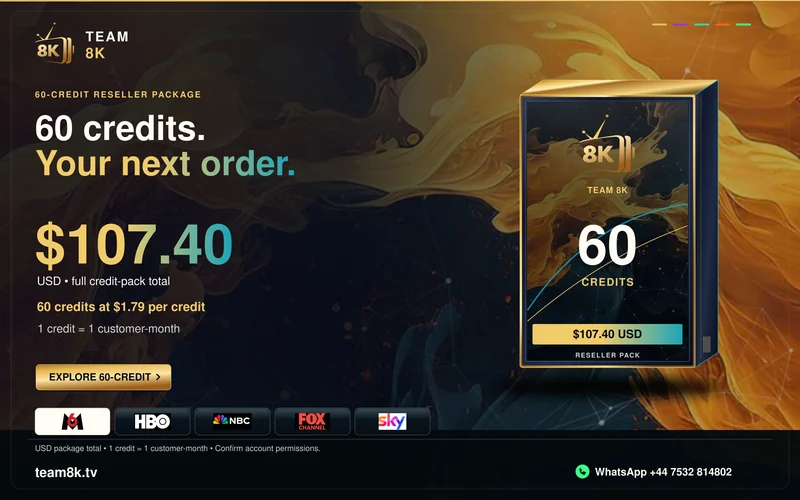
The cleanest budgeting row for the first five annual customers is an actual pack with 60 credits. Team 8K lists such a pack at USD 107.40, which is USD 21.48 of listed inventory cost per fully used annual slot. Trex lists a 60-credit pack at USD 111.00, or USD 22.20 for each of five complete annual slots. With those stated unit rules, equal quantities and the same currency, the difference in cash outlay is USD 3.60. Whether the lower amount matters depends on the startup bill and panel conditions applied to your account. Keep support, refunds and payment or app costs outside the displayed unit rate until you can verify them.
A buyer who expects only three customers needs thirty-six customer-month credits. If the eligible offer is still a pack of sixty, twenty-four credits remain after the three annual lines. You still pay the full pack amount up front. The advertised per-line inventory rate assumes you can use all five annual slots. If you cannot use the extra stock before expiry, your real cost over the three sold lines is higher. That is why the opening charge, unit rate and actual purchases made by customers belong on three separate rows. Team 8K reseller evidence Trex reseller evidence
Annual equivalents and fractional credits
The word annual can refer to the unit, an account term or a plan billed on a yearly cycle. Ask which applies. In a model where one credit funds a standard twelve-month customer and shorter periods use fractions, a pack of ten can fund ten eligible annual accounts before any extra charge. The same ten credits do not necessarily turn into twenty six-month accounts. Calculate from the actual fractional debit and round down for complete activations. Until the seller supplies the specific rates, leave the shorter-term calculations blank.
MegaOTT's published reseller material gives a useful example. Its standard schedule lists 0.1 for one month, 0.3 for three, 0.5 for six and 1 for twelve. Under that schedule, two six-month lines use one credit. Lion OTT's documented half-year deduction is 0.6, so two six-month lines use 1.2. In a 25-credit starting pack, the MegaOTT schedule funds fifty complete half-year lines if the same product rules apply. The Lion schedule funds forty-one and leaves 0.4 credits unused after those lines. The two packs both fund twenty-five complete annual lines using the stated standard annual unit. A reseller expecting half-year customers should compare the fractional result instead of leaning entirely on that annual tie in capacity.
The difference can show up later than the first order. A reseller may sell a quarter, renew for a half-year and then upgrade an eligible customer. Confirm whether those actions trigger new standard deductions, a different type of adjustment or a fee. Write down the specific results the panel produces on those actions where you have authorisation to test. The planned calculation belongs beside the record of what happened on the issued panel. MegaOTT.io reseller evidence Lion OTT reseller evidence
Two separate presentations of the MegaOTT name
The .io and .app provider entries publish matching initial USD consumer amounts and reseller pack sizes in the sources used in this forum. The six-month debit is likewise presented as half an annual-equivalent credit. That makes it tempting to treat the two offers as interchangeable. In a reseller business the question is more concrete. Ask whose account owns the credit balance and whether the one-year customer line already issued through one route can be renewed through the other. Check the contact shown on the quote, the receipt and the actual panel used for activation.
Suppose your business previously bought inventory through the .io route and is considering a quote through the .app site. Determine whether the seller accepts responsibility for the remaining .io balance and the customer accounts you already manage. A public price match by itself says nothing about the credential or accounting relationship. Get confirmation of the exact panel and scope if the seller proposes a move. Ask about remaining credit expiry and which party can resolve support issues while the change is in progress.
It is also possible that the first purchase is new and no existing balance needs to move. In that case, your practical checklist is shorter: correct seller, exact pack, permissions and a private way to escalate activation issues. Equal prices leave you free to compare those differentiators. The comparison page shows why the evidence supports a price tie while leaving portability or service data open. MegaOTT .app versus .io
List the packs that cover your real order
When B1G lists a 100-credit pack with a customer-month unit, eight standard annual activations use ninety-six credits. Four remain. For a 4K IPTV pack with the same nominal quantity and documented customer-month unit, the number of standard annual lines is also eight, but the published amounts in the reviewed sources are in different currencies and the offer conditions differ. A rate is easier to compare within the same billed market. Write down the pack that actually covers the order and how the issued panel can use the balance. Keep the original currency and quote date if you need a conversion for your own books.
If you need ten annual lines, neither of the two 100-credit units alone funds the intended work. A supplier might allow multiple packs, sell a larger pack or give a separate quote. The correct result is the cheapest eligible combination it actually sells, including any startup fee and residual inventory. Multiplying 120 units by the cheapest displayed unit rate does not turn that calculation into a price you can buy. Ask which pack combinations are allowed for a first order and whether topping up will trigger a different rate.
This is also a useful way to compare cash exposure. One seller may ask you to buy capacity for more customers than you already have. That seller can show a low nominal cost per credit and still require a higher startup payment. A smaller pack may be useful if you wish to prove the workflow, get a few customers working and verify how refunds affect accounting before making a larger commitment. Check whether the smaller scope gives you the same support and permission conditions. B1G starter pack 4KIPTV.app inventory
Put unused credits on the balance sheet
Imagine you can sell eight annual subscriptions now and have two prospects who expect to decide next month. If you buy a 120-credit monthly-unit pack, you use ninety-six credits to fulfil the eight orders. Twenty-four remain available under the documented standard rule. The relevant questions now are whether those units expire, whether any other customer types can use them and who can see or transfer them if the panel arrangement changes. Record the date, seller and pack allocation. When the two prospects do commit, your open capacity can supply the extra renewals if the original stock remains eligible.
A common ledger problem combines an inventory purchase and customer payment into one entry. Your supplier invoice records inventory. A client's payment records the transaction for that particular line. A debit in the panel records the use of stock. Keep the three events separate. Ask the supplier to show how a failed activation, correction, refund and reissued account will appear on its panel. This makes it possible to reconcile the opening balance and account for unused units. It also helps you notice a discrepancy without sharing a customer's personal access information in a public support thread.
Create a narrow accounting exercise before attempting to automate any workflows. Begin with a known initial balance; apply two purchases with different allowed terms; verify the amount remaining; and review whether you can trace a correction to the relevant order. If the software offers exports, check which data fields you actually need and whether roles can limit access. Availability of an interface picture or a download button does not prove the export meets your operational requirements. Only test functions you are authorised to use. Forum reseller discussions
Compare the panel role before comparing the software screen
A reseller panel may let an operator create and renew account lines funded by its balance. A distributor role may also pass inventory to approved reseller accounts or oversee several businesses. The actual permissions depend on the service and quote. Ask your seller to name the role for each staff member and describe operations available under that role. A user control panel for sorting personal categories is a different access requirement from the ability to operate other people's accounts. The Ultra 8K pricing and reseller material is a useful case because the site discusses both in separate places.
Start with one task you expect to do weekly. A staff member should be able to view a named order through their own authorised account, see the credit debit for its identified term and record who performed the action. If a process fails, find out which role handles reversal and what event is logged. If you need several employees, ask whether you can grant and remove their access individually. You may decide a source is worth a slightly higher price because the role covers your workload securely, rather than sending every routine correction back through the supplier.
A potential distributor should also verify the relationship between its master balance and the balances it can allocate. If an existing reseller asks for stock, who receives payment and how is the allocation acknowledged? Does a staff action need an approval from the owner? If a reseller stops working with you, can the role be removed while its customer conditions remain intact? Those questions define the product you are measuring. Visit an actual authorized demo where possible before relying on any item shown in an illustration. Ultra 8K profile Roles and handover
Reconcile an ambiguous reseller directory entry
Some sources use a per-credit rate without a starting pack. Hello Sky is one example. Rates quoted for different business levels do not establish the actual up-front price. Before ranking them, ask how many credits come at each rate, how much the first purchase costs and what a twelve-month line debits under the targeted role. If the answer changes with a distributor application or branding option, write each quote separately. Keep the confirmation date with the seller and eligibility.
Other sources show real package totals but leave the billable unit unclear. Crystal IPTV gives several EUR packs in that position. The easy arithmetic is to divide each total by its credits. The difficult comparison is to know which supply of customer terms each pack supports. Ask how many annual customers an actual pack can fund and what happens when you choose a six-month subscription for the same viewer role. A written response that specifies the nominal debit and full initial bill can make it comparable to another provider. Published kit artwork plays a limited part in identifying which package a reply is discussing.
Dream 4K illustrates a third issue. The retrieved /streams/ FAQ provides one set of reseller prices and customer-month terms. A different indexed route on the root describes EUR packs. A prudent quote request asks the actual account issuer which route and product apply to your purchase. Until that is clear, treat the two observations separately, including the different currencies and term labels. If your customer renewals depend on the answer, record the uncertainty on the inventory calendar rather than buying based on the lower apparent price. Hello Sky terms Crystal IPTV terms Dream 4K terms
Review the first actual reseller order
Start with a seller who can provide an actionable quotation and the panel permissions your actual role needs. Agree on two or three intended customer scenarios. Make sure your company has authority to operate the proposed lines and that the intended service complies with your own rights and customer agreements. Confirm which party handles payments and customer support. The quote should name the payment recipient and give a complete current cost, including any required setup charge. Save a copy with the document stating the debit and expiry.
When a permitted initial test is available, keep it small. A standard one-month test can show whether the merchant's receipt matches the quote and whether your role can create a line with the expected debit. Check that the authorised recipient can use the supplied instructions. Confirm which panel record you can access if activation does not complete. Ask which support route handles corrections and write down a short list of evidence it expects. Your goal is to establish a process a colleague can repeat without copying credentials to a shared conversation.
Check what happens when the first test expires. Find out whether an extra debit is required or an additional approval must be requested. A reseller planning to renew customers across different dates should know when the debit occurs and which timezone or date boundary the system uses for accounting. If a customer ends service before renewal, verify how the corresponding line is handled under the documented terms. Record the expected and observed behaviour while the trial is fresh. This is often more useful than comparing a decorative list of menu items. Read the methodology
Assess white-label scope in terms you can defend
A white-label option can mean changing a logo, receiving a separately branded player, operating your own portal or taking customer orders under your own business name. Ask the seller to identify exactly what is included and who controls the underlying account. The app developer, actual service seller and reseller may have different responsibilities. Write down who owns the app listing, who can publish updates and whether the name on billing papers matches the merchant taking payment. If the plan depends on a special app version or installer, verify the publisher and authorized distribution method separately.
Be specific about the assets you intend to use. A gallery can show brand marks, dated package artwork or product interface images. A gallery appearance or pricing card does not grant a reseller permission to redistribute trademarks or promise a particular catalogue. Confirm what your agreement allows you to display, how changes in licensing are communicated and who can update misleading material. Keep a local version record of quotes and approved artwork so staff can tell where an older design came from.
Customer-facing wording needs the same discipline. Identify the seller, term and support route without making a general performance guarantee. If a paid player has its own fee, state it separately on an order. For a panel buyer setting up a separate distribution brand, write the user-registration and data handling responsibilities into the package. Those tasks matter much more to the customer than a provider's image claiming that white-label service exists. Software download guidance Provider media sources
Budget the time involved in a low-priced pack
The cost of a credit pack is a clean number. The rest of running a reseller operation takes real effort. A small team may need to answer setup requests, verify private order details, reconcile payments, check which player or device is in use and record renewals. When comparing two packs whose total is close, estimate the practical work you already know you will do. Ask the seller which tasks the panel can complete and which ones require a separate support escalation. A small price difference is less useful if the access role cannot handle day-to-day exceptions.
Build a simple estimate with real costs if you have them. Use the full pack price, the number of lines you expect to sell before any expiry, the fees you pay for accepted orders and time you expect to spend per activation. Keep recurring costs and occasional remedies separate. If your customers pay in a different currency from the provider quote, note the date and conversion. Do not confuse the gross amount charged for a customer with what remains after stock, fees and business costs. A reseller credit price can enter that calculation. It cannot determine earnings.
Try a couple of realistic demand cases. For five expected annual buyers, a 60-credit allocation can be coherent under a customer-month model. If only three sign up, cost per used annual line changes and you have stock risk. If eight show up and the first pack lacks inventory, you may need an additional purchase at the price and quantities then available. Those scenarios expose the effects of minimum purchase and unused credits. Ask the seller about the process before choosing a rate based on a bigger projected number. Reseller credit calculator
Match the evidence to the buyer's business stage
A first-time reseller may care about proving a small workflow and avoiding unsold inventory. An established business may care about permissions, audit history and the ability to work across multiple staff accounts. A distributor adding another business may need to see how stock is allocated, whether a subaccount can receive a transfer and who can make a reversal. All three scenarios can involve the same published rate. They do not require the same package. A useful comparison starts with a job each seller has agreed to support.
You can express the first scenario in a sentence: “I have confirmed demand for five annual single-connection customer lines and need the smallest eligible inventory purchase that funds all five.” You can express a growing distributor's scenario differently: “I need our own authorised staff to allocate balances and trace who changed a customer's line, with documented exports and term charges.” Send the same scenario to each seller and capture the answers side by side. One can often be answered by the structured price register. The other usually needs a documented workflow and role agreement. A price-only result should keep its scope visible.
Where the evidence shows only an illustrative account setup, leave the actual permission as unconfirmed. If the provider cannot offer a permissions matrix, ask for the two operations that matter to you most and request a written description of the assigned role. Decide which gaps you can tolerate while starting small. An operational requirement that blocks serving customers should be checked before choosing a package because it is the cheapest one advertised. Compare providers by scenario Panel terms
A working example with two kinds of inventory
Suppose a reseller has ten annual buyers who all need the documented standard account type. In the Strong 8K material, 120 customer-month credits fund ten standard annual terms. The USD 222.00 published starter pack supplies that quantity. Golden OTT uses an annual-equivalent unit in its displayed scheme. The published ten-credit amount is USD 139.00 and covers ten full annual units under that rule. These two numbers answer the initial price question for the same annual capacity if the seller terms, connection scope and eligibility match. They answer nothing by themselves about actual first activation, refunds or the ability to export or transfer accounts.
Now change the customer's request. Instead of ten annual terms, they want a mixture of six-month and monthly subscriptions. Work out the provider's actual debit for each. For the month-credit plan start with months and add each line. For the annual-equivalent plan seek the exact shorter-term schedule. You may be able to use more or less of the starting inventory depending on the distribution of those orders. Make a new table for the altered scenario. A price winner derived for ten annual lines should not silently become a universal winner for every mix of customers.
Finally, add an operating detail. If your business cannot use a new panel on an authorised device or needs different staff permissions, ask for a revised quote. Include switches in currency, setup and access charges. Keep any unused credits visible. The published comparison is useful because it offers a reproducible baseline on terms you can cite. The first real order should resolve the remaining conditions that affect whether you can use the advertised stock. Strong 8K packs Golden OTT packs
What changes when the purchase is a reseller credit pack
A dealer buying credits to issue customer subscriptions has a different transaction from a household buying a fixed period of television. Trex says reseller credits and provisioned panel access can have stricter terms, and that used, transferred or allocated stock may be treated differently in a refund request. Its thirty-day personal request period cannot simply be applied to the whole business purchase. Ask the issuer for the written conditions covering the proposed pack, including any setup fee and the treatment of unused and already allocated stock. Trex reseller purchase conditions
Record the opening balance, credit purchase and each authorised allocation. A dealer with a ten-credit Golden OTT pack can illustrate why “three customers used it” is too imprecise. Under Golden’s published standard schedule one year consumes one credit, a quarter uses 0.3 and a month uses 0.1. If one customer took each term, they consumed 1.4 credits in total. The remaining balance under that example would be 8.6 before any other transaction. It shows what stock remains arithmetically. It makes no assertion that the remainder can be returned for cash. Golden OTT credit calculator
Dream 4K’s credit planner supplies dollar totals for its published units while asking resellers to obtain the activation conversion for their offered panel. A dealer trying to reverse or correct a mistaken one-year activation needs the actual debit shown on that panel. Borrowing a month-based rule from a different operator could give the upstream seller a completely inaccurate complaint. Preserve the issued account type, original preview if available, actual debit and resulting customer expiry. Those records also help explain what the end customer has already received. Dream 4K credit-planning guide
If you sold the end customer their service, keep that customer informed while seeking a decision from the upstream issuer. Tell them what you can confirm, which issue is under review and when you expect to update them. Do not turn your wholesale stock discussion into a public exchange of client names or payment records. A dealer can give a meaningful account of its own experience by describing the role, type of line, debit and resolution while keeping individual customer identities private.
Take a reseller’s figures apart before publishing them
A reseller review needs a unit, a duration and a purchase total. A stock pack labelled sixty credits can have a precise supplier price while leaving the cost of a twelve-month household account unknown. Some operators publish a credit as a customer month. Another seller can debit one whole credit for a year and a fraction for a shorter term. A review that compares two prices per credit without identifying both mappings can confidently point readers in the wrong direction.
XOTT publishes a standard monthly unit. Its sixty-credit pack is USD 107.40, so a standard annual term consumes twelve credits and allocates USD 21.48 of that inventory. Lion’s published Starter pack is 25 credits at USD 249.75, with one credit debited for a standard annual term. The stock assigned to one standard year in that example is USD 9.99. Those figures come from different offers with different upfront payments and conditions. They do not establish what either operator can sell, the rates a customer will pay or the quality of the service. XOTT credit packs Lion credit mapping Lion fixed packs
Say whether the debit was calculated from a public table, quoted privately or observed on a live authorised panel. If you personally processed a renewal, a useful public account might give the existing term, the confirmed debit and the new expiry, with private details removed. If there was a discrepancy, check that the action was applied to the intended account before blaming the supplier. A screenshot of an old balance with no opening amount or matching action is a weak way to establish a missing credit. A modest, reconciled example can be far more informative than a gallery of admin menus.
A reseller should quote customer connections separately from credits
A business order for stock and a household order for screens can meet in the same conversation. An operator might buy credits in customer-month units and then quote a two-room household for a year. The credit mapping for the standard service is a starting point for the operator’s cost. It does not automatically establish how the panel debits an additional simultaneous connection. XOTT, for instance, publishes a standard one-credit-per-customer-month model and tells operators to check account-specific options and the actual debit. XOTT panel workflow and duration model
Work through the customer promise before applying an action. Will the household receive one login permitting two concurrent streams or two separate one-connection lines? Which device configurations are covered and what is the total customer price? Which dates will be shown and who is responsible for correcting an error? Only then apply the supplier’s confirmed debit. Charging double for a second screen because the operator assumes it always consumes twelve further credits can be as misleading as promising the second room for free because the first app already works.
Give the household a confirmation in consumer language. State the two rooms or device types if that matters to the arrangement, the allowed location, number of simultaneous programmes, service expiry and any separate app purchase. Keep panel balances, administrative credentials and other customers out of the handover. For the business ledger, retain the approved term, actual debit and reference needed to support the household. A clear separation lets a customer ask why the bedroom stopped playing without having to understand how the reseller bought or accounted for stock. Reseller credit guide
A reseller’s handover should name the software as well as the line
A household buying through a reseller may never visit the upstream service page or the player publisher’s website. It still needs a usable account of what it bought. An installer or reseller can provide the seller name, selected customer term, number of concurrent connections, private support route and paid expiry. Then identify the app, publisher, device and any separate licence or renewal. If the installer used the household’s store account with permission, make sure the account holder knows where their receipt and normal restoration options can be found.
Keep the business stock calculation separate from the customer’s bill. A reseller might activate a year by consuming a specific number of prepaid credits. That internal rule establishes neither the price of the player nor the number of simultaneous streams supplied unless its agreement explicitly says so. A customer should be able to understand the domestic product without obtaining panel credentials or learning the reseller’s inventory balance. Information about a customer line and a business operator login belongs to the appropriate people separately.
Spell out who will answer which question after installation. Will the reseller help find an app store update, ask the service supplier to correct a term or simply refer a publisher licence issue to the publisher? What is the support process if the customer replaces a television? A handover containing those answers has practical value months after the sales conversation. It can also protect the buyer from being charged for a new customer line when the actual job was to reinstall compatible software for an existing paid account. Reseller and wholesale information
When a reseller quote is part of the search
A subscription for your own television uses a consumer price. A reseller plan may require cash for a pack, a panel role and a separate obligation to support other people's accounts. Keep those rows apart. An amount that looks expensive next to a retail annual charge could be inventory for five or more customers. A quoted unit that looks cheap could fund only one customer month. Ask the seller for a written example that starts with the number of annual lines you expect to activate and ends with the charge, debit and any unused balance.
Marketing images can be genuinely useful when identifying the panel or naming a package from a quote. The image archive keeps original provider material so you can recognise the brand and category. Use the current source table to verify the amount or allowance. Check whether an individual customer can be created or renewed with the operator role you receive. The owner of a credit balance and the owner of the panel or customer records also deserve separate fields in a business comparison.
A buyer who simply needs a household plan can skip the wholesale arithmetic. Someone deciding to become a reseller should read the provider's terms and plan out real expected demand before committing to a larger pack. Estimate paid activation, refunds, support time and how a customer line will be renewed. An eligible starting amount is only the beginning of that business decision. Wholesale credit guide Panel and distributor access